A form of optic nerve damage linked to higher one-year death odds
The odds of dying within one year were 1.38 times as high as in matched patients with age-related cataract.
Our read
Populations- Studied:
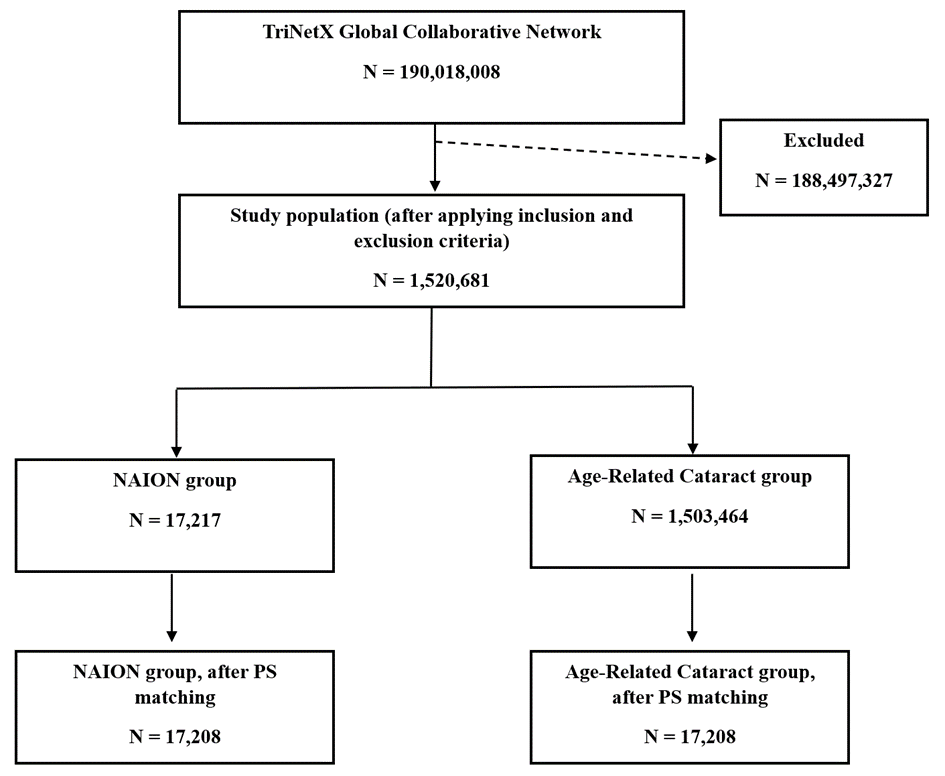
- Preprint: cohort study of 17,208 patients with NAION, one year, against patients with age-related cataract
- What changed:
- Odds of death within 1 year were higher with NAION than cataract (odds ratio 1.38)
- The catch:
- Administrative diagnosis codes could misclassify NAION
- In the record:
- The 7th paper on non-arteritic anterior ischemic optic neuropathy with results in people; 17 on record in all.
Editor of record: Boris Djordjevic · AgingResearch.News
Patients with a first recorded episode of non-arteritic anterior ischemic optic neuropathy, a form of optic nerve damage, were compared with patients with age-related cataract in a retrospective cohort study of existing health records. The researchers identified patients in the TriNetX network between 2015 and 2024. Statistical matching on 59 demographic and health characteristics yielded 17,208 patients in each group.
Over one year, the optic nerve condition was associated with higher odds of death from any cause. It was also linked to strokes caused by blocked blood flow, strokes caused by bleeding, and heart attacks. The researchers found no statistically clear association with heart failure or atrial fibrillation, an irregular heartbeat.
Why it matters
The authors suggest considering this optic nerve condition a marker of increased short-term cardiovascular risk, supporting prompt cardiovascular assessment.
Caveats
The authors note that unmeasured lifestyle factors could still have contributed to the associations despite matching. The report is a preprint and has not yet been peer-reviewed.
From the paper
- Result
At 1 year, NAION was associated with increased all-cause mortality (OR, 1.38; 95% CI, 1.14–1.68; p = 0.001), ischaemic stroke (OR, 3.26; 95% CI, 2.73–3.91; p < 0.001), haemorrhagic stroke (HR, 2.23; 95% CI, 1.51–3.31; p < 0.001), and AMI (HR, 1.33; 95% CI, 1.03–1.73; p = 0.031).
- Limitation
Several limitations must be acknowledged: reliance on administrative ICD-10 codes carries a risk of diagnostic misclassification, the database lacks detailed ophthalmological metrics (such as visual acuity, OCT findings, or optic disc morphology) …
Quoted word for word from the full text on researchsquare.com.
- Non-arteritic anterior ischemic optic neuropathy
- Heart failure
- Atrial fibrillation
- Acute myocardial infarction
- Hemorrhagic stroke
- Humans
The paper
Bretonneau University Hospital of Tours
Research Square, Nov 10, 2026, Open access, Preprint, not yet peer-reviewed


Comments
Be the first to comment.