Death risk differed by site of osteoporosis-related fractures
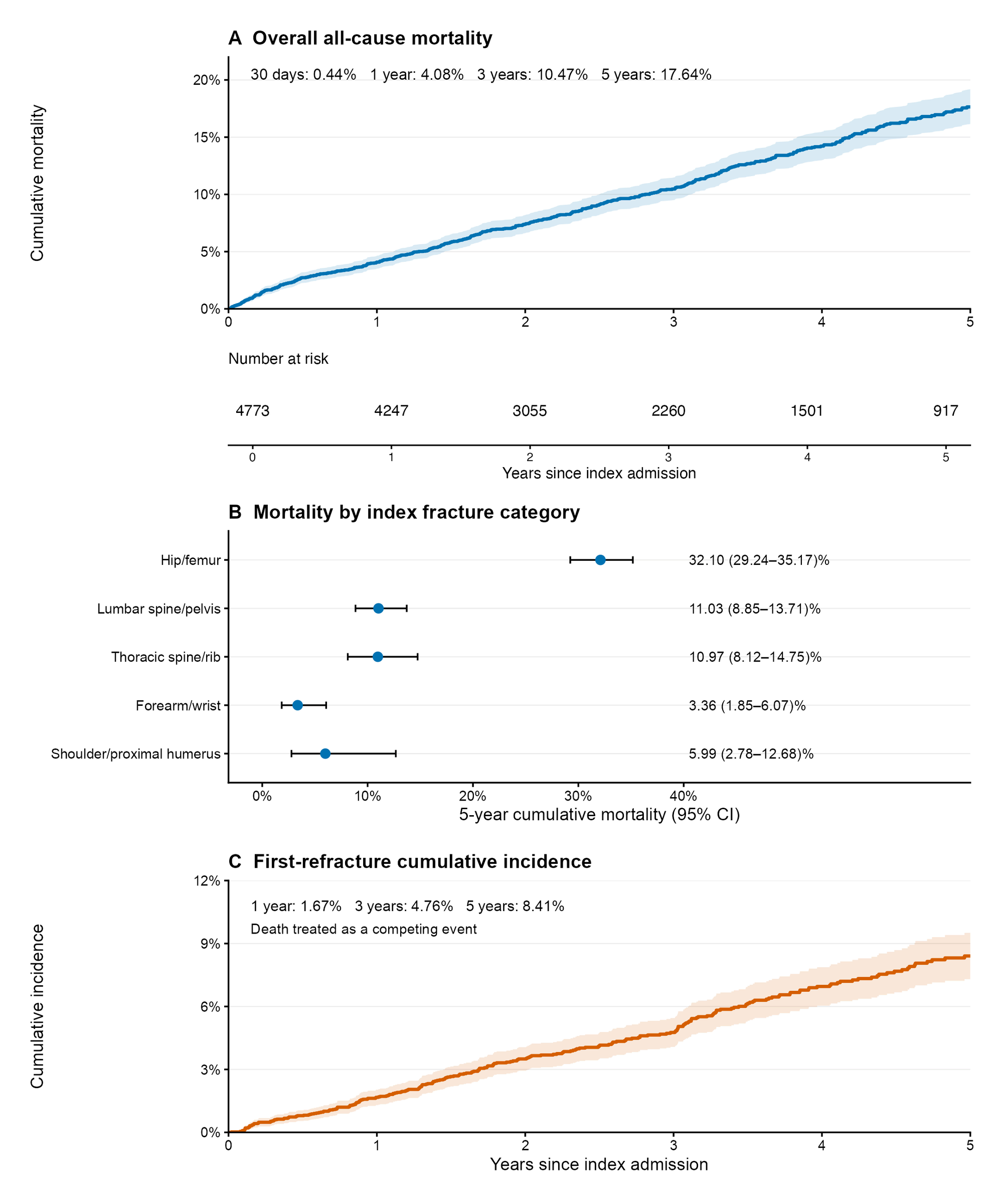
Among 4,773 patients, estimated five-year mortality was 17.64%, compared with an 8.41% risk of a first repeat fracture.
Independent replication
Limit: Incompletely recorded frailty and functional status could confound mortality differences between fracture sites
Edited by Boris Djordjevic · AgingResearch.News
Researchers conducted a retrospective observational study of 4,773 patients hospitalized with osteoporotic fractures, or fractures related to weakened bones. They also tested a prediction model in an independent hospital cohort of 695 patients.
In the development cohort, estimated five-year mortality was highest after hip or thighbone fractures, at 32.10%. Female sex was associated with lower mortality but higher repeat-fracture risk. The researchers built a model using nine patient characteristics to estimate the risk of death within 365 days after discharge. Applied without changes to the independent cohort, its overall predictions closely matched the observed mortality. Twenty of that cohort’s 28 deaths (71.4%) occurred among the fifth of patients with the highest predicted risk.
Why it matters
For osteoporosis, an age-related bone disease, the authors suggested that the model may provide a practical basis for grouping patients by mortality risk after a fracture.
Caveats
External validation included only 28 deaths in one hospital cohort, limiting the evidence for performance elsewhere. This preprint has not been peer-reviewed, and the authors called for evaluation in broader clinical settings.
From the paper
- Participants
The development cohort comprised 4,773 patients with osteoporotic fractures reconstructed from a publicly released longitudinal dataset.
- Result
Female sex was associated with lower mortality (HR, 0.64; 95% CI, 0.54–0.76) but higher refracture risk (cause-specific HR, 1.47; 95% CI, 1.09–1.98; Fine–Gray sHR, 1.54; 95% CI, 1.14–2.08).
- Limitation
Both the development and external validation cohorts were retrospective, and residual confounding, misclassification, and incomplete capture of clinical information remain possible.
Quoted word for word from the full text on researchsquare.com.
- Modeling and theory
- Osteoporotic fractures
- Hip/femur fracture
- Lumbar-spine-pelvis fractures
- Thoracic spine/rib fracture
- Humans
The paper
Wuhan Integrated Traditional Chinese and Western Medicine Orthopedic Hospital; General Hospital of Central Theater Command of the Chinese People’s Liberation Army
Research Square, Nov 1, 2026, Open access, Preprint, not peer-reviewed


Comments
Be the first to comment.