Digital exclusion linked to frailty in older Chinese adults
A two-year observational study of 10,216 older adults in China linked full digital exclusion to new frailty, reporting a relative risk of 1.42.
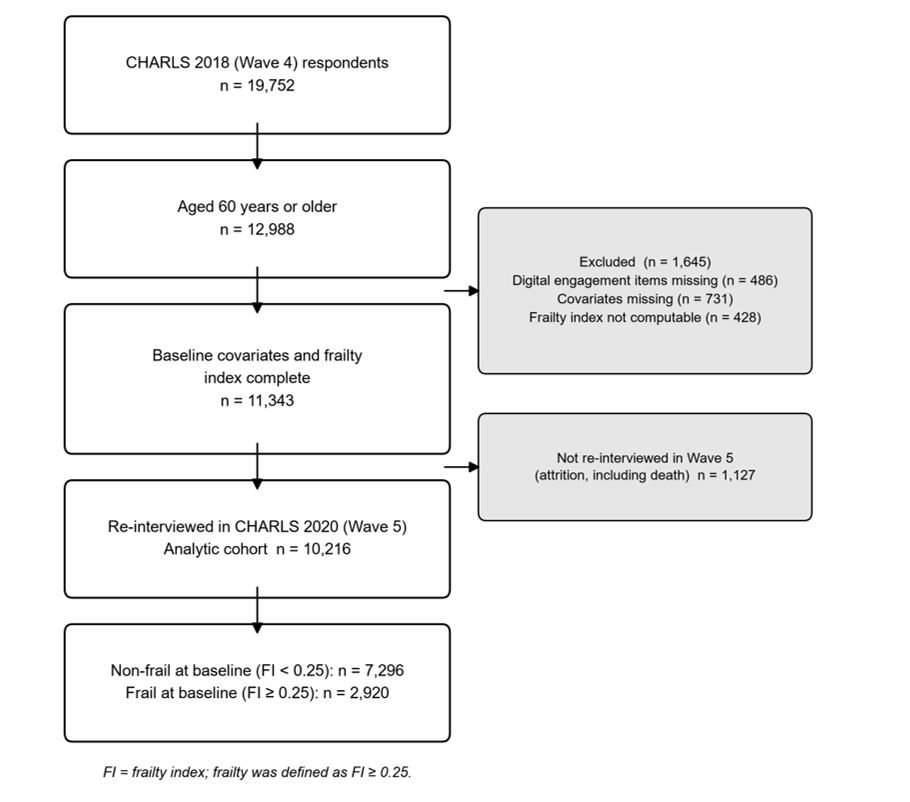
10,216 participants, 2 years, dose-response
Limit: Unmeasured early-life circumstances could explain part of the association
Edited by Boris Djordjevic · AgingResearch.News
An observational study followed 10,216 community-dwelling adults aged 60 or older in China for two years, using surveys from 2018 and 2020. Their mean age was 67.8 years, and 52.4% were women. Researchers assessed internet use, smartphone use, mobile payments and online social activities. No engagement in any domain counted as full digital exclusion, which affected 61.4% of participants.
Among participants without frailty at the start, 17.3% developed it. Full digital exclusion was associated with new frailty after adjustment for other factors. It was also linked to faster accumulation of health problems, measured by a frailty index. Associations were strongest among rural residents and people with primary education or less.
Why it matters
As everyday services move online, the authors suggest considering digital inclusion in healthy-aging strategies, particularly for rural and less-educated populations.
Caveats
This observational analysis cannot establish cause and effect, and its population was community-dwelling Chinese adults aged 60 or older. The preprint has not been peer-reviewed.
From the paper
- Result
After full adjustment, full digital exclusion was associated with incident frailty (RR 1.42, 95% confidence interval [CI] 1.24–1.63) and with a faster annualised increase in the FI (adjusted difference 0.29 per 0.01 units, 95% CI 0.17–0.41).
- Limitation
First, digital engagement was self-reported and did not capture usage intensity, quality or digital literacy.
Quoted word for word from the full text on researchsquare.com.
The paper
Digital Exclusion and Frailty Among Older Adults: A Longitudinal Analysis From China
Hangzhou Normal University
Research Square, Nov 1, 2026, Open access, Preprint, not peer-reviewed

Comments
Be the first to comment.