Recent health recovery linked to later decline in older adults
At the next assessment, estimated deterioration risk was 54.5% after recent recovery versus 34.9% with consistently favorable assessments in one of three cohorts.
Limit: The main outcome captured next-wave deterioration, not whether that decline persisted
Edited by Boris Djordjevic · AgingResearch.News
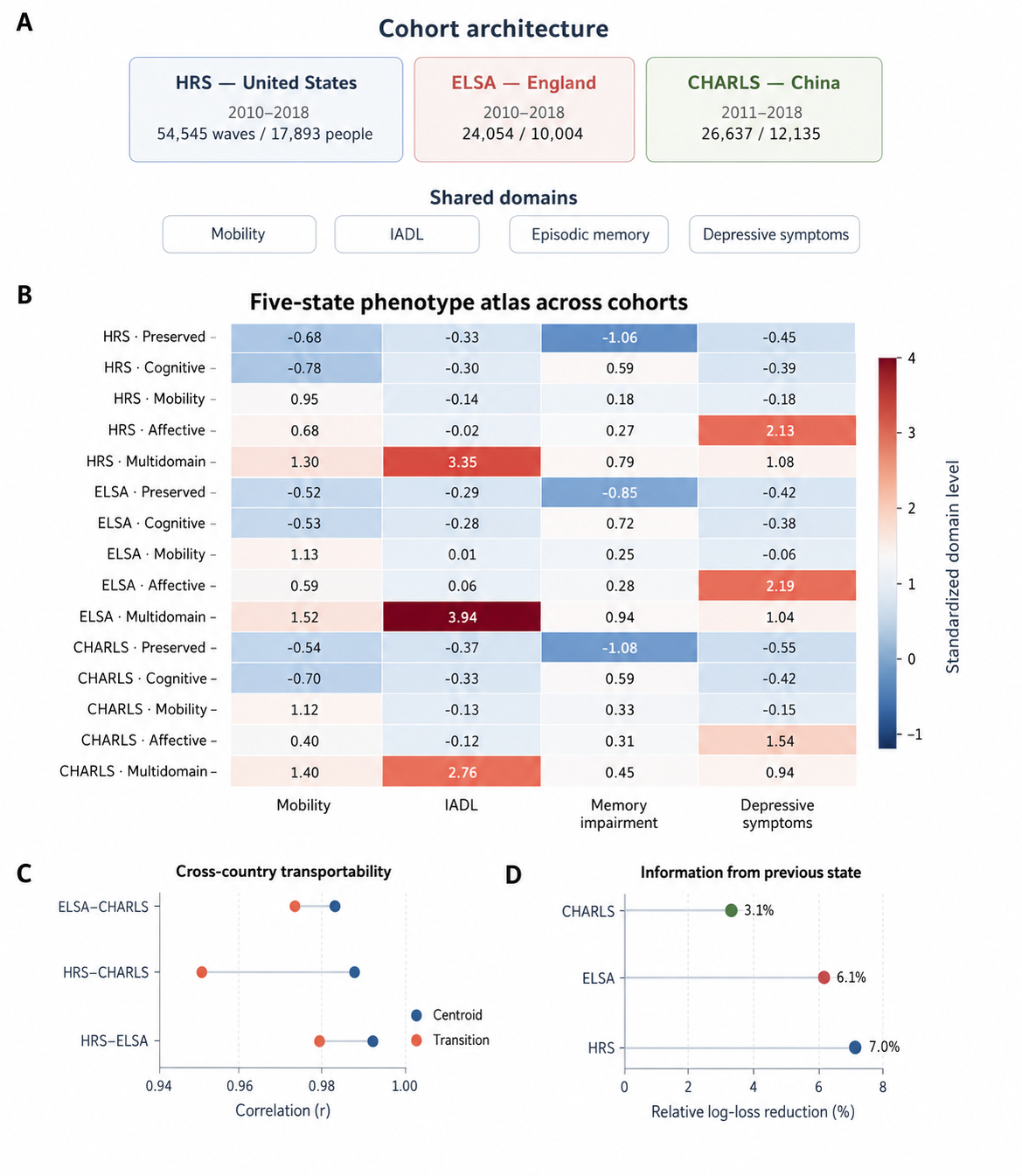
Adults aged 60 or older in three national cohorts were studied in an observational analysis of repeated assessments of mobility, tasks needed for independent living, memory and depressive symptoms. Researchers compared people with currently favorable assessments who had recently recovered from vulnerability with those whose assessments had remained favorable. They adjusted for current measurements, age, sex, education and assessment wave.
At the next assessment, estimated deterioration risk was 54.5% versus 34.9% in one cohort, 43.6% versus 29.7% in another, and 56.4% versus 40.2% in the third, comparing recent recovery with sustained favorable health. Recurrent vulnerability was linked to the highest risk in all three cohorts. Earlier health information also improved predictions tested on participants not used to build the prediction models.
Why it matters
The authors suggest that histories of function, memory and mood may improve near-term risk assessment in older adults when considered alongside current health.
Caveats
This observational analysis cannot establish cause and effect, and the preprint has not been peer-reviewed. The comparison concerned adults aged 60 or older with currently favorable assessments.
From the paper
- Result
Recent recovery was associated with higher standardized next-wave deterioration risk in HRS (54.5% vs 34.9%; RR 1.56, 95% CI 1.47–1.66), ELSA (43.6% vs 29.7%; RR 1.47, 1.36–1.59), and CHARLS (56.4% vs 40.2%; RR 1.40, 1.28–1.54).
Quoted word for word from the full text on researchsquare.com.
- Mobility
- Depressive symptoms
- Basic activities of daily living limitation
- Episodic memory
- Instrumental Activities of Daily Living
- Humans
The paper
West China Hospital of Sichuan University
Research Square, Nov 1, 2026, Open access, Preprint, not peer-reviewed


Comments
Be the first to comment.