Heatwaves linked to faster cognitive aging in Chinese adults
Each additional 10 heatwave days was linked to a steeper age-related decline in cognitive scores, by 0.020 standard deviations per decade.
Limit: City-level heat exposure ignored temperature differences within cities
Edited by Boris Djordjevic · AgingResearch.News
An observational cohort analysis covered 13,741 Chinese adults aged 45 and older across five survey waves from 2011 to 2020. Researchers compared cognitive scores, measured on a scale from 0 to 31, with heatwave days accumulated during the three years before each interview. Exposure data covered 126 cities.
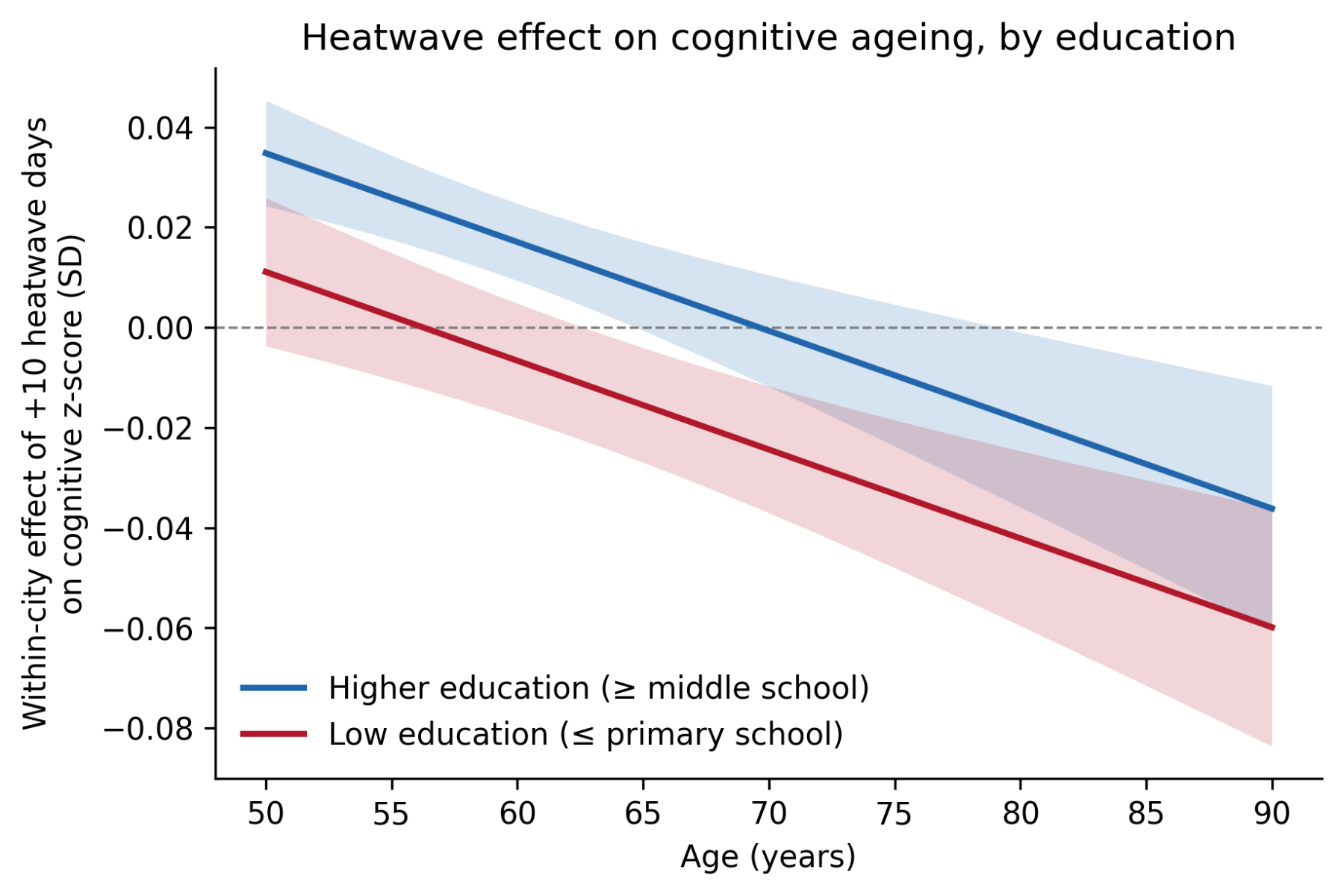
The link between heatwave exposure and cognitive decline strengthened with age. A standard deviation measures how widely scores vary. The association was concentrated among less-educated adults, and heat-related cognitive aging was steeper among urban than rural residents. At age 75, an additional 10 heatwave days corresponded to about one extra year of cognitive aging overall and 2.1 years among less-educated adults.
Why it matters
For efforts to address cognitive aging, the authors recommended prioritizing heat-adaptation resources for less-educated and urban older adults.
Caveats
This observational analysis cannot establish causation or show whether the findings extend beyond Chinese adults aged 45 and older. The report is a preprint and has not been peer-reviewed.
From the paper
- Participants
For incidence analyses, the cohort consisted of 9,459 participants who were cognitively intact at baseline (score above their education group's 2011 mean minus 1 SD), contributing 22,063 person-intervals.
- Limitation
Limitations: the 2020 telephone wave lacked figure copying; air conditioning in 2011 was borrowed from 2013; attrition and survival selection were only partly addressed by weighting; exposure was assigned at city level, ignoring intra-urban gradients …
Quoted word for word from the full text on researchsquare.com.
The paper
First Affiliated Hospital of Xi'an Jiaotong University
Research Square, Oct 27, 2026, Open access, Preprint, not peer-reviewed


