Extreme heat linked to higher dementia risk in older US adults
Relative dementia risk was 14% higher in the moderate extreme-heat exposure group and 23% higher in the high-exposure group than in the low-exposure group.
Limit: Unmeasured diet and nitrogen dioxide exposure could confound the heat–dementia association
Edited by Boris Djordjevic · AgingResearch.News
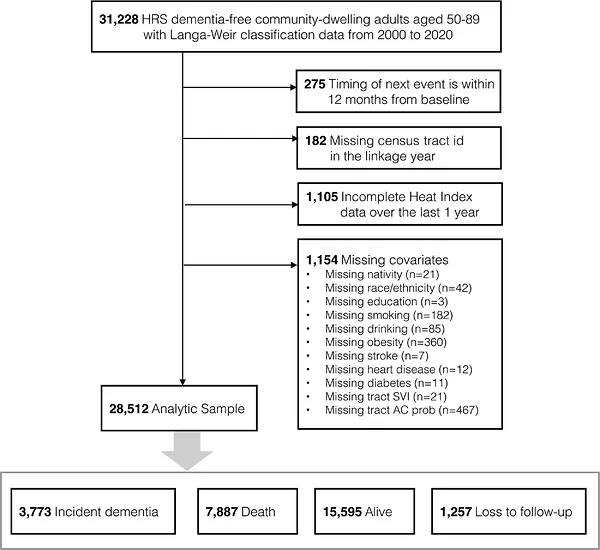
An observational cohort study followed 28,512 dementia-free, community-dwelling US adults aged 50 to 89 at entry. Of these, 52.5% were female. Follow-up averaged 10.5 years, using data from 2000 to 2020. Researchers estimated neighborhood heat exposure over five-year periods, accounting for moves. They used the heat index, which combines temperature and humidity.
Compared with 0.2 or fewer days yearly reaching a heat index of at least 103°F, exposure to 0.4 to 1.8 such days was associated with 14% higher relative dementia risk. Exposure to at least 7.2 such days was associated with 23% higher relative risk. Links were stronger in areas with greater social and economic disadvantage and less widespread central air conditioning. Days with a heat index of 90°F to 102°F were not associated with dementia. The analysis accounted for deaths before dementia classification.
Why it matters
Dementia prevention efforts should consider local heat exposure and prioritize support for people facing barriers to staying cool, the authors suggested.
Caveats
The observational design cannot establish causation, and neighborhood heat estimates did not measure personal or indoor exposure. Dementia classifications relied on tests and reports, and the cohort excluded people already living with dementia or in institutions at entry.
From the paper
- Participants
The final analytic sample included 28,512 respondents (person‐period observations = 175,629).
- Follow-up
The unweighted mean age at baseline was 62.1 years, and respondents were followed for an average of 10.5 years (unweighted).
- Result
Compared with the low exposure group, the subdistribution hazard of dementia was 14% higher among participants in the moderate exposure group (SHR = 1.14, 95% CI: 1.01 to 1.27) and 23% higher among those in the high exposure group (SHR = 1.23, 95% CI: 1.08 to 1.40).
- Limitation
First, outdoor temperature was estimated at the census‐tract level and may not reflect personal exposure or indoor thermal environments, which likely vary with housing quality, cooling access, and behavior.
Quoted word for word from the full text on PubMed Central.
The paper
Arizona State University; University of Southern California
Alzheimer's & Dementia, Oct 2026, Open access