Combined diabetes drugs linked to fewer limb events and deaths
Combined use was associated with lower relative rates of serious limb complications and death than neither drug type, with hazard ratios of 0.50 and 0.23.
Edited by Boris Djordjevic · AgingResearch.News
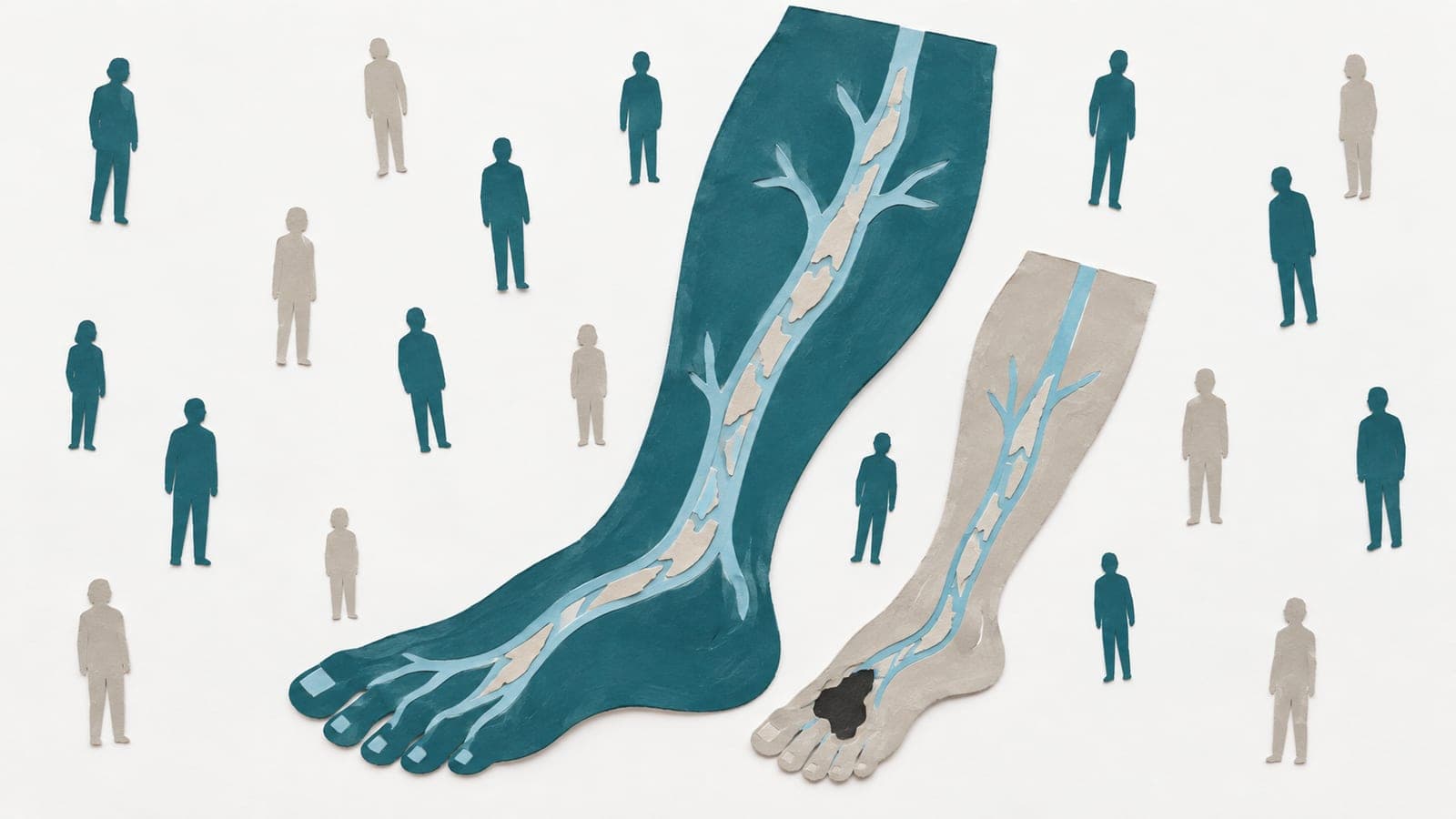
In an observational cohort study, researchers analyzed medical records for 13,471 patients with peripheral artery disease—narrowed arteries supplying the limbs—and diabetes. They compared two diabetes drug classes, glucagon-like peptide 1 receptor agonists and sodium-glucose transporter 2 inhibitors, used alone, together or neither.
Median follow-up was 5.75 years for serious limb complications and 4.42 years for mortality. Compared with neither drug class, combined use was associated with hazard ratios—measures of relative event rates over time—of 0.50 for serious limb complications, 0.30 for major amputation and 0.23 for death from any cause. The researchers used statistical weighting to balance measured differences between the groups.
Why it matters
People with peripheral artery disease and diabetes face high risks of limb complications and death. Choosing diabetes drugs for this population therefore bears on questions about healthy lifespan.
Caveats
The observational design cannot establish cause and effect, despite adjustments for measured differences between groups. This preprint has not been peer-reviewed, and its findings concern people with both peripheral artery disease and diabetes.
From the paper
- Participants
The cohort included 13,471 patients.
- Follow-up
Median follow-up was 5.75 years for MALE and 4.42 years for mortality.
- Result
Compared with neither treatment, combined therapy was associated with lower hazards of MALE (HR, 0.50; 95% CI, 0.33–0.75), major amputation (HR, 0.30; 95% CI, 0.17–0.53), and all-cause mortality (HR, 0.23; 95% CI, 0.19–0.28).
Quoted word for word from the full text on researchsquare.com.
The paper
Kaplan Medical Center; Tel Aviv University
Research Square, Oct 22, 2026, Open access, Preprint, not peer-reviewed