Adult hippocampal neurogenesis is age dependent and differently modulated in male and female wild house mice
Cross-sectional study
Abstract
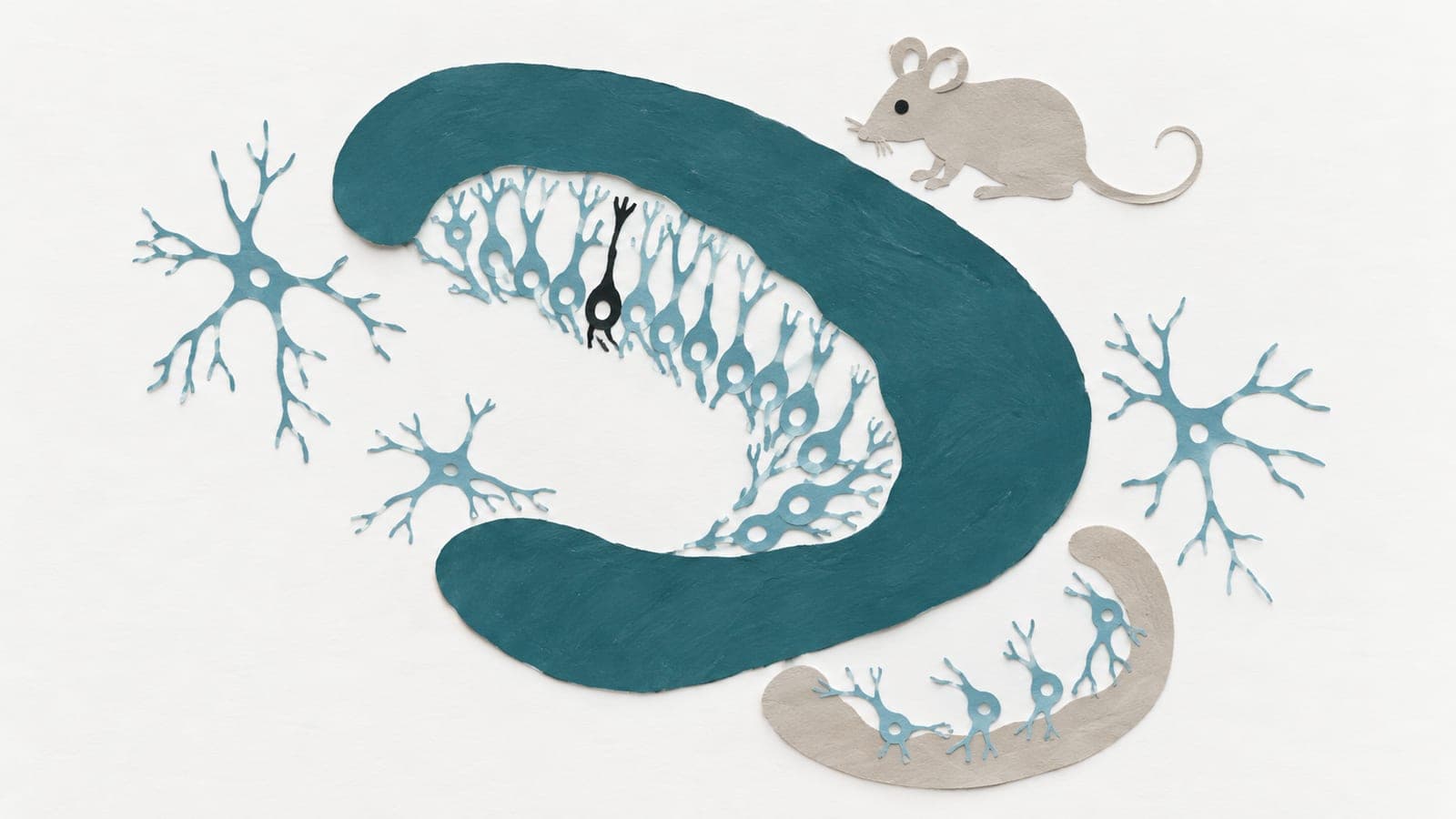
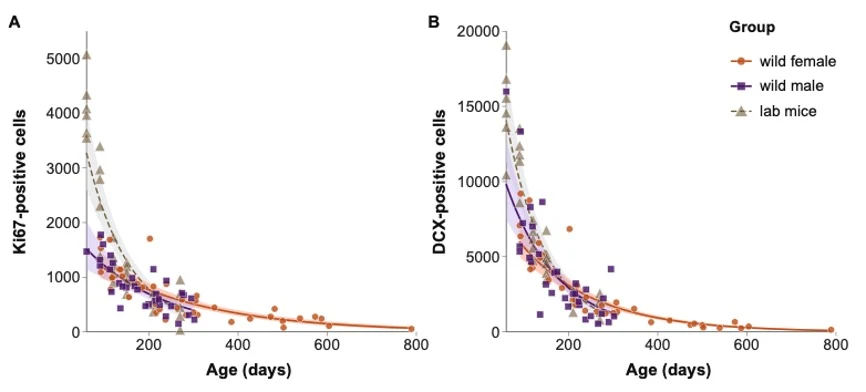
Adult hippocampal neurogenesis (AHN) is often studied with respect to age and physiological neuromodulators in laboratory rodents. Here, we analyzed modulatory effects of age as well as steroid hormones and endocannabinoids (eCBs) in hair on AHN in a population of wild, free-ranging house mice exposed to naturally varying environmental conditions. AHN was assessed in 73 male and female house mice ( Mus musculus domesticus ) of known age using design-based stereology in brain sections immunostained for Ki-67-positive proliferating cells and Doublecortin (DCX)-positive young neurons. Age emerged as the strongest predictor of AHN, with exponential decline across individuals aged 2 to 26 months, similar to the decline reported for C57BL/6J lab mice. In both sexes, AHN further decreased with increasing levels of both the stress hormone corticosterone and the sex hormones testosterone and progesterone. Higher eCB concentrations (2-arachidonoylglycerol, 2-AG, and anandamide, AEA) were positively associated with AHN in both sexes. However, when all five neuromodulators were analyzed together, separately for each sex and corrected for age, most of these effects were no longer significant, while sex differences became evident. In females, age was the dominant predictor of AHN, followed by testosterone and progesterone. In males, by contrast, 2-AG emerged as most important predictor, followed by age and progesterone. Our study on wild house mice from a free-ranging population revealed that an integrative approach allows new insights into sex-specific modulation of age-dependent adult hippocampal neurogenesis.
- Cell cycle regulation
- Sex hormone signalling (oestrogen, androgen)
- 2-arachidonoylglycerol
- Anandamide
- Corticosterone
- Mice
The paper
Technische Universität Dresden; University of Zurich
Research Square, 14 Oct 2026, Open access, Preprint, not peer-reviewed