Genetic study links sedentary leisure to higher infection odds
A genetic analysis linked each standard-deviation increase in genetically predicted sedentary leisure behaviour to 1.43 times the odds of any infection.
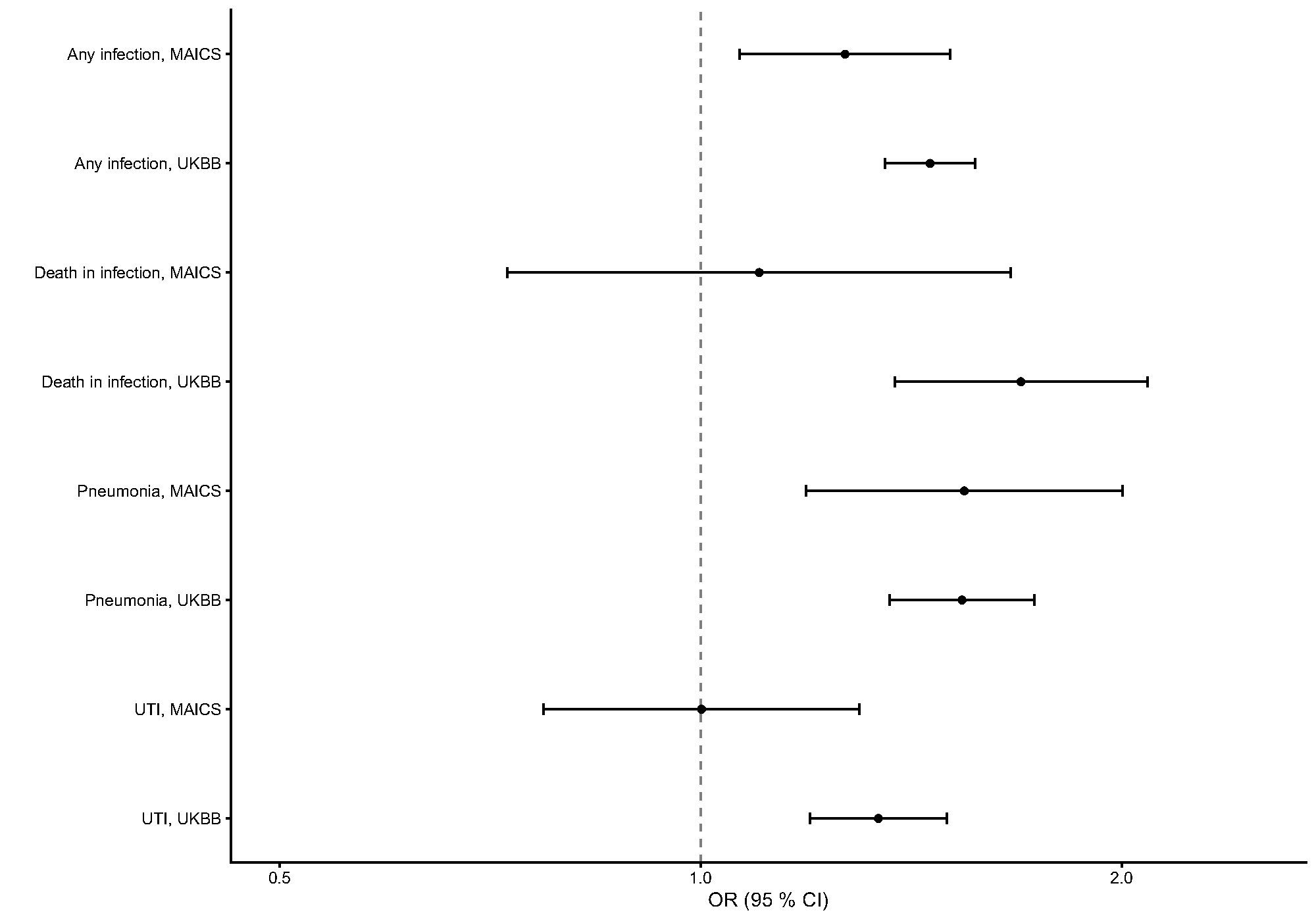
Researchers analysed genetic data covering up to 466,087 participants in the Merged Anaesthesia and Intensive Care Cohort of Sweden and UK Biobank. They used two-sample Mendelian randomisation, which uses genetic variants as indicators of behaviours rather than testing changes in those behaviours.
Higher genetically predicted leisure sedentary behaviour—sitting or reclining while awake—was associated with higher odds of any infection, infection-related death, pneumonia and urinary tract infection. The researchers expressed differences in behaviour in standard deviations, a statistical measure of variation. Links with any infection and pneumonia appeared in both cohorts. Links with infection-related death and urinary tract infection were more pronounced in UK Biobank. In pooled analyses, a genetic tendency towards more moderate-to-vigorous physical activity was associated with lower odds of any infection and urinary tract infection.
Why it matters
For research on health in later life, the study addresses whether activity-related behaviours may play a role in susceptibility to infection.
Caveats
Genetic variants may affect infection through pathways other than activity; this possibility, variation between genetic estimates and overlapping samples limited causal interpretation. The paper is a preprint and has not been peer-reviewed.
From the paper
- Result
Per 1-standard deviation increase in genetically proxied leisure sedentary behaviour, pooled odds ratios (OR) were 1.43 (95% CI 1.33–1.53) for any infection, 1.55 (95% CI 1.29–1.87) for infection-related mortality, 1.54 (95% CI 1.38–1.71) for pneumonia, and 1.28 (95% CI 1.15–1.42) for UTI.
Quoted word for word from the full text on researchsquare.com.
- Sedentary behaviour
- Moderate-to-vigorous physical activity
- Television watching
- Infection
- Pneumonia
- Humans
The paper
Uppsala University
Research Square, 14 Oct 2026, Open access, Preprint, not peer-reviewed