Cancer survivors in China had faster declines in daily function
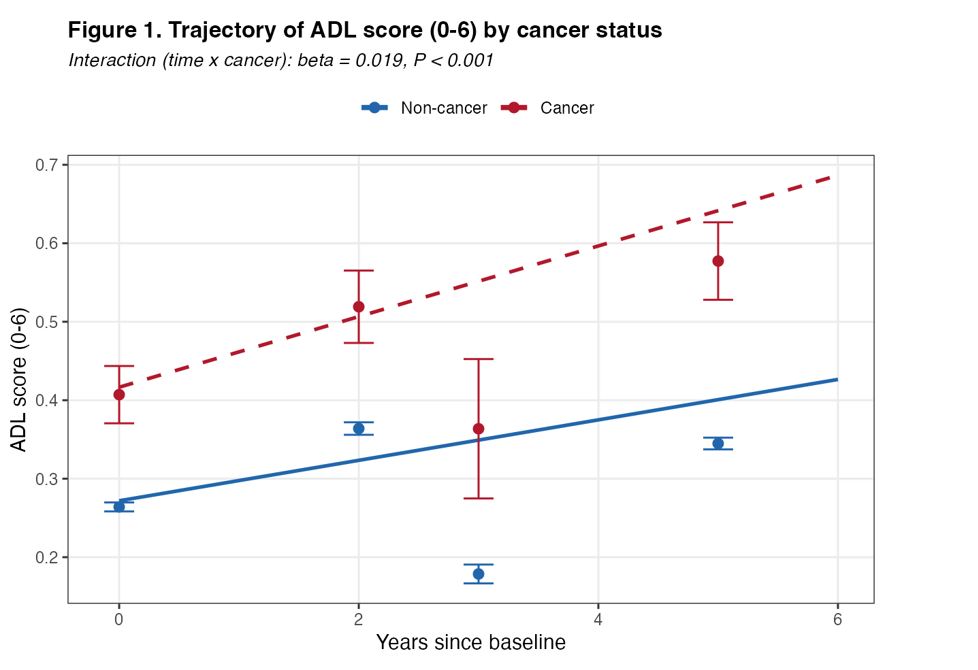
Scores for difficulties with basic daily tasks worsened 1.7-fold faster in cancer survivors than controls; depressive symptom scores worsened 1.5-fold faster.
Limit: Any-wave cancer classification can mislabel prediagnosis function as survivor function
Researchers analysed data from 815 middle-aged and older adult cancer survivors and 22,131 controls in China in a longitudinal observational study. The data covered 2013–2020. They examined difficulties with basic daily tasks and more complex everyday activities, alongside depressive symptom scores. Their main analysis accounted for sex and age at the start of the study.
Cancer survivors started with greater difficulties in both types of activity and higher depressive symptom scores than controls. Scores measuring difficulties with basic tasks worsened 1.7-fold faster than in controls. Scores for more complex activities worsened 1.8-fold faster, while depressive symptom scores worsened 1.5-fold faster. The researchers found no statistically significant evidence that these differences in change over time varied by sex.
Why it matters
For middle-aged and older cancer survivors, the authors said the findings supported long-term care combining monitoring of daily function with sustained psychological support.
Caveats
This observational analysis cannot establish that cancer caused the faster deterioration, and the findings may not apply beyond the Chinese population studied. The report is a preprint and has not been peer-reviewed.
From the paper
- Participants
The final analytical sample comprised 22,946 participants contributing 67,647 person-wave observations (2,445 from cancer survivors and 65,202 from non-cancer controls).
Quoted word for word from the full text on researchsquare.com.
- Cancer
- Depressive symptoms
- Activities of Daily Living
- CES-D-10
- Instrumental Activities of Daily Living
- Humans
The paper
Shanghai Traditional Chinese Medicine Hospital; Shanghai University of Traditional Chinese Medicine
Research Square, 14 Oct 2026, Open access, Preprint, not peer-reviewed