Association between latent gait patterns and reduced femoral neck bone mineral density in community-dwelling older women: a cross-sectional study
Abstract
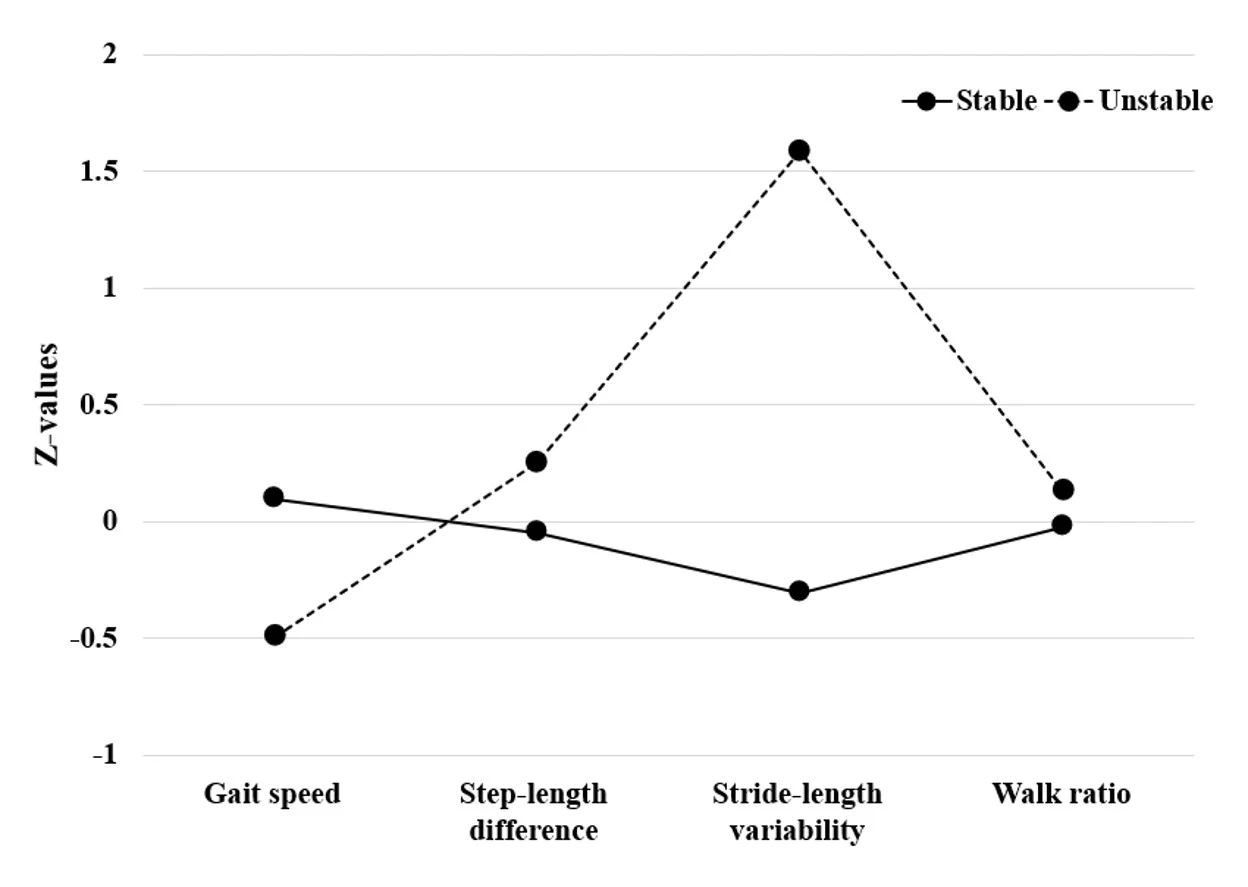
Background There are limitations in identifying the comprehensive gait patterns associated with reduced bone mineral density. The main purpose of this study was to examine the association between latent gait patterns and femoral neck bone mineral density in community-dwelling older women. Methods The participants were women aged 60 years or older who were using senior welfare facilities in Suwon-si, Gyeonggi-do. Gait patterns were identified through the latent profile analysis based on four variables (gait speed, step length difference, stride-length variability, and walk ratio) measured during usual-speed and fast-speed gait. Then, participants were classified in the normal (T-score ≥ − 1.0), osteopenia (− 1.0 > T-score > − 2.5), or osteoporosis group (T-score ≤ − 2.5) based on the T-score of femoral neck bone mineral density measured by dual-energy X-ray absorptiometry. Results This study included 179 women. The gait pattern analysis identified a stable gait pattern and an unstable gait pattern during usual gait. When the relative risk of osteopenia and osteoporosis according to the gait pattern was subsequently calculated, the unstable gait group (odds ratio [OR] = 3.335, 95% confidence interval = 1.066–10.431, p = 0.038) showed a significantly higher risk of osteoporosis than the stable group (OR = 1, reference). Conclusions These findings suggest that an unstable gait pattern combining slow gait speed, bilateral step length asymmetry, and high stride-length variability may represent a gait phenotype associated with osteoporosis in older women. Once the reproducibility and clinical classification criteria of this gait phenotype are established, it is expected to be useful as baseline data for screening older adults with a high likelihood of osteoporosis.
From the paper
- Participants
This study included 179 women.
- Result
… the unstable gait group (odds ratio [OR] = 3.335, 95% confidence interval = 1.066–10.431, p = 0.038) showed a significantly higher risk of osteoporosis than the stable group (OR = 1, reference).
Quoted word for word from the full text on researchsquare.com.
The paper
Changwon National University
Research Square, 11 Oct 2026, Preprint, not peer-reviewed