Machine Learning and Logistic Regression Models Incorporating Clinical and CT-Derived Muscle-Fat Parameters for Predicting Geriatric Hip Fracture: A Prospective Study
Abstract
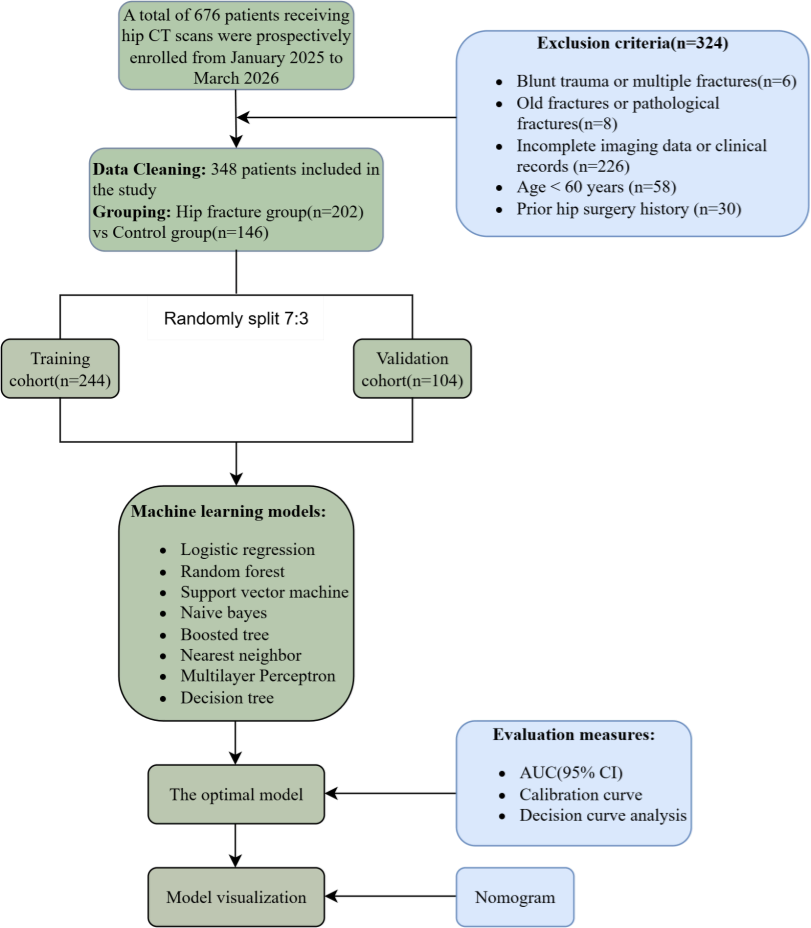
Hip fractures cause substantial morbidity and mortality in older adults. Sarcopenia is a key modifiable risk factor, yet few models integrate CT-derived muscle-fat metrics with clinical data. This study aimed to develop a risk prediction model for elderly hip fractures, compare multiple machine learning algorithms, and convert the optimal model into an interpretable nomogram. This prospective cohort enrolled patients aged ≥ 60 years undergoing hip CT, including fracture cases and controls. Muscle/fat area, mean attenuation, and skeletal muscle index were measured at femoral head, lesser trochanter, and L3. The cohort was split 7:3 into training and validation sets. Eight classifiers were built using Boruta-selected features, with performance assessed by AUC, calibration, and decision curve analysis (DCA). The logistic regression (LR) achieved the highest AUC (0.779). Multivariable regression retained eight independent predictors: age, elevated glucose, osteoporosis, fat area1/2, muscle mean2, SMI1, and SMI3. The nomogram incorporating these variables showed good discrimination (training AUC = 0.826; validation AUC = 0.817), favorable calibration (Hosmer-Lemeshow P = 0.647 and 0.412, respectively), and clinical net benefit on DCA. LR performed comparably or better than other ML algorithms. The nomogram offers a simple, interpretable tool for individualized hip fracture risk stratification using eight routinely available parameters.
From the paper
- Participants
The fracture group comprised 202 patients (69 intertrochanteric [34.2%], 133 femoral neck [65.8%]) and the control group 146 patients.
Quoted word for word from the full text on researchsquare.com.
The paper
Quanzhou Orthopedic-Traumatological Hospital
Research Square, 11 Oct 2026, Preprint, not peer-reviewed