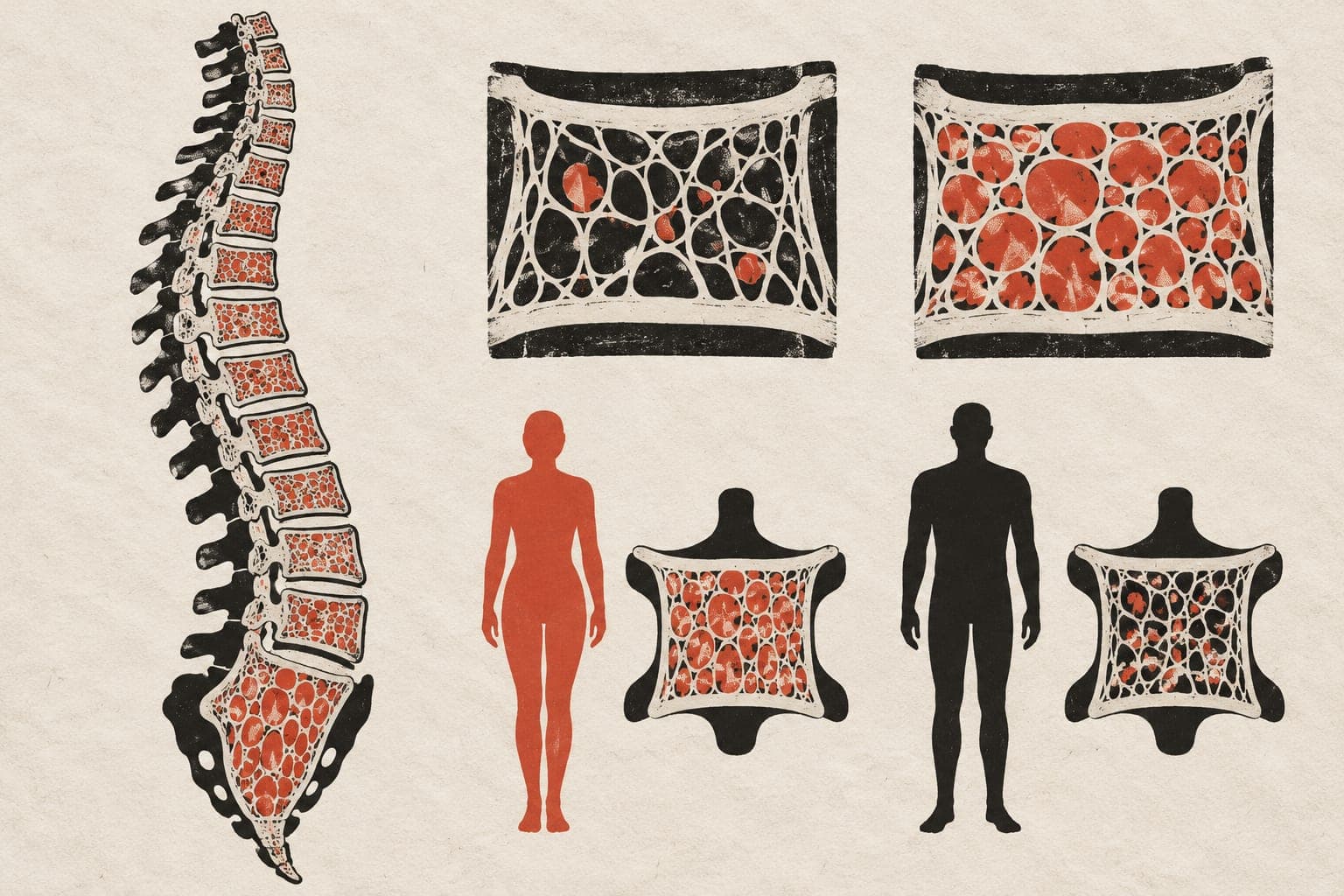
Medullary Contact Channels of the Vertebral Endplate: A Histomorphometric Study by Age and Spinal Segment
Abstract
Purpose To characterize bony endplate (BEP) porosity in intervertebral discs without radiographic signs of degeneration, evaluating the morphometric characteristics of medullary contact channels (MCC) and correlating them with age and vertebral segment. Methods Thoracic (T7–T8) and lumbar (L4–L5) vertebral segments were removed during routine autopsy of 41 individuals without prior diagnosis of spinal disease. Variables evaluated by histological analysis included the length of the vertebral endplates and the dimensions of the medullary contact channels (MCC). Results A total of 41 individuals were analyzed. Contrary to our hypothesis, the MCC index (IC = number of MCC divided by BEP length) did not differ significantly between age groups in either segment (thoracic: 0.278 vs. 0.262, p = 0.47; lumbar: 0.292 vs. 0.311, p = 0.34), and the MCC extension index (IEC = total MCC length divided by BEP length) likewise showed no significant age effect in either segment (p = 0.77 thoracic, p = 0.39 lumbar). Among individuals older than 40 years, IC was higher in the lumbar segment than in the thoracic segment (p = 0.001); no such difference was observed in individuals 40 years or younger (p = 0.38). Conclusions Contrary to our hypothesis, MCC density (IC and IEC) did not decline with age in either segment. Instead, the thoracic and lumbar segments diverged in MCC density specifically after the fourth decade of life, independent of overt disc degeneration.
From the paper
- Participants
A total of 41 individuals were analyzed.
- Limitation
First, histological thin sections provide only a two-dimensional sample of a three-dimensional porous structure and cannot capture the full pore network the way volumetric methods such as µCT[10, 11] can.
Quoted word for word from the full text on researchsquare.com.
The paper
Universidade de São Paulo
Research Square, 2 Sep 2026, Preprint, not peer-reviewed