Leukocyte Composition Change Accounts for Most Apparent Ten-Year DNA Methylation Drift in Blood: A Two-Cohort Longitudinal Analysis
120 months, independent replication
Abstract
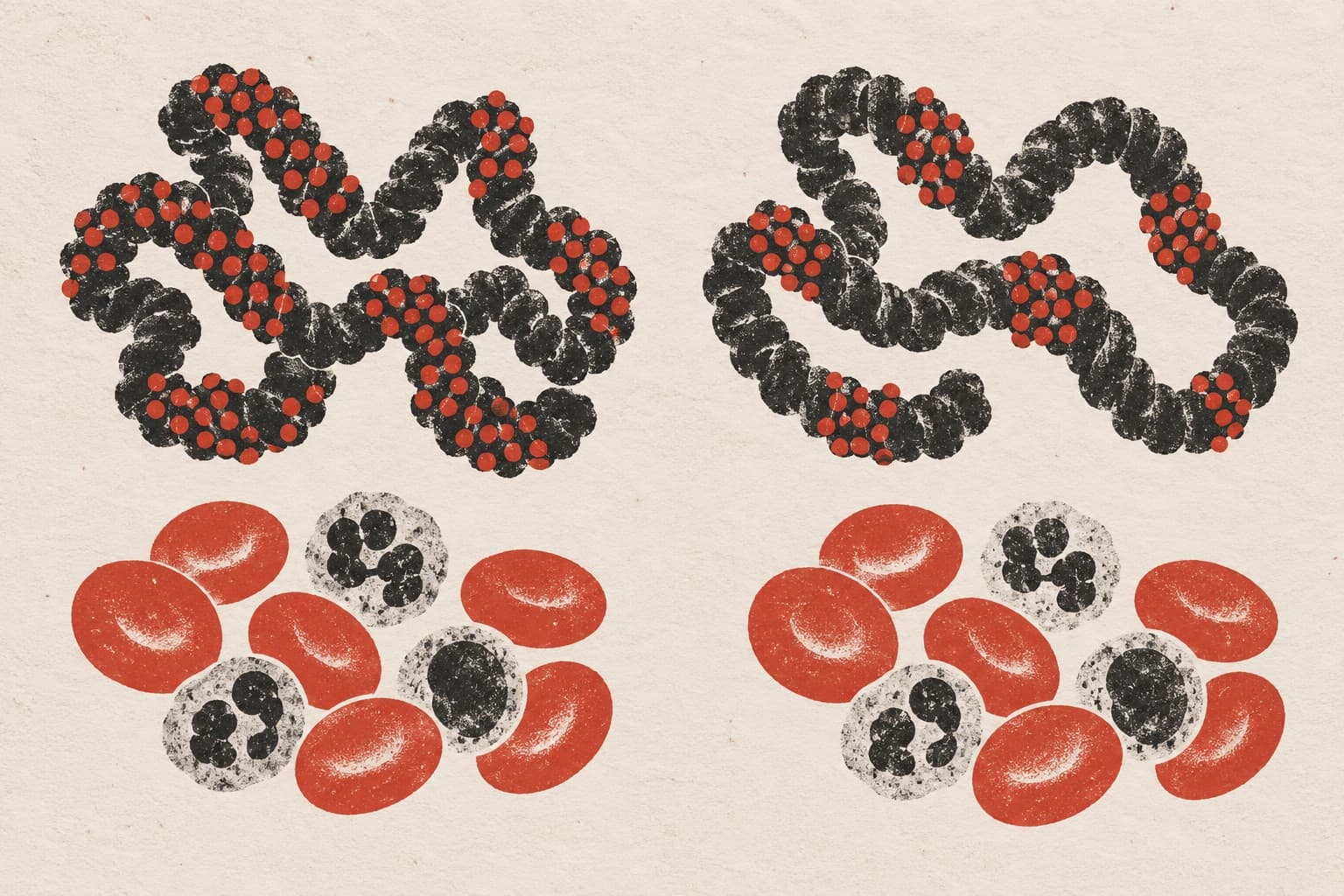
Longitudinal DNA methylation measurement is increasingly proposed as a surveillance tool, on the premise that within-subject differencing removes the between-person and technical offsets that confound cross-sectional comparison. We tested whether that premise holds when the confounding variable is itself time-varying. We quantified change in a 48-locus, blood-referenced methylation burden score in two independent longitudinal cohorts of older adults — 86 paired whole-blood samples from the Danish Longitudinal Study of Aging Twins (120-month interval, Illumina 450K) and 16 paired buffy-coat samples from the Health, Aging and Body Composition study (60-month interval, Illumina EPIC) — and then adjusted each participant's change for concurrent change in leukocyte composition estimated by reference-based deconvolution. Unadjusted burden increased significantly in the Danish cohort (+0.000518 units/month; 95% CI, +0.000353 to +0.000682; P = 2.2 × 10⁻⁸), and the result survived correction for twin non-independence. After composition adjustment, 32.2% of that velocity remained and it was no longer distinguishable from zero (+0.000167 units/month; P = .106). Composition change alone explained 36.4% and 63.9% of the variance in burden change in the two cohorts, with concordant lymphoid-to-myeloid direction. Replicate arrays on physically distinct chips placed the technical standard deviation of a burden difference at 0.0328, indicating that 88% of the variance in 10-year change is biological rather than measurement error. Per-locus change ran toward β = 0.5 rather than along the panel's directional axis, and differential storage duration was excluded on two independent grounds. Within-subject differencing does not control leukocyte composition, because composition drifts alongside the outcome.
The paper
Alercell
Research Square, 19 Aug 2026, Preprint, not peer-reviewed