Exercise as a Non-Drug Intervention to Improve Body Composition and Cardiometabolic Health in Middle-Aged Saudi Men: A Community-Based Study in Al-Ahsa
12 weeks, controlled
Abstract
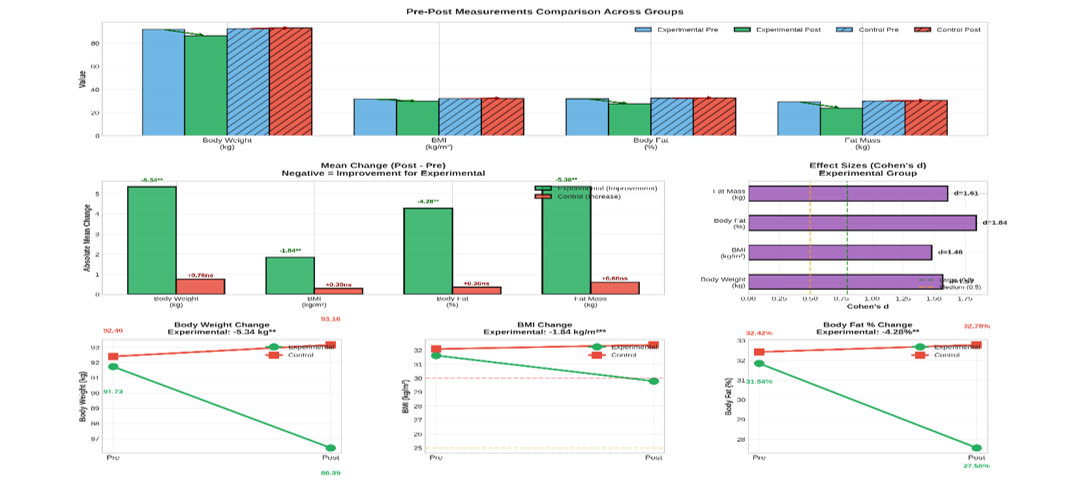
Background: Obesity and sedentary behavior among Saudi men pose a critical public health threat, contradicting the preventive health goals of Saudi Vision 2030. This study examines whether a structured, community-based exercise program can serve as an effective non-pharmacological intervention to improve body composition, physical fitness, and cardiometabolic health in middle-aged Saudi men. Methods : A quasi-experimental pre-post controlled trial was conducted with 30 sedentary, overweight or obese men (aged 40–55 years) from Al-Ahsa, Saudi Arabia. Participants were assigned to an experimental group (n = 15) that completed a 12-week progressive combined exercise program (aerobic, resistance, and flexibility; 4 sessions/week, 60–75 min/session) or a control group (n = 15) that maintained usual routines. Assessments included anthropometry, body composition (via bioelectrical impedance), muscular strength and endurance, agility, blood pressure, and fasting blood biomarkers (lipid profile, glucose, HbA1c). Results : At baseline, groups were comparable (all p > 0.05). After 12 weeks, the experimental group showed significant improvements: body weight (−5.34 kg), BMI (−1.82 kg/m²), body fat% (−4.26%), and fat mass (−5.38 kg) (all p < 0.001). Physical fitness markedly increased in grip strength (+4.74 kg), leg strength (+17.82 kg), plank endurance (+27.16 s), and agility (−1.68 s) (all p < 0.001). Cardiometabolic markers improved significantly: systolic BP (−8.16 mmHg), total cholesterol (−22.58 mg/dL), triglycerides (−28.36 mg/dL), HDL-C (+6.38 mg/dL), fasting glucose (−12.82 mg/dL), and HbA1c (−0.42%) (all p ≤ 0.002). The control group showed no significant changes. Between-group differences were highly significant across all outcomes (p < 0.001). Conclusion : A 12-week community-based combined exercise program induces clinically meaningful improvements in adiposity, fitness, and metabolic health, supporting its integration into national preventive health strategies under Saudi Vision 2030.
The paper
King Faisal University
Research Square, 11 Aug 2026, Preprint, not peer-reviewed