Spinal fluid protein patterns recur in early Parkinson’s
The observational preprint compared healthy controls, people with possible early signs and people with untreated Parkinson’s in independent cohorts of 721 and 974 participants.
Our read
Biomarkers- Studied:
- Preprint: cross-sectional study of controls and people with prodromal or manifest Parkinson's (Independent replication)
- What changed:
- Spinal fluid levels of 15 proteins differed consistently between early manifest Parkinson's and healthy controls across independent cohorts
- The catch:
- Disease-stage comparisons measured differences between people, not protein changes within individuals over time
- Stake:
- Authors work for Octave Bioscience. An author works for Ionis Pharmaceuticals.
- Why it’s aging research:
- It bears on staying healthy in midlife and later life.
Editor of record: Boris Djordjevic · AgingResearch.News
An observational study examined healthy controls, people with reduced smell or a sleep disorder involving dream-enacting behavior, and people with untreated Parkinson’s disease in cohorts of 721 and 974 participants. Researchers measured proteins in cerebrospinal fluid, which surrounds the brain and spinal cord.
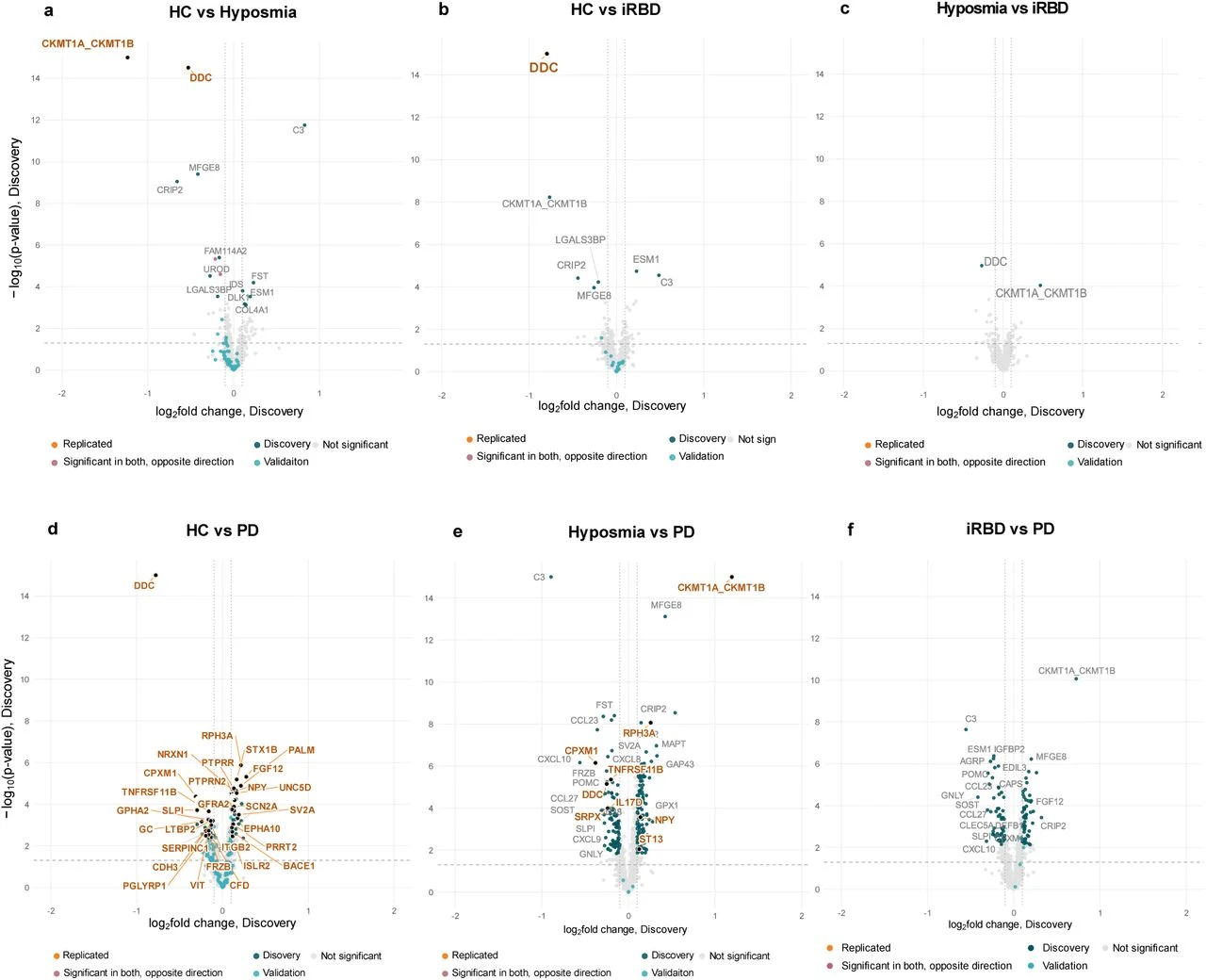
In the discovery cohort, the reduced-smell and sleep-disorder groups differed from controls in no more than 16 proteins. Comparisons involving clinically apparent disease showed differences in up to 305 proteins. Across cohorts, a reproducible set of proteins involved in nerve-cell communication distinguished controls from Stage 3 disease, which involved slight impairment in functioning. The authors suggested that these patterns could help select participants for prevention and intervention trials based on disease biology.
Why it matters
Parkinson’s, an age-related disease, begins years before movement problems appear. Identifying its early biology could help researchers select participants for prevention trials.
Caveats
These observational findings do not establish a clinical test or show that the proteins cause disease. The preprint has not been peer-reviewed.
From the paper
- Participants
Phenoconversion analyses included 640 prodromal participants with baseline CSF data, of whom 55 converted to PD or DLB.
Quoted word for word from the full text on medRxiv.
- Proteomics
- Parkinson's disease
- Dopaminergic dysfunction
- Hyposmia
- Isolated REM sleep behavior disorder
- Humans
The paper
Paracelsus Elena Klinik Kassel
medRxiv, Oct 20, 2026, Open access, CC BY, Preprint, not yet peer-reviewed


Comments
Be the first to comment.