Protein production largely tracked gene activity in aging mice
A comparison of liver profiles in DNA-repair-deficient and normal mice found that changes in protein production largely mirrored changes in gene activity.
Our read
Interventions- Studied:
- Experiments in male DNA-repair-deficient and wild-type mice, ∼8 weeks, against wild-type mice
- What changed:
- Protein production changes largely tracked gene activity in repair-deficient mice versus wild-type mice, with 45.0% overlap among altered genes
- The catch:
- Relative sequencing can produce apparent increases when total transcription and translation decrease
Editor of record: Boris Djordjevic · AgingResearch.News
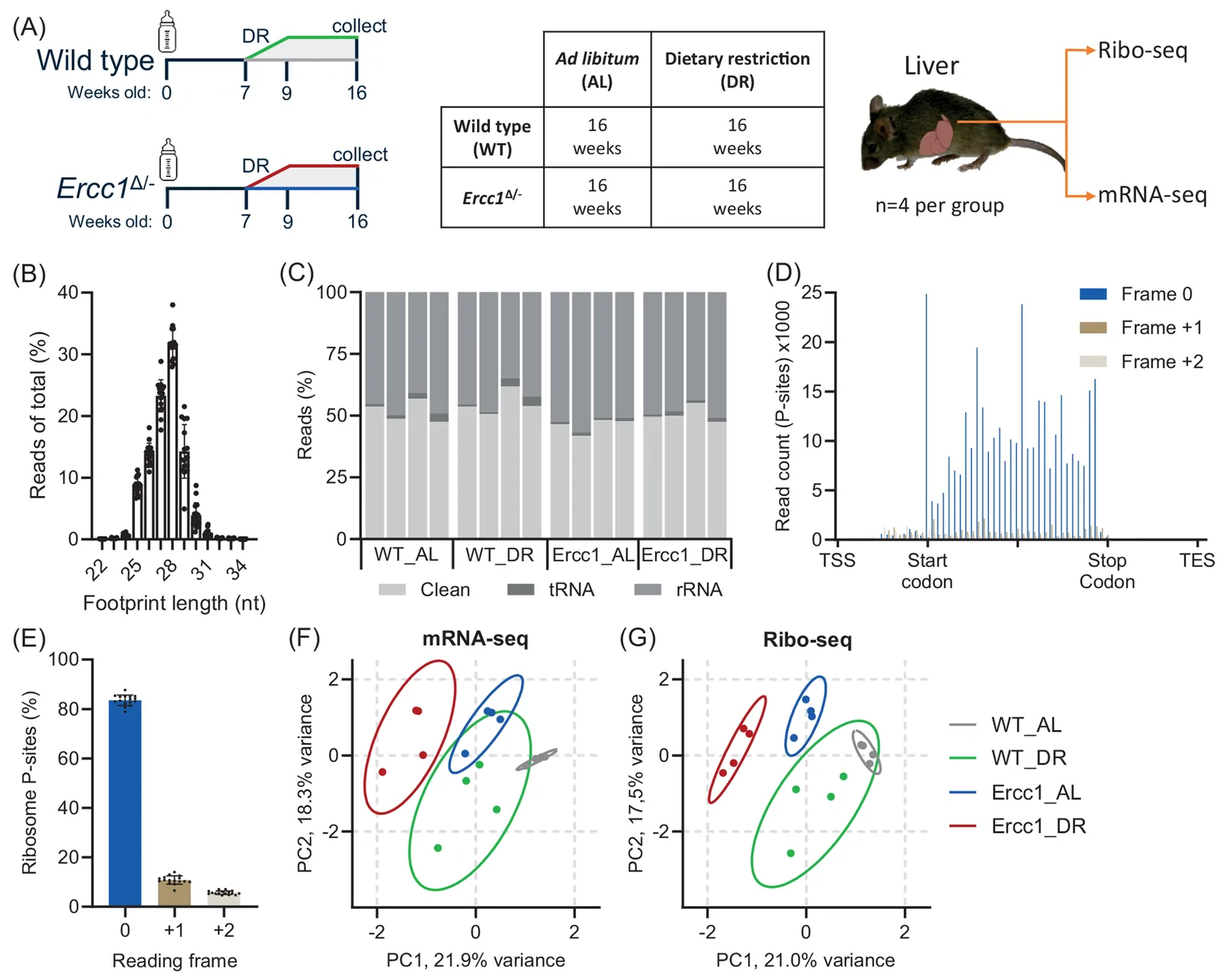
Liver samples from mice with defective DNA repair and accelerated aging, and from normal mice, were compared in an animal experiment. The researchers analyzed gene activity alongside translation, the process cells use to make proteins. They also examined dietary restriction, which strongly delays aging in the DNA-repair-deficient mice.
Changes in gene activity during accelerated, normal and delayed aging were largely preserved in protein production. The authors concluded that translation did not have a major impact on aging-related changes in gene expression. Dietary restriction nevertheless altered finer details of protein production. It further increased pauses in ribosomes, the cell’s protein-making machinery. The authors interpreted the findings as evidence of fine-tuning under cellular stress.
Why it matters
DNA damage can disrupt gene activity as organisms age. The work points to dietary restriction as a potential way to modify the resulting changes in protein production.
Caveats
The experiments examined mouse liver, leaving open whether other tissues or people show the same patterns.

Comments
Be the first to comment.