Valve trial found benefit in patients with diabetes and heart failure
After catheter-based valve replacement, 12-month death or worsening heart failure rates were 15.2% with dapagliflozin versus 22.7% with standard care in patients with diabetes and prior heart failure.
Our read
Interventions- Studied:
- Randomized trial in 1,222 people (12 months, multicenter, sample size calculated, registered EUCTR2020-003930-18)
- In the record:
- The 127th paper on dapagliflozin with results in people; 482 on record in all. Its result on genital infections agrees with all 4 other findings on record.
Editor of record: Boris Djordjevic · AgingResearch.News
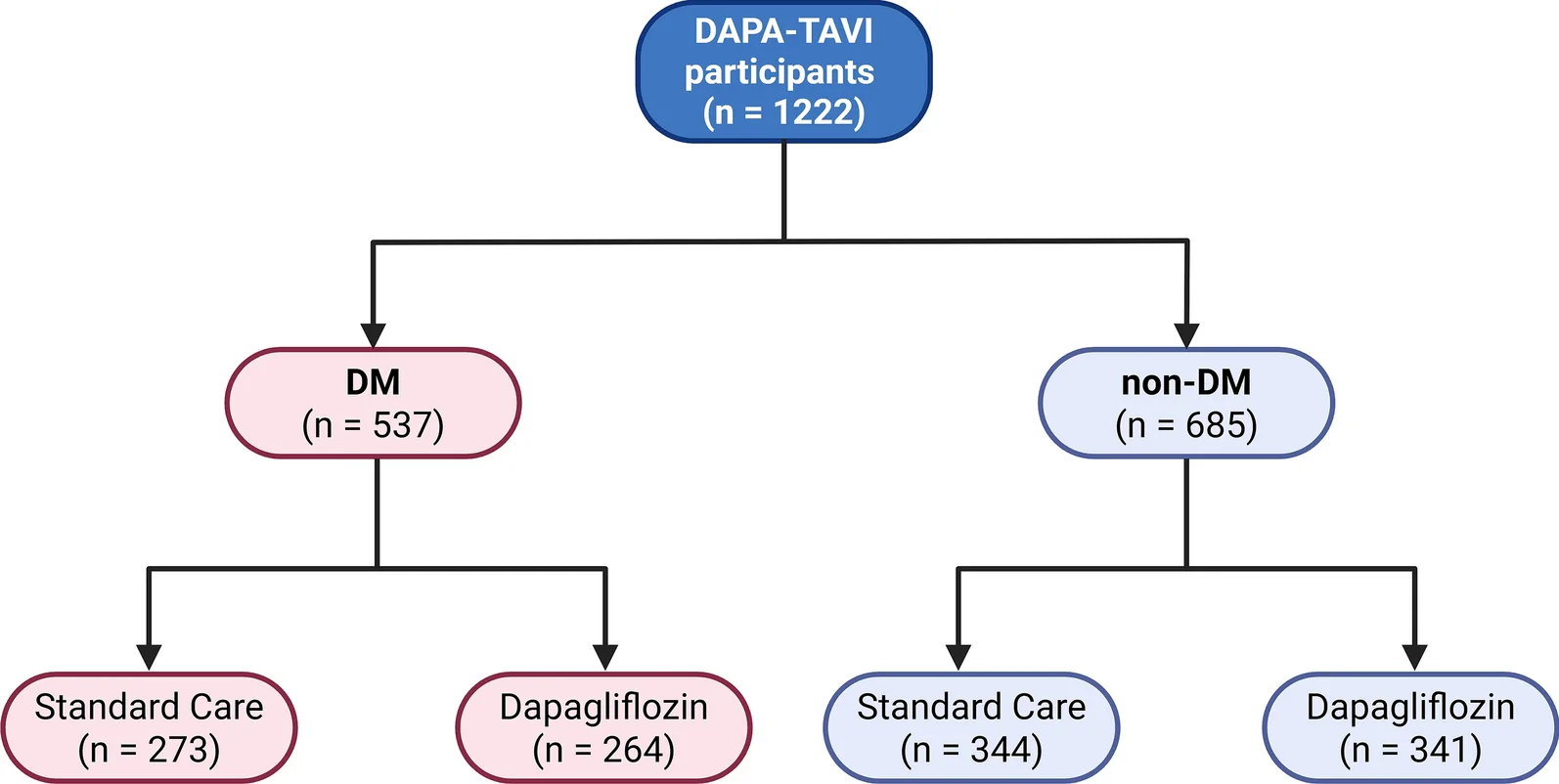
The 1,222 women and men in this prespecified subgroup analysis of a randomized trial had severe narrowing of the heart’s main outlet valve and prior heart failure. Of these, 537 had diabetes. Average ages were 81.5 years with diabetes and 83.1 years without. After catheter-based valve replacement, participants received dapagliflozin, 10 mg daily, or standard care for 12 months.
The benefit with diabetes came mainly from fewer worsening heart failure events. Without diabetes, death or worsening heart failure occurred in 15.0% versus 18.0%; the range of likely effects included no difference. The analysis found no clear difference in benefit by diabetes status. Genital infections affected 2.7% versus 0.4% with diabetes; symptomatic low blood pressure affected 7.0% versus 2.9% without diabetes, comparing dapagliflozin with standard care. Serious adverse events did not differ significantly in either subgroup.
Why it matters
For older adults with heart failure undergoing valve replacement, a key question is whether diabetes changes the benefits of added medication.
Caveats
The authors note that the trial was not specifically powered to detect differences in benefit by diabetes status. Its findings do not cover patients managed without valve replacement or with surgical valve replacement.
From the paper
- Participants
Among 1222 patients, 537 (43.9%) had DM.
- Primary outcome
In patients with DM, dapagliflozin significantly reduced the primary endpoint compared with standard care (15.2% vs. 22.7%; HR 0.580; 95% CI 0.389–0.866; p = 0.008; number needed to treat [NNT] = 11), driven primarily by fewer worsening HF events.
- Events by group
Worsening of HF occurred in 9.5% of DM patients receiving dapagliflozin, compared to 15.8% in DM patients randomized to standard care group (adjusted HR 0.527; 95% CI 0.321–0.866, p-value 0.012) (Figs. 2 and 3).
Results, Outcomes stratified by the presence or absence of diabetes mellitus
- Limitation
Furthermore the study was not specifically powered to detect treatment-effect heterogeneity between subgroups.
Quoted word for word from the full text on link.springer.com.
The paper
Spanish National Centre for Cardiovascular Research; Universidade de Santiago de Compostela
Cardiovascular Diabetology, Aug 10, 2026, Open access



Comments
Be the first to comment.