Long-term heat linked to higher death risk in California
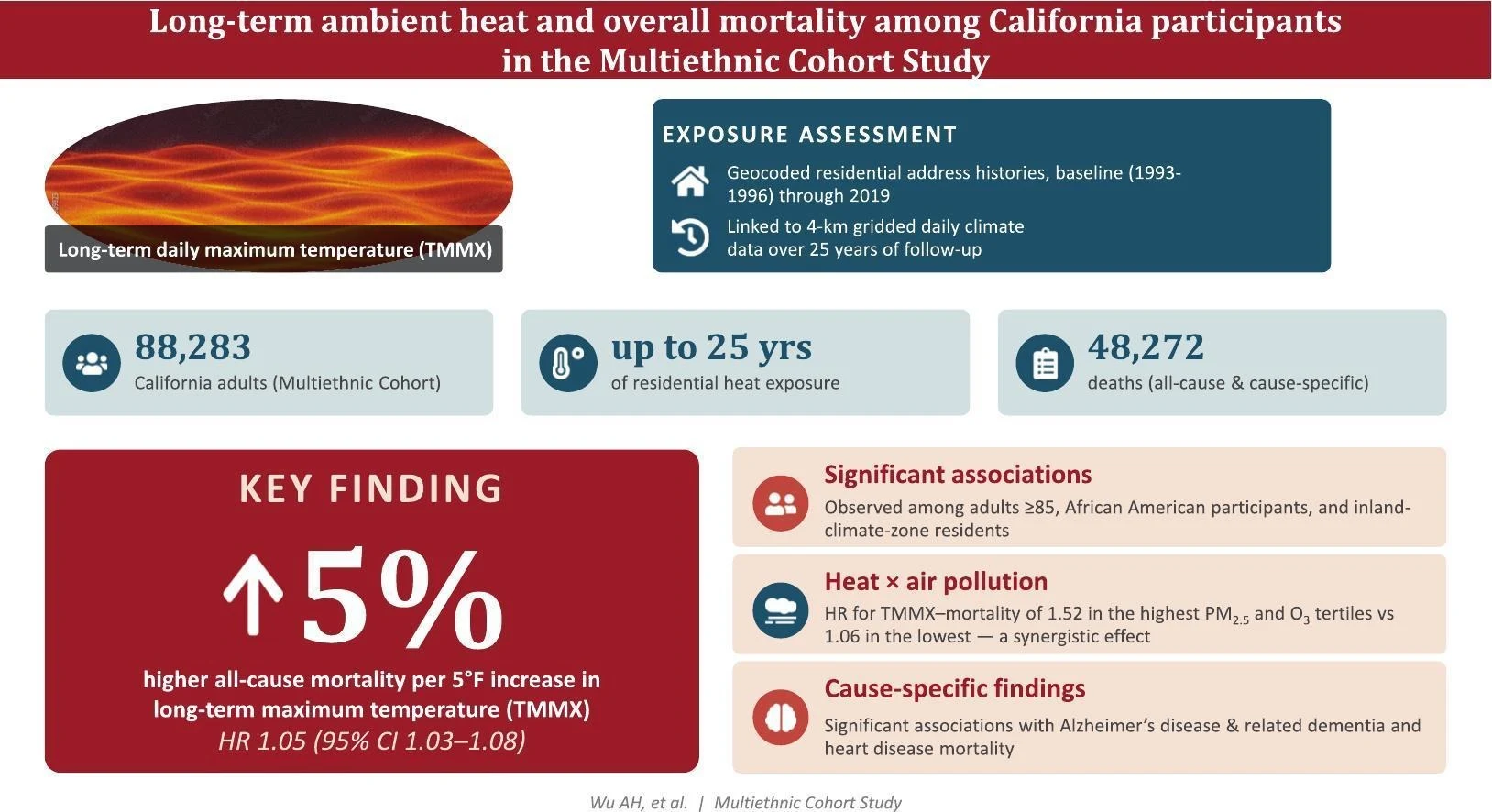
Each 5°F increase in long-term average daily maximum temperature was linked to a 5% higher relative risk of death among California cohort participants.
Our read
Populations- Studied:
- Cohort study of 88,283 California participants in the Multiethnic Cohort Study
- What changed:
- Death risk was 5% higher per 5°F increase in long-term average daily maximum temperature
- The catch:
- People in hotter areas could differ in health or living conditions despite adjustments
- Why it’s aging research:
- It measures an outcome that worsens with age.
Editor of record: Boris Djordjevic · AgingResearch.News
The 88,283 California participants in the Multiethnic Cohort Study were followed from a 1993–1996 baseline through 2019 in a prospective observational study. About 70% were African American or Latino. The analysis examined annual averages of daily maximum temperatures at their homes, covering up to 25 years of exposure.
During follow-up, 48,272 participants died. Each 5°F increase in long-term average daily maximum temperature was associated with a 5% higher relative risk of death. The association remained after adjustments for individual and neighborhood characteristics and other climate factors. Heat-wave exposure was also linked to mortality. Higher temperatures were associated with deaths from Alzheimer’s disease and related dementias and from heart diseases.
Why it matters
For understanding survival in later life, the findings support examining sustained heat alongside short heat waves. The authors say the evidence could inform climate-health research and intervention development.
Caveats
People living in hotter areas may have differed in health or living conditions that the adjustments did not fully capture. The California cohort does not establish whether the same pattern holds in other regions.
Where the evidence stands
Fine particulate matter
- 193 independent labs in 39 countries
- 27 findings against
- Funders: National Natural Science Foundation of China and others
- 26 of 716 findings with company ties
Heat waves
- 17 independent labs in 9 countries
- 1 finding against
- Funders: Coordenação de Aperfeiçoamento de Pessoal de Nível Superior and others
The paper
University of California, Irvine; University of California, San Francisco
Environment International, Oct 27, 2026, Open access

Comments
Be the first to comment.