Social disadvantage linked to bone and joint disease progression
Unfavorable social conditions were linked to a 21% higher relative risk of a first bone or joint disease than favorable conditions.
Our read
Populations- Studied:
- Cohort study of 283,146 UK Biobank participants, median 13.7 years (Multicenter)
- What changed:
- Risk of progression to multiple bone and joint diseases was 33% higher with unfavorable versus favorable social conditions
- The catch:
- Hospital records could miss milder bone and joint diseases managed outside hospitals
- In the record:
- The 43rd paper on social determinants of health with results in people; 68 on record in all. Its result on mortality agrees with all 12 other findings on record.
- Why it’s aging research:
- Biological age, frailty, function, multimorbidity or death.
Editor of record: Boris Djordjevic · AgingResearch.News
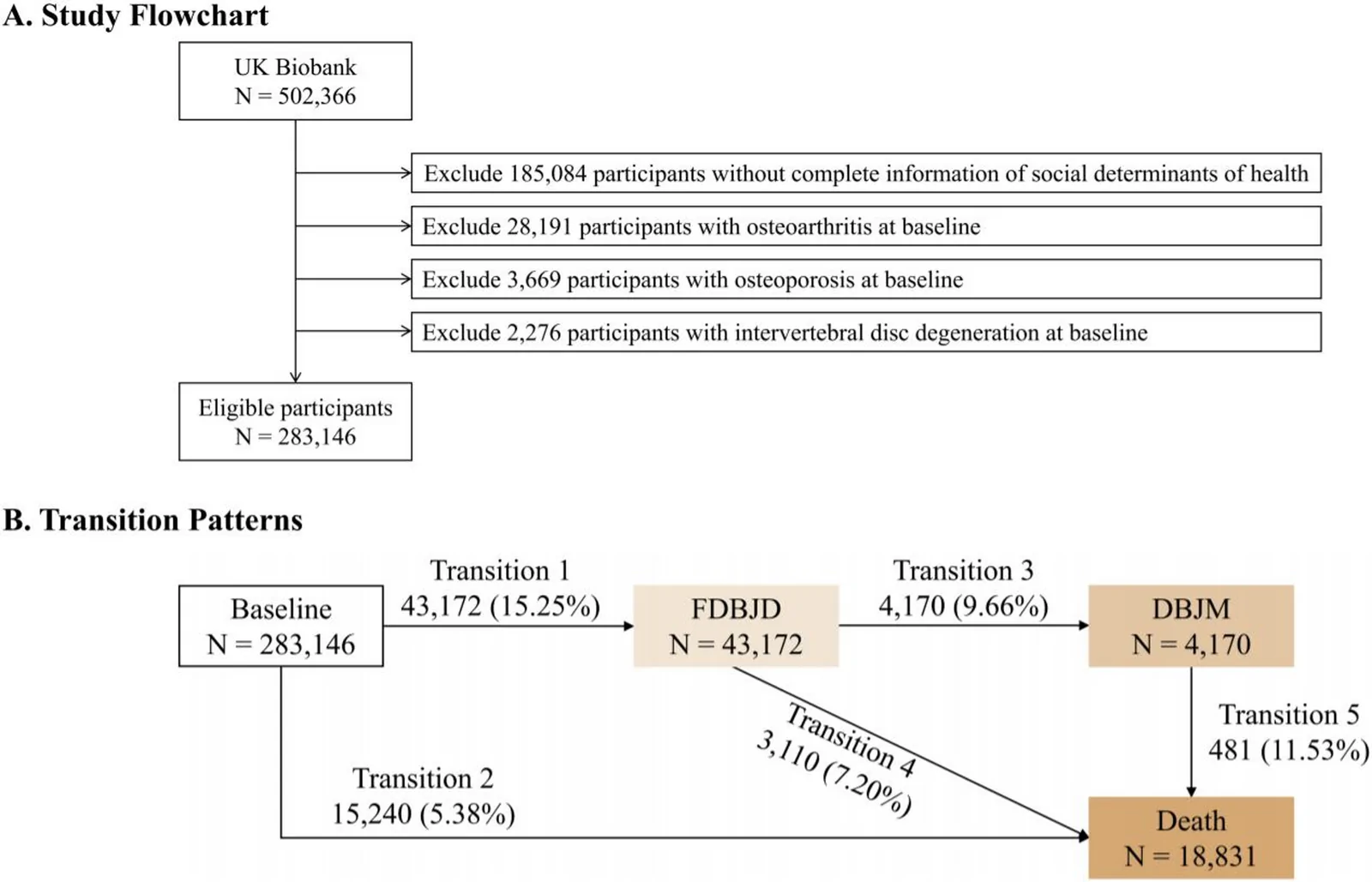
The 283,146 UK Biobank participants in this prospective observational study averaged 54.9 years old; 52.2% were women. They began without osteoarthritis, a joint disease; osteoporosis, which weakens bones; or spinal disc degeneration. Researchers scored 17 measures of economic circumstances, education, healthcare, neighborhoods and social connections.
Over a median 13.7 years, 43,172 developed one of these conditions, and 4,170 subsequently developed at least two. Unfavorable social conditions were linked to higher risks of disease onset, progression to multiple conditions and death, compared with favorable conditions. Economic stability and social circumstances showed the most consistent links. Among 229,595 participants with complete lifestyle data, statistical models suggested lifestyle partly accounted for the associations. People with both unfavorable social conditions and unfavorable lifestyles had the highest risks.
Why it matters
For age-related bone and joint diseases, the authors called for addressing social conditions alongside lifestyle to reduce disease burden and health inequalities.
Caveats
Unmeasured health differences between social groups could have contributed to the associations. Diagnoses came from hospital records, and the findings do not cover people who already had one of the three conditions at enrollment.
Where the evidence stands
Economic stability
- 1 lab in 1 country
- Funders: Alzheimer's Association and others
- 2 of 2 findings with company ties
From the paper
- Participants
As shown in Table 1, this study included 283,146 participants with a mean age of 54.9 years (SD = 8.0), of whom 52.2% were female.
- Follow-up
During a median follow-up of 13.7 years, 43,172 participants developed FDBJD, of whom, 4,170 subsequently developed DBJM, and 18,831 died.
- Result
… including from baseline to FDBJD (HR = 1.21, 95%CI = 1.18–1.24), from baseline to death (1.58 [1.52–1.65]), from FDBJD to DBJM (1.33 [1.23–1.44]), from FDBJD to death (1.64 [1.50–1.80]), and from DBJM to death (1.48 [1.17–1.87]).
Quoted word for word from the full text on link.springer.com.
- Economic stability
- Social and community context
- Social determinants of health
- Degenerative bone and joint disease
- Degenerative bone and joint disease multimorbidity
- Humans
The paper
Sichuan University
BMC Public Health, Aug 7, 2026, Open access


Comments
Be the first to comment.