Wrist trackers gave comparable overall activity readings
An observational comparison in 85 British and 117 Chinese adults aged 50 or older found comparable overall movement readings over up to eight days.
Our read
Biomarkers- Studied:
- Cross-sectional study of British and Chinese older adults, against Axivity AX3 readings
- What changed:
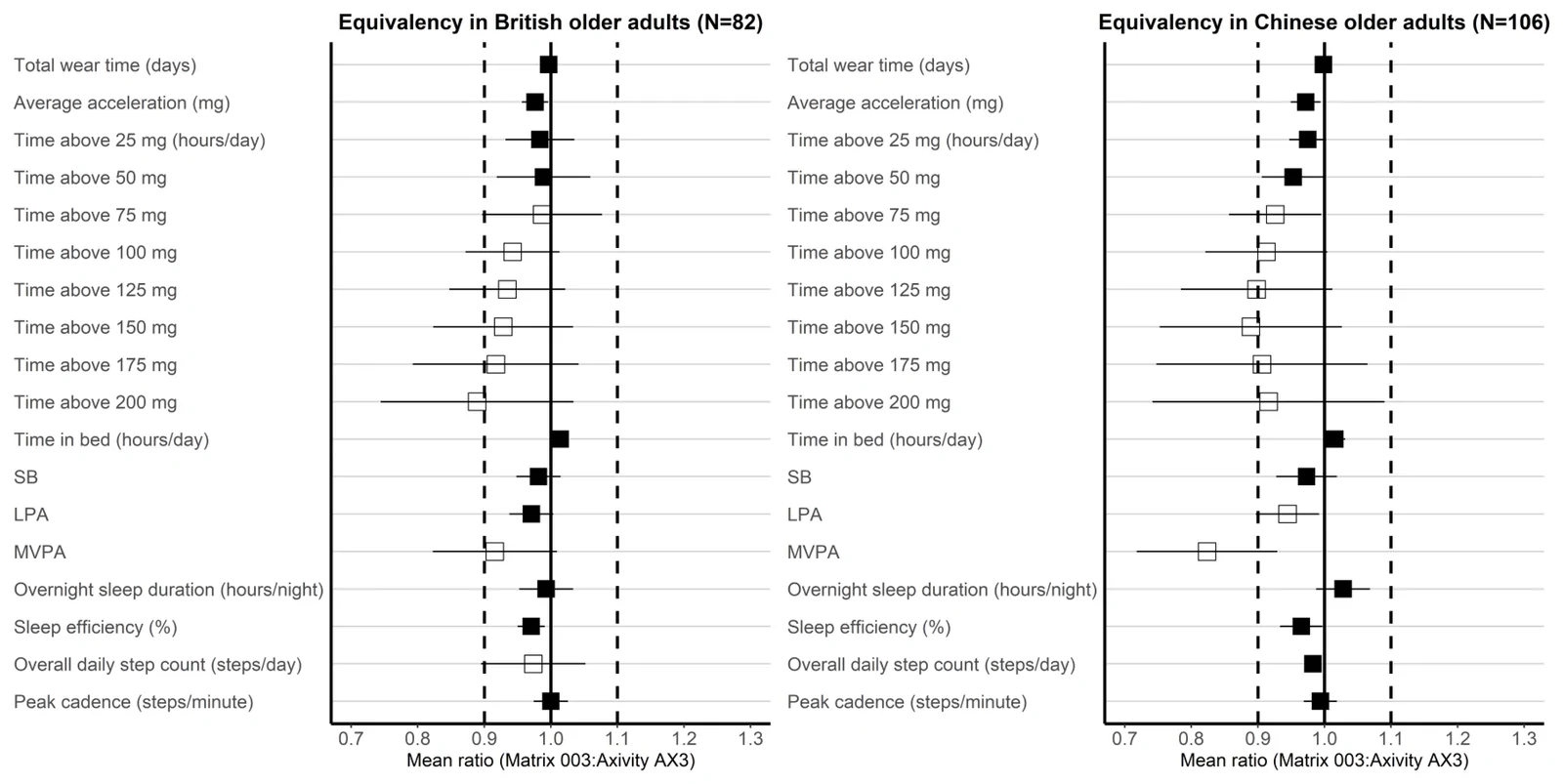
- Overall activity readings were equivalent within ±10% between Matrix and Axivity trackers in British and Chinese older adults
- The catch:
- Chinese participants were monitored for only two nights and one day, reducing robustness
- Why it’s aging research:
- A tool or dataset for aging research.
Editor of record: Boris Djordjevic · AgingResearch.News
Eighty-five British and 117 Chinese women and men aged 50 or older wore Axivity AX3 and Matrix 003 movement sensors together on their dominant wrist in an observational validation study. British participants were asked to wear them for eight days; Chinese participants for two nights and one day. Analyses included 82 British and 106 Chinese participants with valid data.
UK-developed computer programs estimated activity and sleep from the recordings. Average movement readings, sedentary time, time in bed and sleep duration were equivalent. The test required the likely range for one device’s average to fall within 10% of the other’s. Estimates of time spent in moderate or vigorous activity did not meet that threshold. Light-activity estimates were equivalent in British adults but borderline in Chinese adults. Daily step counts showed the opposite pattern.
Why it matters
Studies of aging in England and China use different movement sensors. The authors called for further development and validation of population-specific programs to interpret their readings.
Caveats
Neither device was a reference standard, so agreement did not establish accuracy. Both groups were convenience samples of adults able to walk, rather than nationally representative samples.
From the paper
- Limitation
Another limitation of this study was the use of self-selected cohorts, which may limit the generalisability of the findings.
Quoted word for word from the full text on PubMed Central.
The paper
Journal for the Measurement of Physical Behaviour, Sep 26, 2025, Open access


Comments
Be the first to comment.