Night work linked to higher risk of muscle, bone and joint disorders
The relative rate of new disorders over time was 1.15 for usual or permanent night workers versus day workers, where 1 means no difference.
Our read
Populations- Studied:
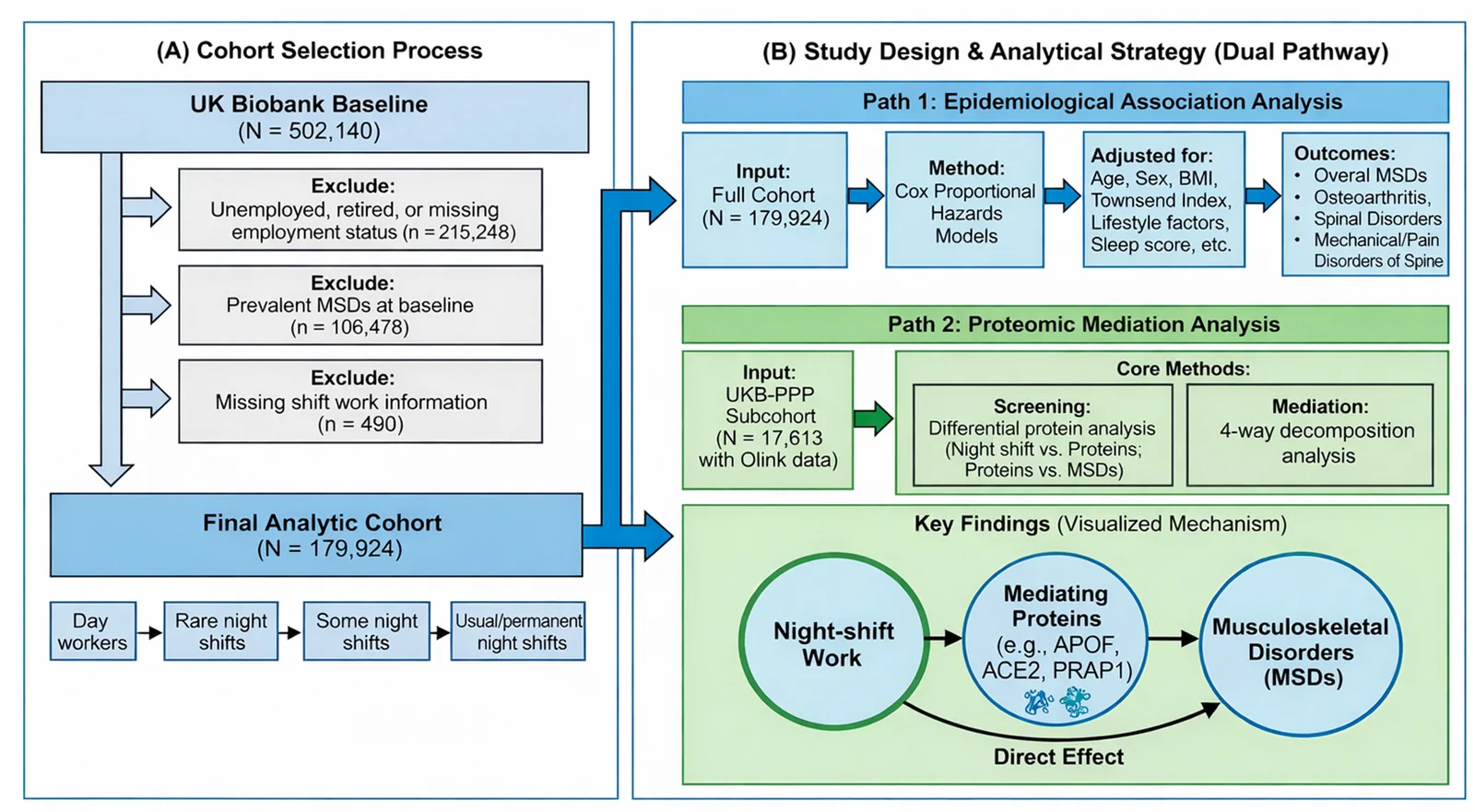
- Cohort study of 179,924 employed UK Biobank participants, median 13.1 years, against day workers
- What changed:
- Risk of musculoskeletal disorders was higher among usual or permanent night-shift workers than day workers (HR 1.15)
- The catch:
- Measures of job-related physical workload and ergonomic exposures were coarse, leaving residual confounding
- In the record:
- The 40th paper on night-shift work with results in people; 57 on record in all.
Editor of record: Boris Djordjevic · AgingResearch.News
In a prospective cohort study, researchers followed 179,924 employed UK Biobank participants without musculoskeletal disorders—conditions affecting muscles, bones and joints—at enrollment. Follow-up lasted a median of 13.1 years. Night-shift exposure was classified as rare, some, or usual/permanent, with day workers as the comparison group.
All three night-shift categories were associated with higher risk of developing these disorders. Hazard ratios, which compare rates over time, were 1.12 for rare night shifts, 1.13 for some, and 1.15 for usual or permanent night shifts. Associations were stronger among people with at least 10 years of exposure. Blood-protein analyses identified 78 candidate mediators—proteins that might help account for the links—shared across key outcomes. The authors suggested that these analyses pointed to possible biological pathways.
Why it matters
Osteoarthritis, one of the conditions studied, is an age-related disease. The authors said the findings supported schedules that better respect the body’s daily rhythms and targeted workplace measures to reduce musculoskeletal disease burden.
Caveats
This observational study cannot show that night work caused the disorders or that the proteins mediated the associations. Participants were employed and free of musculoskeletal disorders at enrollment.
From the paper
- Participants
Among the 179 924 participants, 83.3% (n=149 892) were ‘day workers’, 8.1% (n=14 580) were ‘shift workers without/rare night-shifts’, 4.9% (n=8813) worked ‘some night-shifts’ and 3.7% (n=6639) worked ‘usual/permanent night-shifts’.
- Follow-up
The median follow-up was 13.10 years (IQR 8.62–14.13), ranging from 0.0027 to 16.65 years (mean 11.11, SD 4.40).
- Result
… all categories of night-shift workers demonstrated elevated MSD risk: ‘rare night-shifts’ (HR 1.122; 95% CI 1.09 to 1.16), ‘some night-shifts’ (HR 1.126; 95% CI 1.08 to 1.17) and ‘usual/permanent night-shifts’ (HR 1.151; 95% CI 1.10 to 1.20) …
Results, Night-shift work is associated with increased musculoskeletal disorder risk
- Limitation
Limitations include the observational design and possible residual confounding, particularly from obesity and job-related physical workload/ergonomic exposures; although we adjusted for BMI, physical activity and a proxy for heavy manual work …
Quoted word for word from the full text on bmjpublichealth.bmj.com.
- Night-shift work
- Musculoskeletal disorders
- Mechanical and pain disorders of the spine
- Osteoarthritis
- Spinal disorders
- Humans
The paper
Shanghai Jiao Tong University
BMJ Public Health, Oct 27, 2026, Open access
Comments
Be the first to comment.