Spice extract reduced body fat in Korean adults with overweight
Body fat fell by 4.2 percentage points with the extract versus 0.8 with placebo in a 12-week randomized trial.
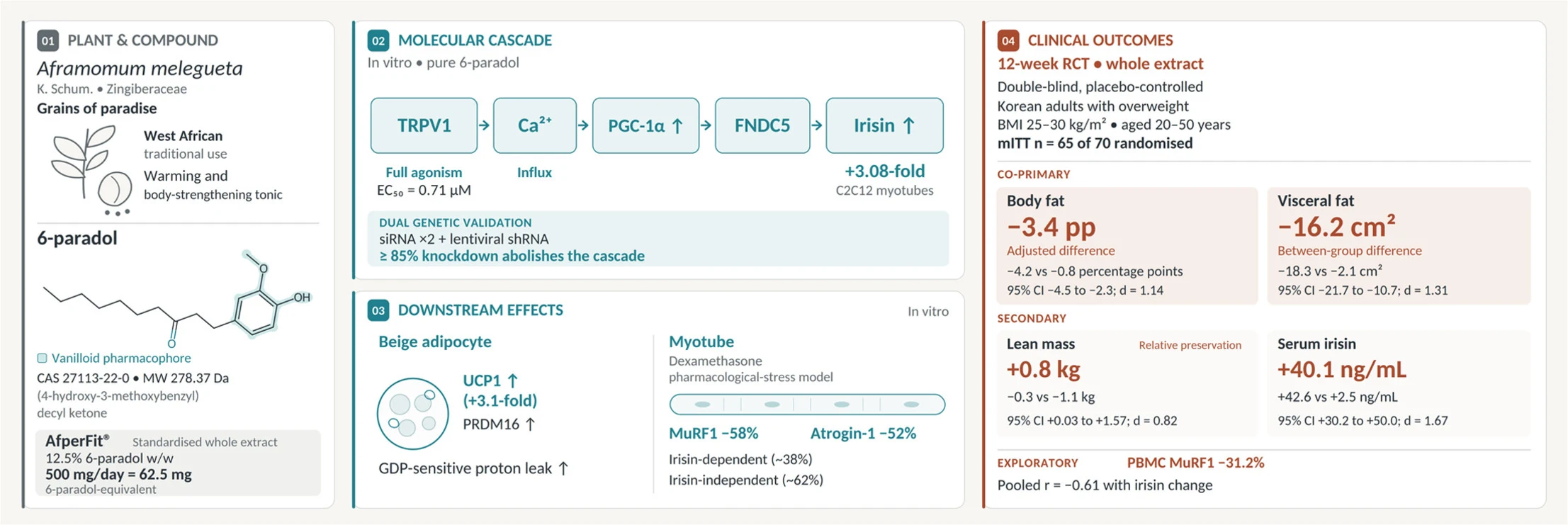
Double-blind, placebo-controlled
Limit: Only 65 of 70 randomized participants were analyzed, risking bias from exclusions
Edited by Boris Djordjevic · AgingResearch.News
In a 12-week randomized, double-blind, placebo-controlled trial, 70 healthy Korean adults aged 20–50 with overweight received a grains of paradise spice extract or placebo. Participants had a body mass index of 25–30. The extract dose was 500 milligrams daily. Researchers analyzed 65 participants.
Body fat fell by 4.2 percentage points with the extract versus 0.8 with placebo. The area of visceral fat, which surrounds internal organs, fell by 18.3 versus 2.1 square centimeters. These were the trial’s two main outcomes. Lean body mass fell by 0.3 versus 1.1 kilograms, indicating relative preservation, not a gain. Blood levels of irisin, a hormone, rose by 42.6 versus 2.5 nanograms per milliliter. The abstract does not report adverse events.
Why it matters
Preserving lean mass during fat loss is relevant to sarcopenic obesity, the combination of excess fat and low muscle mass that can occur with aging.
Caveats
The trial tested a multi-ingredient extract, so its effects cannot be attributed specifically to 6-paradol. Results need validation in people with sarcopenic obesity and populations beyond healthy Korean adults aged 20–50 with overweight.
The paper
Korea University College of Medicine
The Journal of Nutritional Biochemistry, Oct 31, 2026


Comments
Be the first to comment.