Loss of an RNA regulator depletes egg reserves in animals
In an animal experiment, deleting an RNA-processing gene in egg cells caused complete female infertility and progressive depletion of the structures that house developing eggs.

Edited by Boris Djordjevic · AgingResearch.News
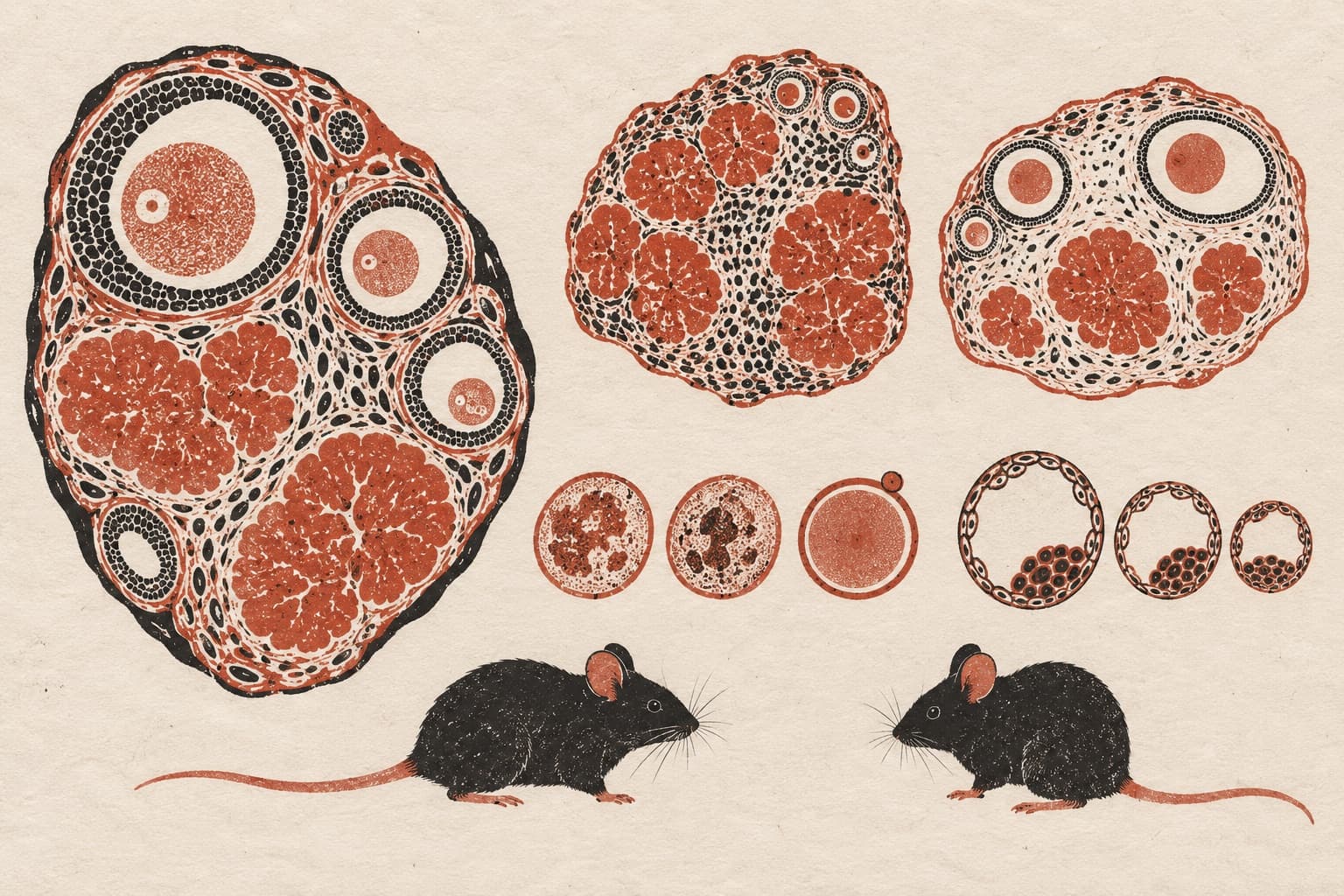
In an animal experiment, researchers deleted the gene for SRSF2, a protein that regulates how RNA messages are assembled, specifically in oocytes, the cells that develop into eggs. The females were completely infertile. Their ovarian follicles, structures that house developing eggs, progressively dwindled and showed increased cell death.
The deletion broadly disrupted gene activity and RNA splicing, the process that joins sections of RNA messages. One affected message carried instructions for NOBOX, a protein that controls gene activity in egg cells. The message skipped one section, and levels of the full-length protein fell markedly. Adding correctly assembled Nobox messenger RNA partly corrected follicle development defects outside the body. This supported Nobox as an important target of SRSF2, rather than the sole explanation for the defects.
Why it matters
The ovarian follicle reserve helps determine female reproductive lifespan. The work points to disrupted RNA processing as a possible contributor to ovarian insufficiency.
Caveats
These were animal experiments, and the partial rescue occurred only outside the body. The abstract did not identify the animal species or report sample sizes.
The paper
mRNA alternative splicing dysregulation in oocytes causes premature ovarian failure
The Affiliated Guangdong Second Provincial General Hospital of Jinan University
Journal of Genetics and Genomics, Oct 24, 2026