Pollution sources differ in links to irregular heartbeat risk
For sulfate particles, the hazard ratio—a relative risk measure—was 1.056 per exposure increase spanning the middle half of levels, compared with lower exposure.
Limit: Exposure estimates used ZIP codes rather than individual measurements
Edited by Boris Djordjevic · AgingResearch.News
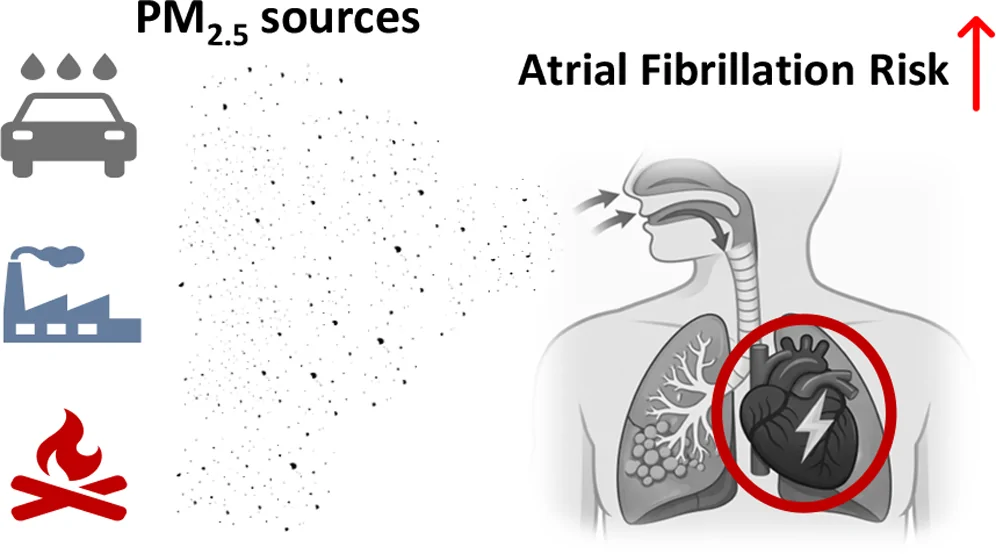
In 26.3 million older US Medicare beneficiaries, a nationwide observational cohort study examined fine-particle air pollution and new cases of atrial fibrillation, an irregular heartbeat. The analysis covered 2000–2019. Researchers estimated annual exposure by ZIP code using monitoring stations within 100 kilometers. They identified 4.44 million new cases.
Pollution from vehicle emissions, heavy oil and coal burning, sulfate particles and nitrate particles was associated with higher risk after adjustment for demographic, socioeconomic and environmental factors. Burning biological material, and soil and dust, showed only modest associations. Particles formed in the air from carbon-based substances showed no overall association. Links varied by region, with sulfate and nitrate showing the strongest associations in the southern US.
Why it matters
The focus on older adults makes the results relevant to air-quality policy for aging populations. The authors called for region-specific rules targeting traffic and industrial emissions.
Caveats
This observational study could not establish that pollution caused atrial fibrillation. Exposure estimates reflected ZIP codes rather than individual measurements, and the findings concerned older US Medicare beneficiaries.
- Soil and dust-derived pm2.5
- Biomass burning-derived pm2.5
- Heavy oil and coal combustion-derived pm2.5
- Secondary nitrate pm2.5
- Atrial fibrillation
- Humans
The paper
Emory University
Environment & Health, Jun 22, 2026, Open access