The influence of sensory function on walking stability in aging and falls through a head-movement perturbation model
Registered NCT06345625
Abstract
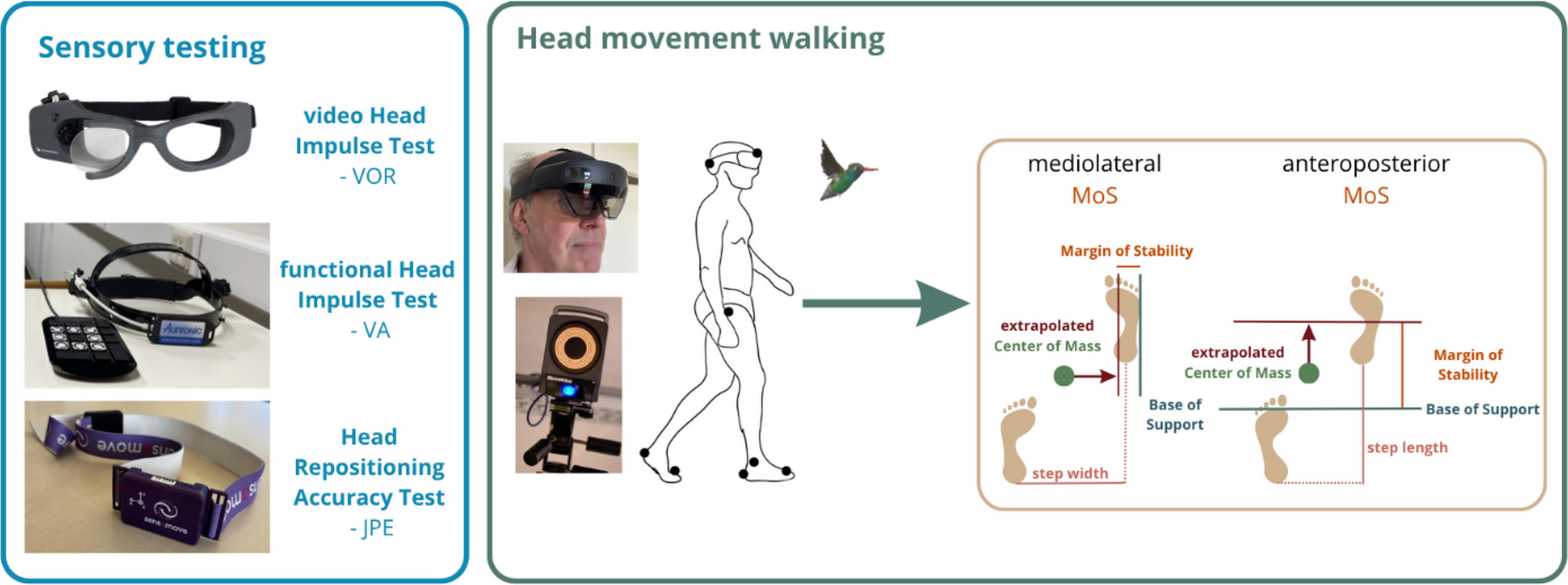
Age-related sensory decline impairs responses to balance disturbances, increasing fall risk. Evaluating gait and balance under sensory challenges can help reveal how this decline affects instability in older adults. This study (Clinicaltrials.gov NCT06345625) incorporates head movements to evaluate the effect of sensory function - cervical sensorimotor control, vestibular function, and visual acuity - on walking stability in aging and its relationship with falls through a novel augmented-reality perturbation model. Sixty-one healthy, community-dwelling older adults (76.2 years; 40 females) with and without fall history walked with head movements (up, down, left, right) cued by augmented-reality (marker-based motion capture and headset). Additionally, cervical sensorimotor control, vestibular semicircular canals (vestibulo-ocular reflex), and static visual acuity were tested. The effects of sensory functions on mediolateral and anteroposterior margin of stability and spatiotemporal parameters (step length, width, time and gait speed) were evaluated, including moderations of fall history through linear mixed models. Older adults with poorer cervical sensorimotor control and vestibular semicircular canal function increased cautiousness in their walking pattern during head movements through increasing step width, step time, and margin of stability. Worse visual acuity was associated with decreased walking stability. Sensory function was more strongly associated with walking stability in individuals with a history of falls. The effects of head movements on walking stability were associated with sensory functioning and falls in older adults. This highlights the potential of head movements as a functional perturbation for walking stability assessments linked with age-dependent sensory decline.


