Y-chromosome loss linked to later eye disease in men
An observational study of 223,051 UK Biobank men linked Y-chromosome loss in blood cells to later age-related macular degeneration.
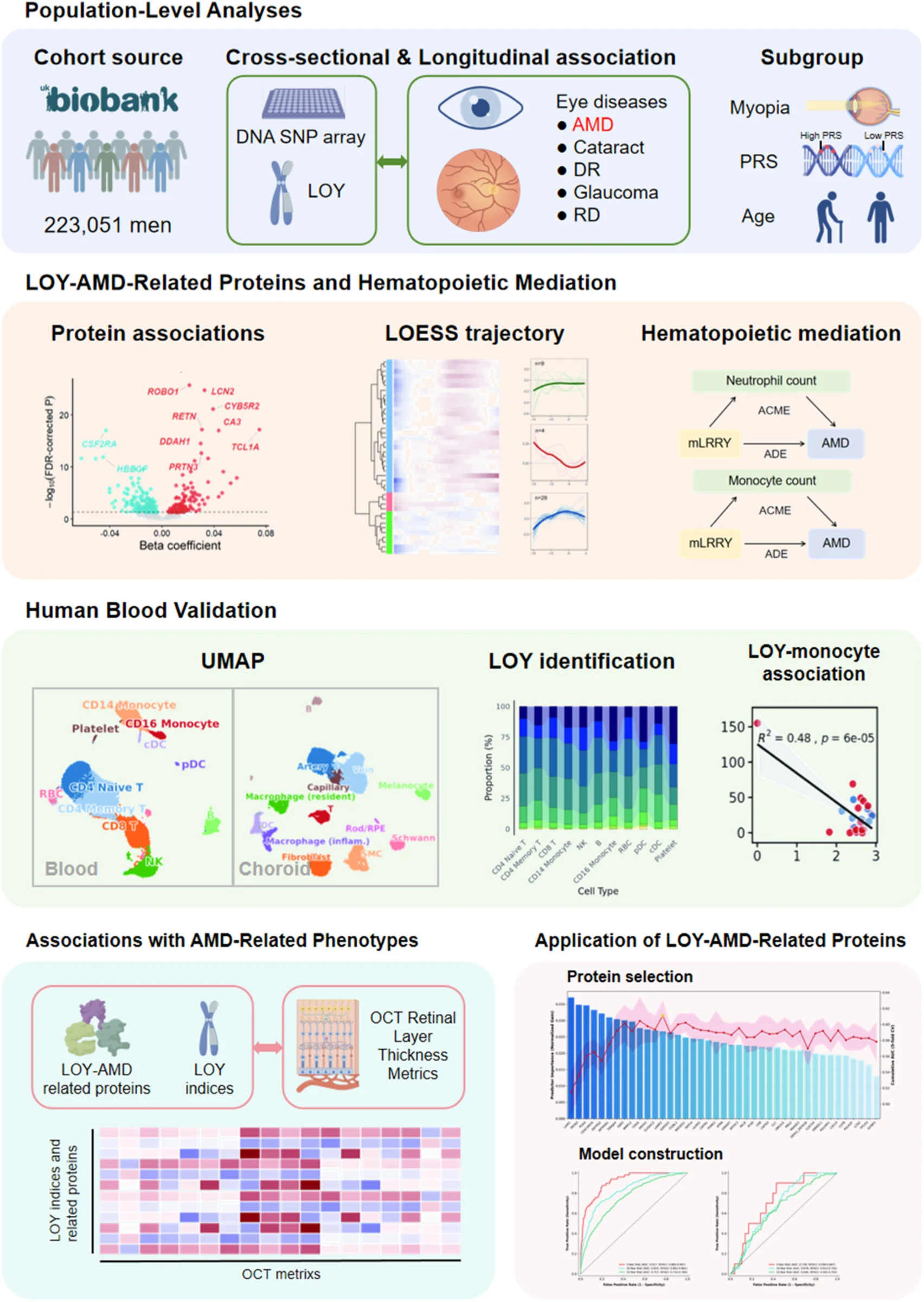
Limit: The Y-chromosome assay misses low-level chromosome loss and complex structural variations
Researchers analyzed 223,051 male UK Biobank participants in an observational study of Y-chromosome loss in blood cells and later eye disease. They linked chromosome loss to subsequent age-related macular degeneration, a disease that damages central vision.
Blood-protein analyses identified 41 proteins with differing patterns over the 15 years before diagnosis. Their levels did not change at a steady rate. Separate analyses examined gene activity in individual cells from blood and the choroid, a layer of the eye. Certain blood monocytes and tissue macrophages—types of immune cells—had the highest frequencies of Y-chromosome loss. Immune cells missing the Y chromosome also showed patterns of gene activity associated with inflammation.
Why it matters
Age-related macular degeneration threatens vision in later life. The work explored blood-based signals that might help identify risk before diagnosis.
Caveats
These observational findings in men cannot establish causation or be assumed to apply to women. The abstract described increased risk but reported a hazard ratio of 0.611 without specifying the comparison, leaving that estimate’s direction unclear.
From the paper
- Participants
A total of 223,051 male participants with high-quality chromosomal data were identified from the UKB cohort, of whom 8920 (4.0%) were classified as LOY carriers (Table 1).
- Result
… a higher continuous mLRRY was uniquely and significantly associated with a reduced risk of incident AMD (HR: 0.611, 95% CI: 0.397–0.942; Table 2) …
Results, 3.2 Association of LOY With Age-Related Ophthalmic Conditions
Quoted word for word from the full text on onlinelibrary.wiley.com.


