Fine particles linked to kidney decline and cardiovascular disease
Models predicted a kidney-function transition after 1,727.43 days at nitrate exposure of 4.2 micrograms per cubic meter, versus 868.56 days at 7.0.
Limit: Kidney function categories relied partly on self-reported chronic kidney disease
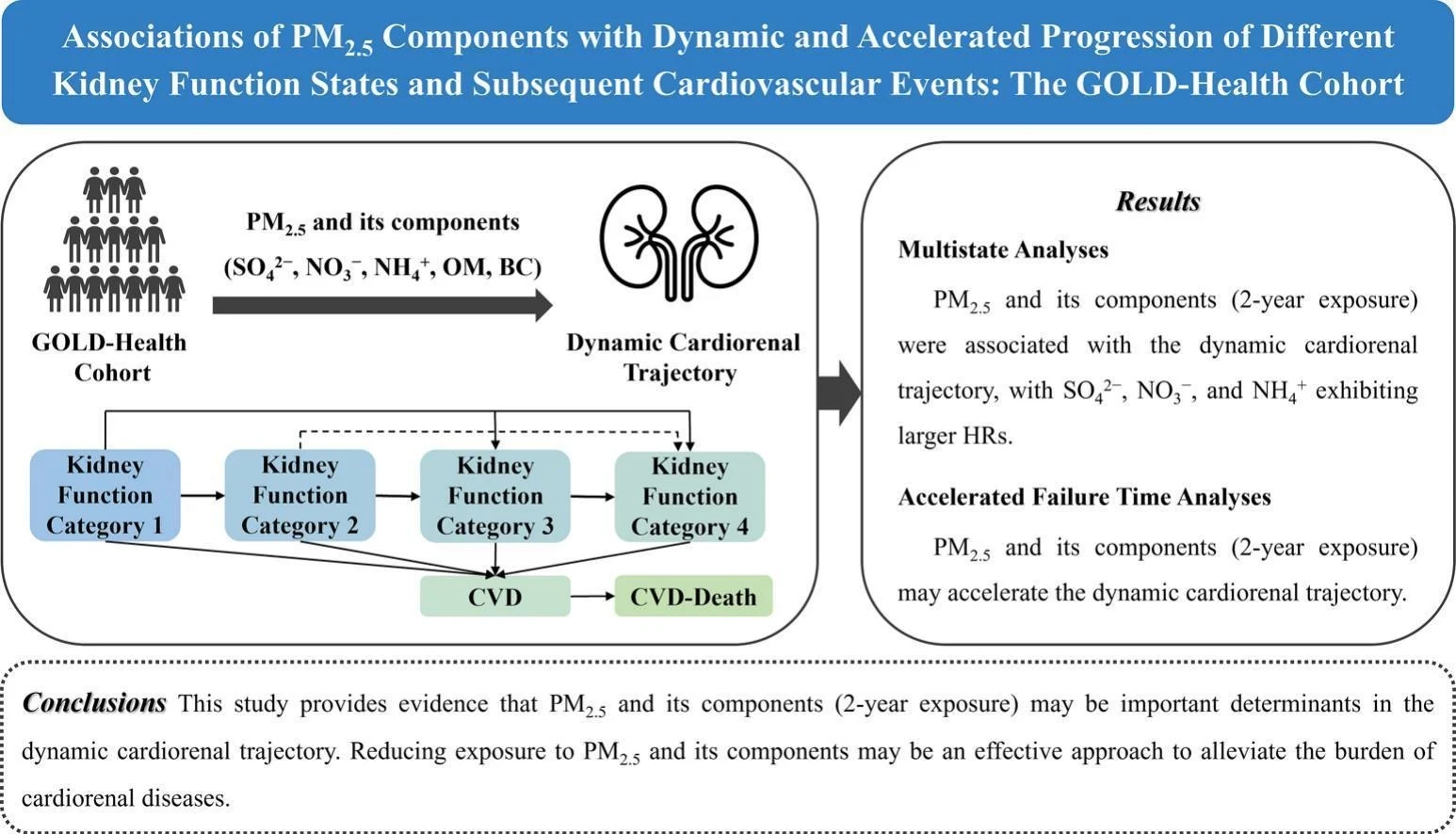
In a prospective observational study of 307,639 participants, researchers examined links between two years of exposure to fine airborne particles and kidney and cardiovascular outcomes. They classified kidney function into four categories using estimated blood-filtering ability and self-reported chronic kidney disease.
During follow-up, researchers recorded 23,948 cases of cardiovascular disease—disease of the heart or blood vessels—and 7,763 cardiovascular deaths. Fine particles and their components were associated with progression through kidney-function states to cardiovascular disease and death. Sulfate, nitrate and ammonium showed stronger associations. Models also linked higher exposures to shorter transition times. The nitrate model predicted shorter times for movement from kidney-function category 2 to category 3 at higher exposure.
Why it matters
Kidney and cardiovascular diseases are concerns as people age. Tracking their linked progression addresses whether specific air pollutants may be risk factors along the path between them.
Caveats
The observational design cannot establish cause and effect, and the transition times were model predictions. Kidney categories relied partly on self-reported chronic kidney disease.
The paper
International Journal of Cardiology, Oct 17, 2026


