Genetic score may help target stomach cancer prevention
In two trials, genetically selected groups showed stronger stomach cancer protection than treating all infected participants, with hazard ratios of 0.44 and 0.20.
1,811 participants
Limit: The score was evaluated in existing trials, not used prospectively to guide prevention
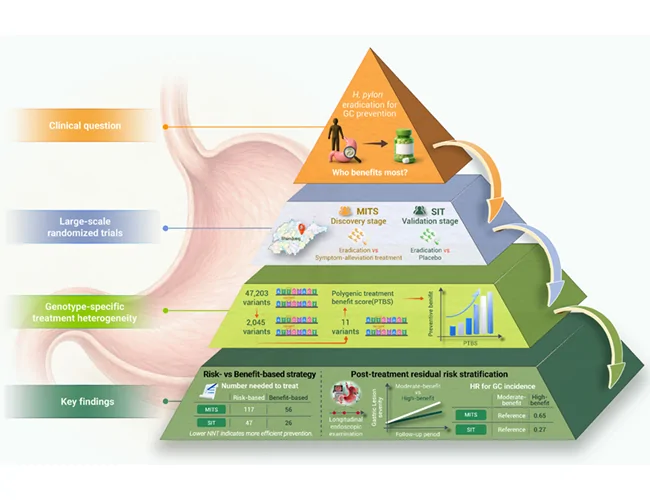
Researchers analyzed two randomized trials involving 1,740 participants in the Mass Intervention Trial in Linqu, Shandong Province, and 1,811 in the Shandong Intervention Trial. They examined whether inherited genetic differences affected how much eliminating Helicobacter pylori, a stomach-infecting bacterium, reduced stomach cancer risk.
The team identified 11 genetic variants that modified the preventive effect and combined them into a score predicting treatment benefit. Groups with high predicted benefit showed stronger protection than either all infected participants or those selected for high genetic cancer risk. Their treatment hazard ratios, comparing cancer occurrence rates over time, were 0.44 in the first trial and 0.20 in the second. The score also distinguished remaining cancer risk after treatment and was associated with slower progression of precancerous changes.
Why it matters
Population screening and bacterial eradication aim to prevent stomach cancer, but the benefit varies between individuals. The findings suggest a framework for tailoring these programs and managing cancer risk after eradication.
Caveats
This was an analysis of existing randomized trials, not a prospective trial of score-guided prevention. The results concern H. pylori-positive trial participants; the abstract did not report ages, treatment schedules, follow-up duration, absolute cancer rates or harms.
- Helicobacter pylori eradication
- Human genetics
- Gastric cancer
- Precancerous lesion
- Polygenic risk score
- Humans
The paper
Peking University Cancer Hospital & Institute
Innovation (Cambridge (Mass.)), Apr 16, 2026