Blood markers may flag who benefits from a lifestyle program
A trial analysis in people with mild cognitive impairment identified a blood-marker subgroup with less cognitive decline after lifestyle intervention than in controls over 18 months.
Genetic association study
Limit: The subgroup was identified and evaluated for intervention benefit within the same cohort
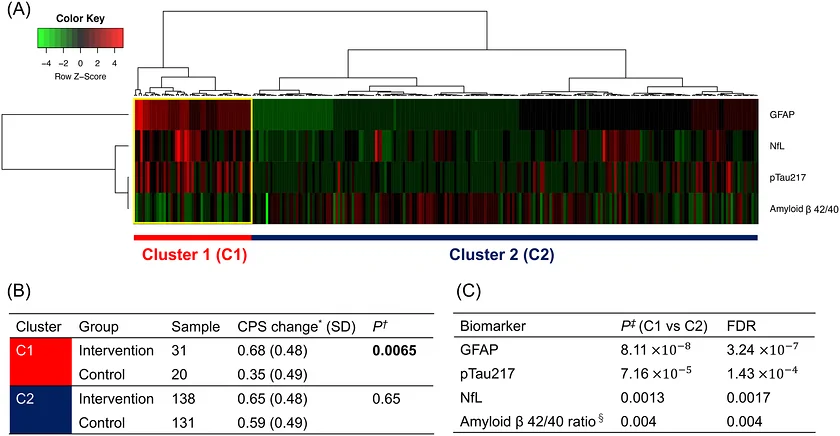
Researchers analyzed blood markers in people with mild cognitive impairment—mild problems with memory or thinking—who participated in a lifestyle intervention trial. They grouped participants by patterns in markers related to Alzheimer’s disease. One subgroup had several abnormal markers and elevated glial fibrillary acidic protein, a protein found in cells that support nerve cells.
Within this subgroup, cognitive performance declined more in the control group than in the intervention group between the study’s start and 18 months. An analysis of participants’ genomes identified four genetic variants with suggestive links to membership in this subgroup. The researchers suggested that blood markers, potentially combined with genetic information, may help identify people with a more progressive Alzheimer’s-related biological profile who may benefit more from the intervention.
Why it matters
For people with mild cognitive impairment, a key question is whether Alzheimer’s-related biology can help guide efforts to delay cognitive decline.
Caveats
The findings came from a blood-marker-defined subgroup and do not establish that marker-guided intervention works. The abstract gives no subgroup sizes, effect sizes or information on harms.
From the paper
- Participants
Of these, 51 dropped out before J-MINT follow-up assessments, leaving 269 patients.
- Limitation
First, the sample size was modest, and analyses were conducted within a single cohort.
Quoted word for word from the full text on alz-journals.onlinelibrary.wiley.com.
- Multidomain lifestyle intervention
- Machine learning
- Mild cognitive impairment
- Glial fibrillary acidic protein
- Amyloid-β42/40 ratio
- Humans
The paper
Medical Genome Center Research Institute
Alzheimer's & Dementia, Oct 16, 2026