Processed meat, unprocessed red meat, poultry, seafood, and egg intake and stomach cancer risk: a pooled analysis of 20 cohorts
Abstract
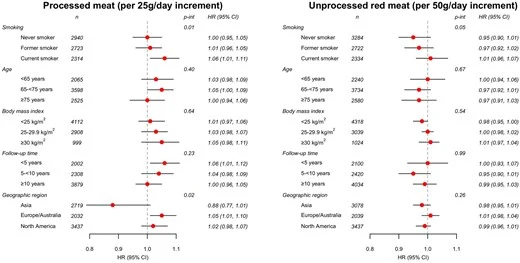
BACKGROUND: Processed meat is classified as a carcinogen and unprocessed red meat a probable carcinogen, but their associations with stomach cancer are not established. We evaluated intakes of these food groups and poultry, seafood, and eggs in relation to stomach cancer risk. METHODS: Individual-level data for 1 100 370 females and 891 919 males from 20 cohorts were analysed. Diet was assessed at baseline by using food-frequency questionnaires or diet histories generally covering the past year and harmonized across studies. We used Cox regression to estimate multivariable-adjusted study- and sex-specific hazard ratios (HRs) and 95% confidence intervals (CIs) for associations with each food group and combined study-specific estimates by using random-effects meta-analysis. We repeated analyses using an aggregated dataset combining all studies. RESULTS: During follow-up (mean = 8-23 years across studies), 8561 invasive gastric adenocarcinomas were diagnosed. Processed meat intake showed weak evidence of an overall association with stomach cancer risk (HR, 1.15 for ≥45 vs <3 g/day; 95% CI, 1.00-1.32 and HR, 1.03 per 25-g/day increment; 95% CI, 0.99-1.07). This association was limited to current smokers (Pinteraction = .01) and differed by geographic region, with evidence for an association in Australian and European studies and no association observed in Asian studies (Pinteraction = .02). Positive associations with stomach cancer were observed for egg intake; no association was found for unprocessed red meat, poultry, or seafood. CONCLUSION: Higher processed meat intake was associated with a modestly increased risk of stomach cancer among current smokers, although residual confounding by smoking dose remains possible. Findings for eggs warrant further investigation.
The paper
Cancer Council Victoria
International Journal of Epidemiology, 14 Oct 2026