Physical Activity and Frailty in patients with Advanced Chronic Liver Disease: A prospective study
Abstract
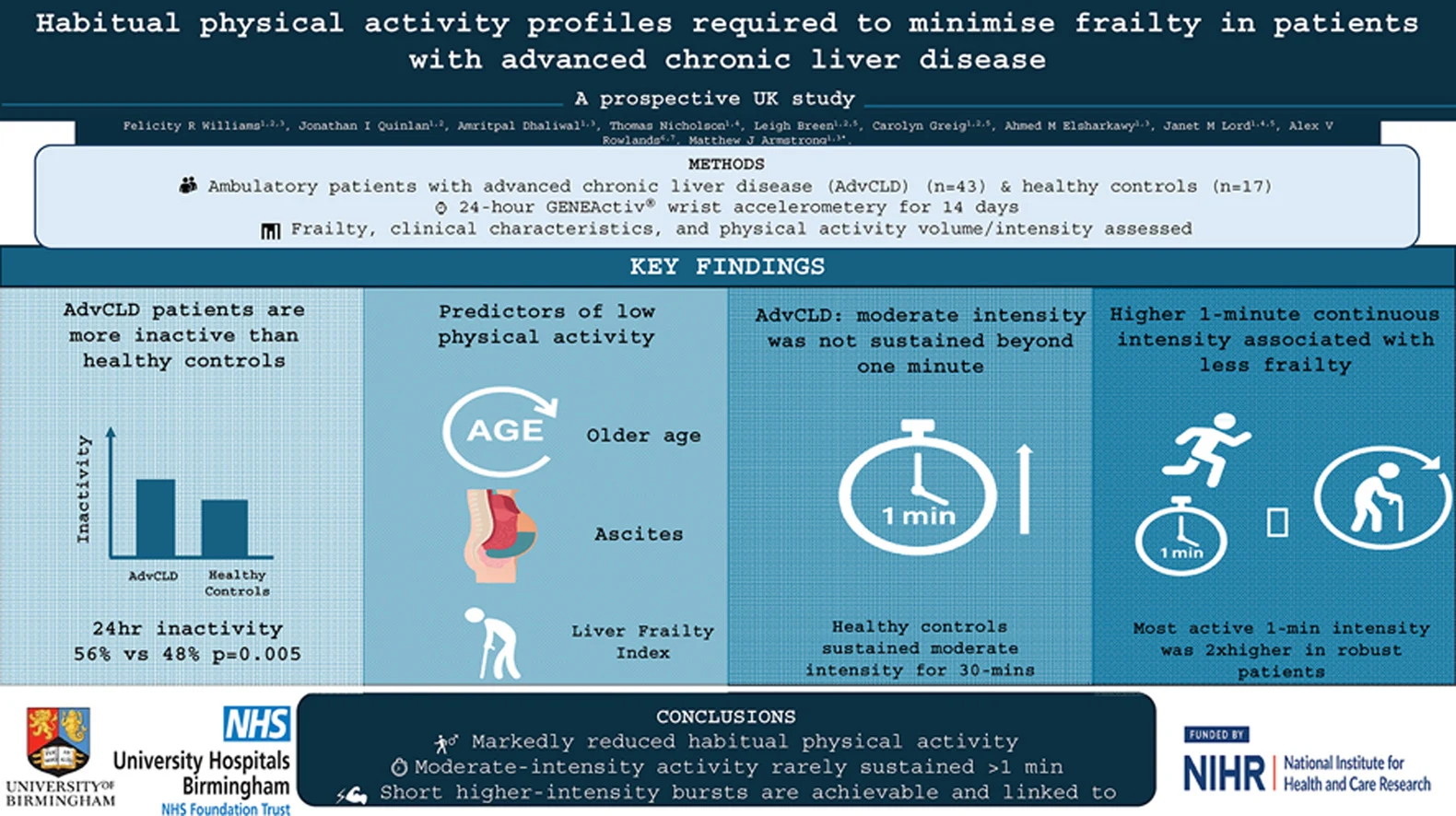
BACKGROUND AND AIMS: Physical frailty is associated with adverse outcomes in advanced chronic liver disease (AdvCLD). Tailoring physical activity prescriptions to minimise frailty is challenging because the volume and intensity of habitual activity remain undefined in AdvCLD. This prospective study aimed to (a) compare device-assessed 24-hour activity profiles in AdvCLD and healthy controls, (b) identify predictors of poor activity and associated frailty, and (c) determine the physical activity profiles required to minimise frailty in AdvCLD. METHODS: Ambulatory patients with AdvCLD (Birmingham, UK) and healthy controls wore 24-hour GENEActiv® wrist accelerometers for 14-days. Clinical characteristics, frailty and physical activity outcomes (i.e. volume and intensity of most active accumulated/continuous time-periods) were collected. RESULTS: Forty-three AdvCLD patients (65% male, median age 56, UKELD 52; 53% ArLD) and 17 healthy age/sex-matched controls (59% male, median age 47) were recruited. AdvCLD patients spent more time inactive (56% vs 48%, p=0.005), less in moderate activity (3% vs 7%, p<0.0001), moved less intensively during their most active minute (313.4 mg vs 691.9 mg, p<0.001), and didn't sustain moderate activity (∼slow walking) beyond one minute (30-times less than health controls). Even 'robust' patients with AdvCLD (23%) didn't sustain moderate continuous activity beyond two minutes. ArLD patients were the least active (volume 13.4[4.6] vs 29.2[8.9] mg, p<0.01). Exploratory analysis revealed older age, refractory ascites and Liver Frailty Index were associated with lower levels of physical activity (all p<0.05). CONCLUSION: Ambulatory patients with AdvCLD, especially ArLD, have drastically reduced volumes of habitual physical activity and didn't sustain moderate intensity beyond one-minute. Short bursts of higher-intensity activity are realistic physical activity goals and are associated with less frailty in AdvCLD. IMPACT AND IMPLICATIONS: Physical frailty is prevalent and associated with adverse outcomes in patients with advanced chronic liver disease (AdvCLD). Inactivity drives physical frailty, yet prescribing effective physical activity interventions remains challenging due to unclear volume and intensity parameters. Utilising high resolution, wrist-worn accelerometers and robust frailty measures we show that ambulatory patients with AdvCLD, especially those with alcohol-related liver disease (ArLD), have markedly lower volumes of habitual physical activity and did not sustain more than one minute of moderate intensity activity, (30-fold less than age/sex matched healthy controls). Additionally, in exploratory analysis, the liver frailty index (LFI) predicted activity volume and intensity, supporting its utility as a practical tool to guide physical activity prescription. Refractory ascites, higher frailty indices (e.g. LFI) and of older age were key determinants of low levels of physical activity in our study. Physical activity interventions in AdvCLD should consider short bursts of higher intensity activity rather than relying on prolonged moderate intensity activity targets, which may be unrealistic for the majority of this population. Tailored intensity-focused prescriptions, guided by frailty assessment, which prioritise older patients, those with refractory ascites, and higher LFIs may offer a pragmatic strategy to physical activity interventions in AdvCLD. CLINICAL TRIALS NUMBER: ClinicalTrials.gov Identifier: NCT04734496.
The paper
University of Birmingham; Queen Elizabeth University Hospital Birmingham
JHEP Reports, 16 Oct 2026


