Association of Korean Healthy Eating Index with Phase Angle and Extracellular Water-to-Total Body Water Ratio: Findings from a Nationally Representative Study
Abstract
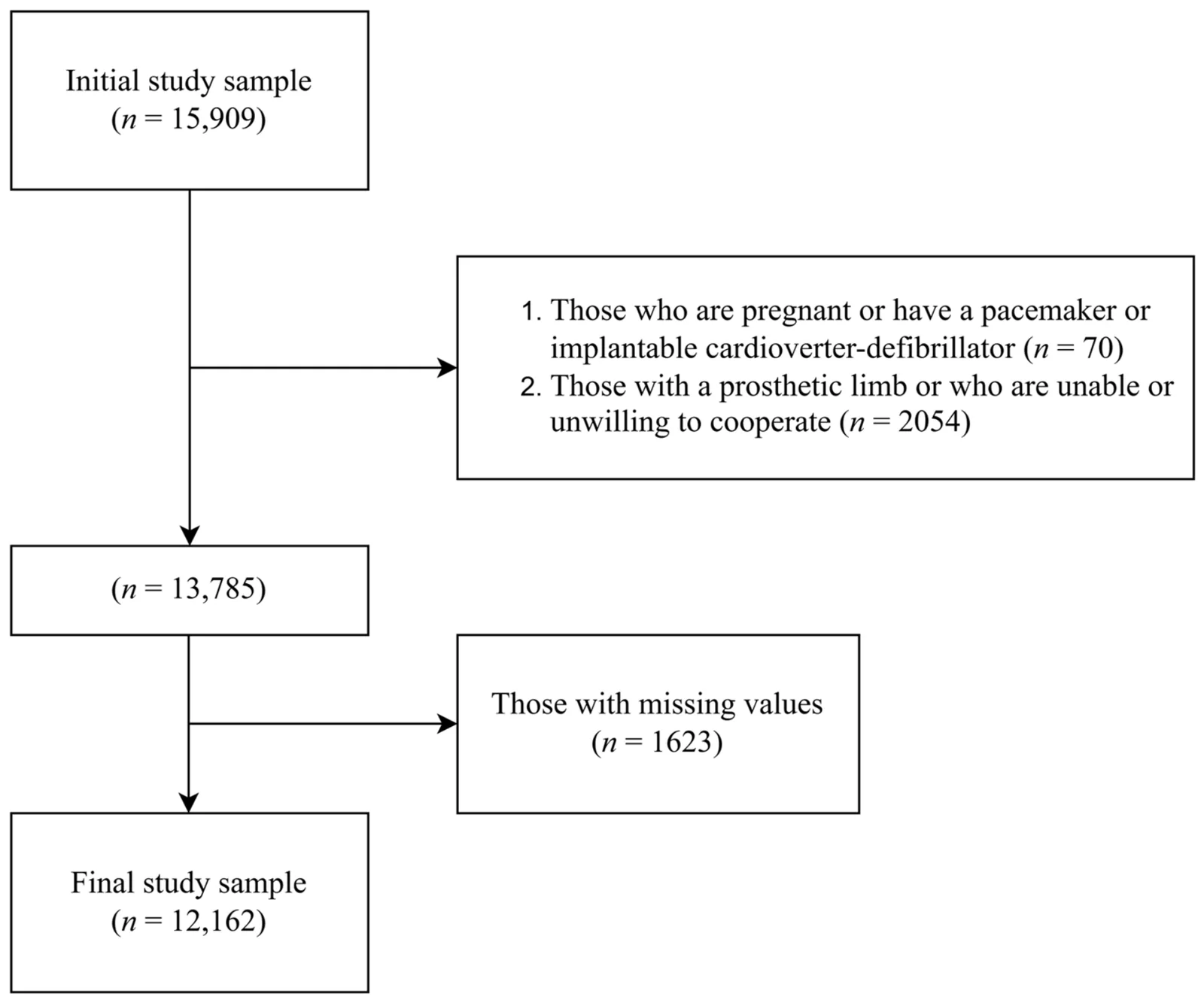
Background: Phase angle and the extracellular water-to-total body water (ECW/TBW) ratio, derived from bioelectrical impedance analysis, have attracted interest as biomarkers. This cross-sectional study analyzed the associations of dietary quality with phase angle and the ECW/TBW ratio. Methods: This study used a nationally representative sample of 12,162 adults from the Republic of Korea. Dietary quality was assessed using the Korean Healthy Eating Index (KHEI; range: 0-100), with higher scores indicating better dietary quality, and categorized into quartiles. Phase angle (°) and the ECW/TBW ratio (%) were measured using a bioelectrical impedance analyzer. Linear regression models were used to analyze associations between the KHEI and phase angle and the ECW/TBW ratio, with results reported as beta coefficients and 95% confidence intervals (CIs). Results: The mean (standard deviation) phase angle and ECW/TBW ratio were 5.37 (0.80)° and 38.19 (0.79)%, respectively. In the fully adjusted model, higher KHEI scores were associated with higher phase angle, with β (95% CI) values of 0.04 (0.01, 0.07), 0.06 (0.02, 0.09), and 0.08 (0.04, 0.11) for Q2, Q3, and Q4, respectively. Additionally, higher KHEI scores were associated with a lower ECW/TBW ratio, with β (95% CI) values of -0.03 (-0.07, -0.00), -0.06 (-0.09, -0.02), and -0.07 (-0.10, -0.03) for Q2, Q3, and Q4, respectively. Conclusions: Our findings showed that dietary quality was positively associated with phase angle and negatively associated with the ECW/TBW ratio. However, longitudinal studies are needed to confirm temporal relationships.