Prospectively collected functional vs. self-reported frailty measures and postoperative outcomes after radical cystectomy in older adults with bladder cancer
Abstract
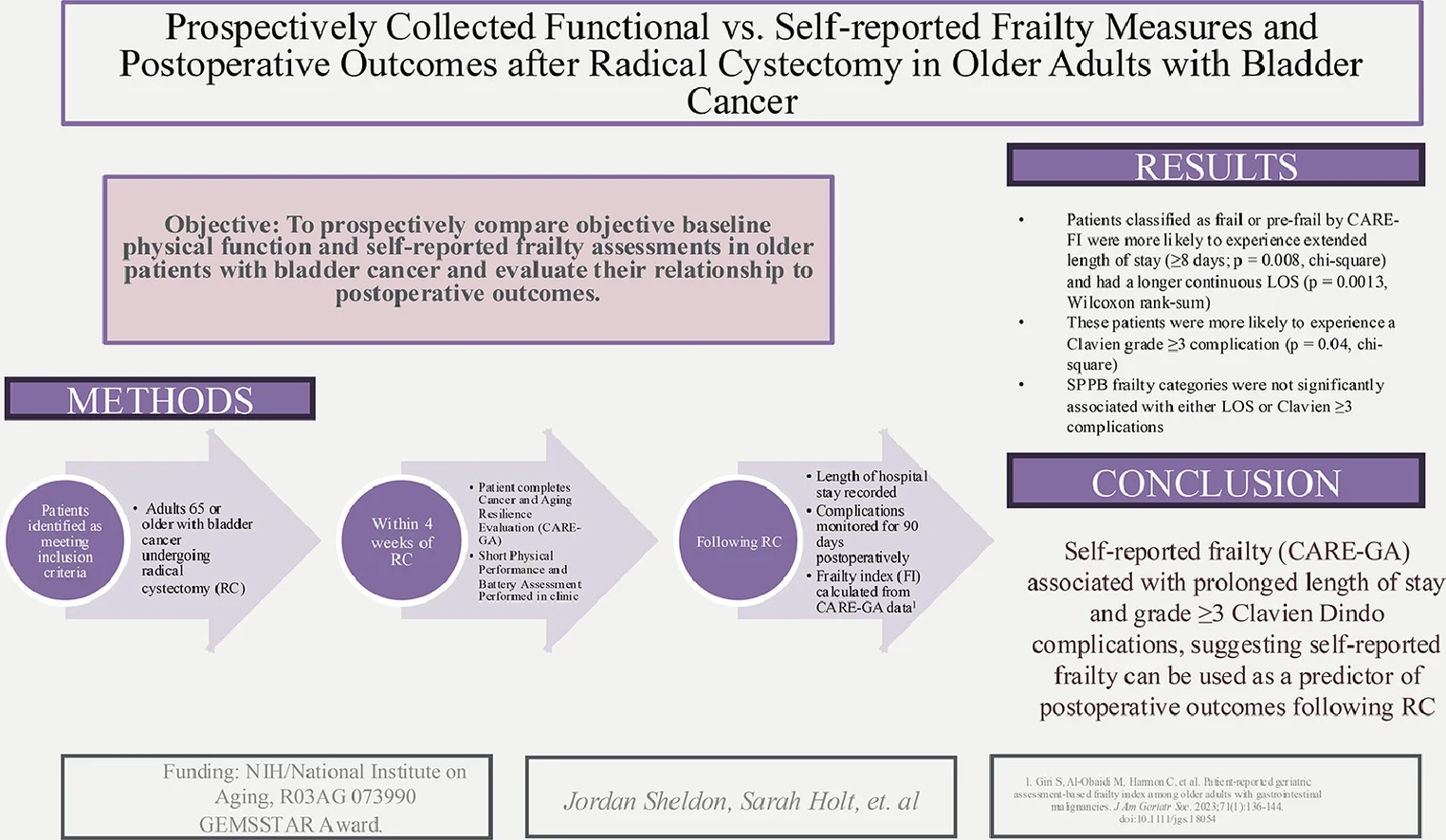
INTRODUCTION AND OBJECTIVES: The optimal tools to measure frailty in patients with bladder cancer are poorly defined. Our objective was to compare baseline physical function with self-reported frailty assessments, and to evaluate associations between functional vs. self-reported frailty assessments and postoperative outcomes. METHODS: Adults ≥65 years old with bladder cancer anticipating radical cystectomy (RC) were preoperatively assessed with the Short Physical Performance and Battery Assessment (SPPB): a physical assessment evaluating balance, gait speed, and lower extremity strength; and the Care and Aging Resilience Evaluation-Geriatric Assessment: a self-reported form which generates a validated frailty index (CARE-FI). Associations between the two frailty measures, postoperative length of stay (LOS), and 90-day grade ≥3 Clavien Dindo complications were assessed. RESULTS: About 53 participants were analyzed. Overall, 3/53 were frail per the CARE-FI, while 1/53 demonstrated poor performance per SPPB criteria. CARE-FI and SPPB frailty categories were strongly associated on an ordinal scale (Kendall's τ-b = 0.88, P = 0.02), agreement between categorical classifications was limited (weighted κ = 0.02). Patients classified as frail or pre-frail by CARE-FI were more likely to experience extended length of stay (≥7 days; P = 0.008, chi-square) and had a longer continuous LOS (P = 0.0013, Wilcoxon rank-sum) and were also more likely to experience a grade ≥3 complication (P = 0.04, chi-square). The SPPB was not significantly associated with either variable per chi squared analysis (P > 0.05 for both). CONCLUSIONS: Functional and self-reported frailty assessments provide different information characterizing individual vulnerability profiles; however, only the CARE-FI was statistically associated with increased LOS and postoperative complications following RC.
The paper
University of Washington School of Medicine
Urologic Oncology, 16 Oct 2026