Japanese-style dietary patterns, mortality, and selected cancer outcomes in Japanese populations: a systematic review integrating meta-analysis, food-group loading visualization, and qualitative synthesis
Abstract
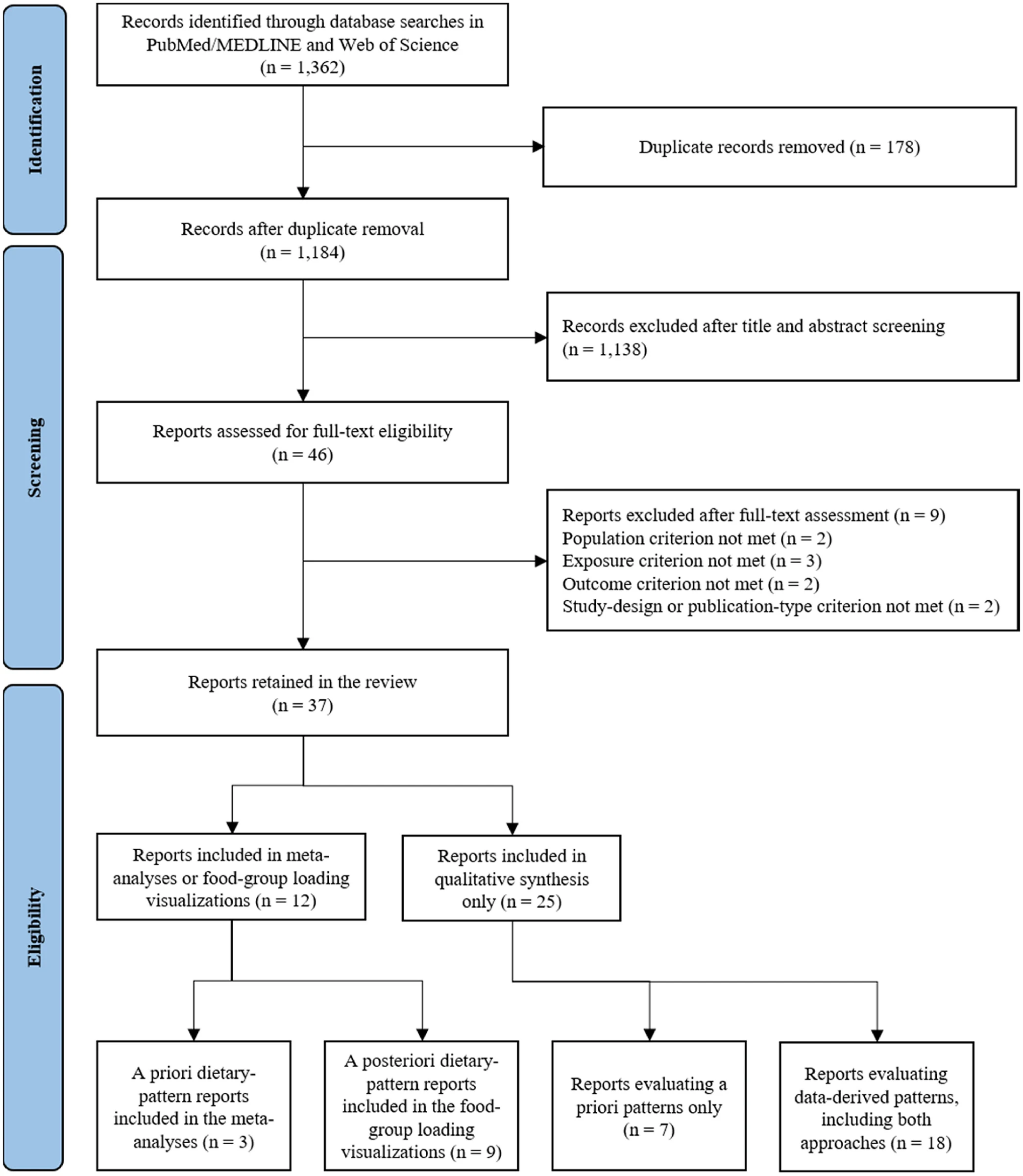
Japanese-style dietary patterns (DPs) are often regarded as healthy, but the food-group combinations needed to develop health-oriented Japanese-style DPs remain unclear. This systematic review synthesized associations between predefined (a priori) Japanese-style DPs and health outcomes in Japanese populations and used data-derived (a posteriori) DPs to examine outcome-specific heterogeneity in food-group composition and loadings. PubMed/MEDLINE and Web of Science Core Collection were searched for observational studies. Random-effects meta-analyses were conducted for comparable a priori Japanese-style DPs using adjusted hazard ratios (HRs) comparing the highest and lowest score categories. A posteriori DPs derived by principal component analysis or factor analysis were visualized using reported estimates, investigator-assigned pattern names, relative similarity to the Japanese Diet Index-9 (JDI-9) reference profile, and food-group loadings. Of 37 reports retained in the review, 12 longitudinal reports contributed to meta-analyses or food-group loading visualizations, and 25 were synthesized qualitatively. Across 3 independent studies contributing 5 analytic estimates per outcome, pooled HRs comparing the highest and lowest score categories suggested lower all-cause mortality (HR: 0.88; 95% CI: 0.83, 0.93; I² = 61.1%) and cardiovascular disease (CVD) mortality (HR: 0.82; 95% CI: 0.73, 0.93; I² = 71.6%), although heterogeneity was substantial; the pooled estimate for total cancer mortality was close to the null. Among 43 a posteriori DPs from 9 studies, 21 were classified as JDI-9-like; however, this relative classification alone did not consistently distinguish reported associations across outcomes; interpretation required examination of the reported component-level food-group loadings. These findings motivate a provisional three-layer framework distinguishing potentially favorable traditional components, high-sodium traditional components, and contemporary dietary components; the framework is hypothesis-generating and requires outcome-specific validation.
The paper
International University of Health and Welfare
Advances in Nutrition, 15 Oct 2026


