Phenotype, treatment, and determinants of prognosis in Erdheim-Chester disease: an international, retrospective, cohort study
Multicentre
Abstract
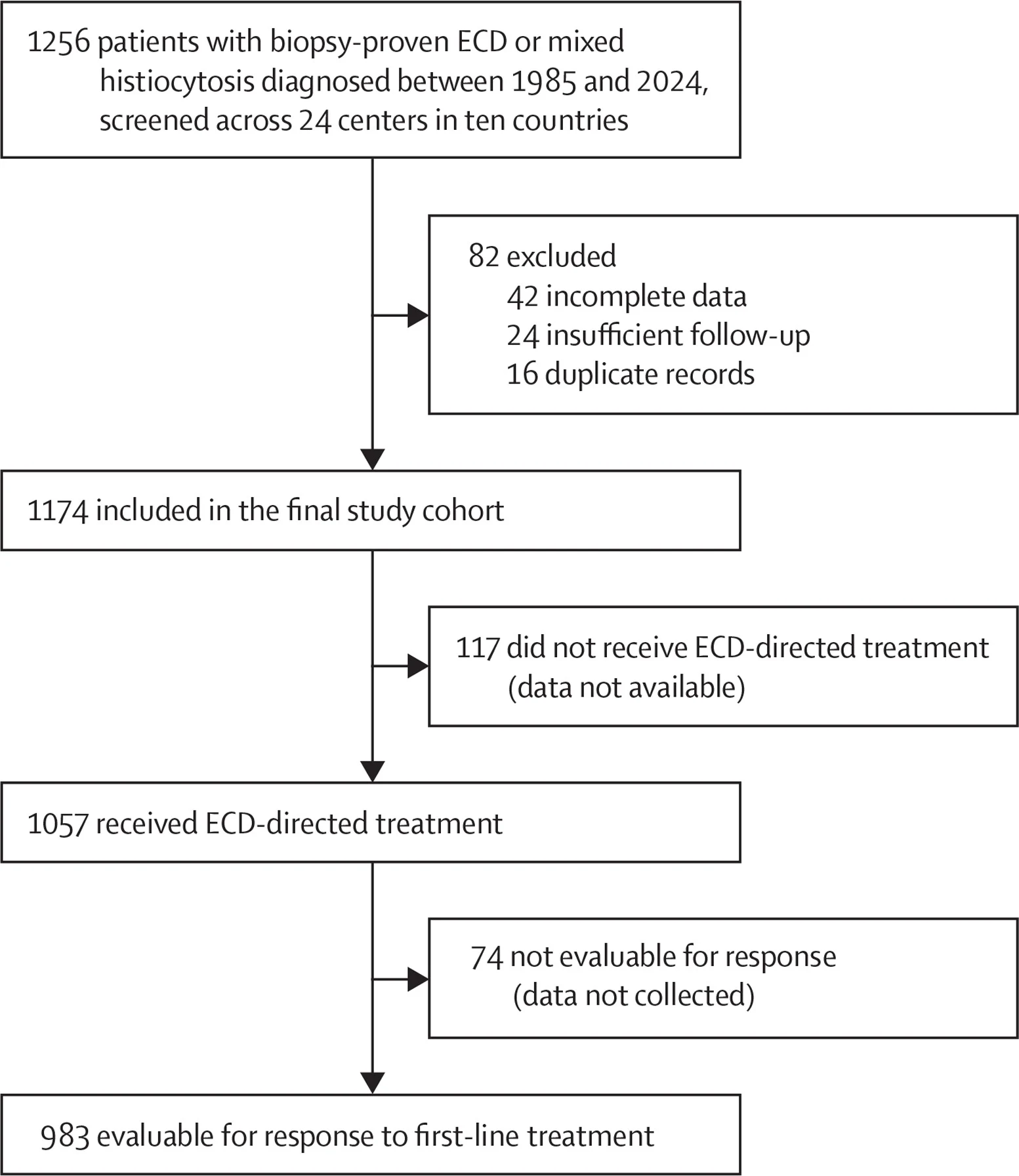
BACKGROUND: Erdheim-Chester disease is a rare histiocytosis driven by MAPK pathway gene mutations. Its clinical presentation is heterogeneous, and there is a shortage of data on natural history and prognosis. We aimed to characterise clinical presentation, associated conditions, treatments, outcomes, and determinants of prognosis in a large international Erdheim-Chester disease cohort. METHODS: We conducted an international, retrospective, cohort study of patients with biopsy-proven Erdheim-Chester disease diagnosed between Jan 1, 1985, and Dec 31, 2024. Data were collected in ten countries by participating investigators from referral centre records using standardised criteria, and were collected by participating investigators from referral centre records using standardised criteria. Patients with available data on treatment and outcome, and a minimum follow-up duration of 6 months, without excluding those who died before month 6, were included. Outcomes were response to treatment and overall survival. Mortality predictors were assessed using multivariable Cox proportional hazards regression. FINDINGS: From Jan 1 to Dec 31, 2025, we included 1174 patients (males 801 [68%], females 373 [32%]), whose median age at diagnosis was 58 (IQR 47-67) years. Multisystem disease (at least four organs) was present in 724 (62%) of 1174 patients, the most frequently affected sites being long bones (940 [80%] patients), retroperitoneum (742 [63%] patients), large vessels (540 [46%] patients), central nervous system (446 [38%] patients), and heart (412 [35%] patients). 643 (62%) of 1043 tested patients were BRAFV600E mutated, and 250 (36%) of 690 patients had clonal haematopoiesis. Overlap with other histiocytoses occurred in 161 (14%) of 1174 patients, whereas 321 (27%) patients had second cancer. First-line therapies most commonly included interferon-α (362 [34%] of 1057 patients) or targeted therapies (BRAF/MEK inhibitors 350 [33%] patients), with targeted therapies achieving the highest objective response rates (286 [74%] of 387 patients for BRAF inhibitors, and 185 [71%] of 262 patients for MEK inhibitors). After a median of 49 months (IQR 20-91), 261 (22%) patients died. Multivariable analysis identified older age (p<0·0001), neurodegeneration (HR 4·2, 95% CI 2·4-7·1; p<0·0001), high C-reactive protein (3·8, 1·6-9·1; p=0·0022), second haematological cancer (3·0, 1·5-6·0; p=0·0023), and no response to treatment (2·8, 1·6-5·1; p=0·0006) as independent predictors of mortality. INTERPRETATION: In a large Erdheim-Chester disease cohort spanning multiple eras, mortality remains substantial. These findings support early identification of patients with high-risk features and development of risk-adapted follow-up and treatment strategies. FUNDING: None.
The paper
University of Florence; Sorbonne University
The Lancet Haematology, 15 Oct 2026