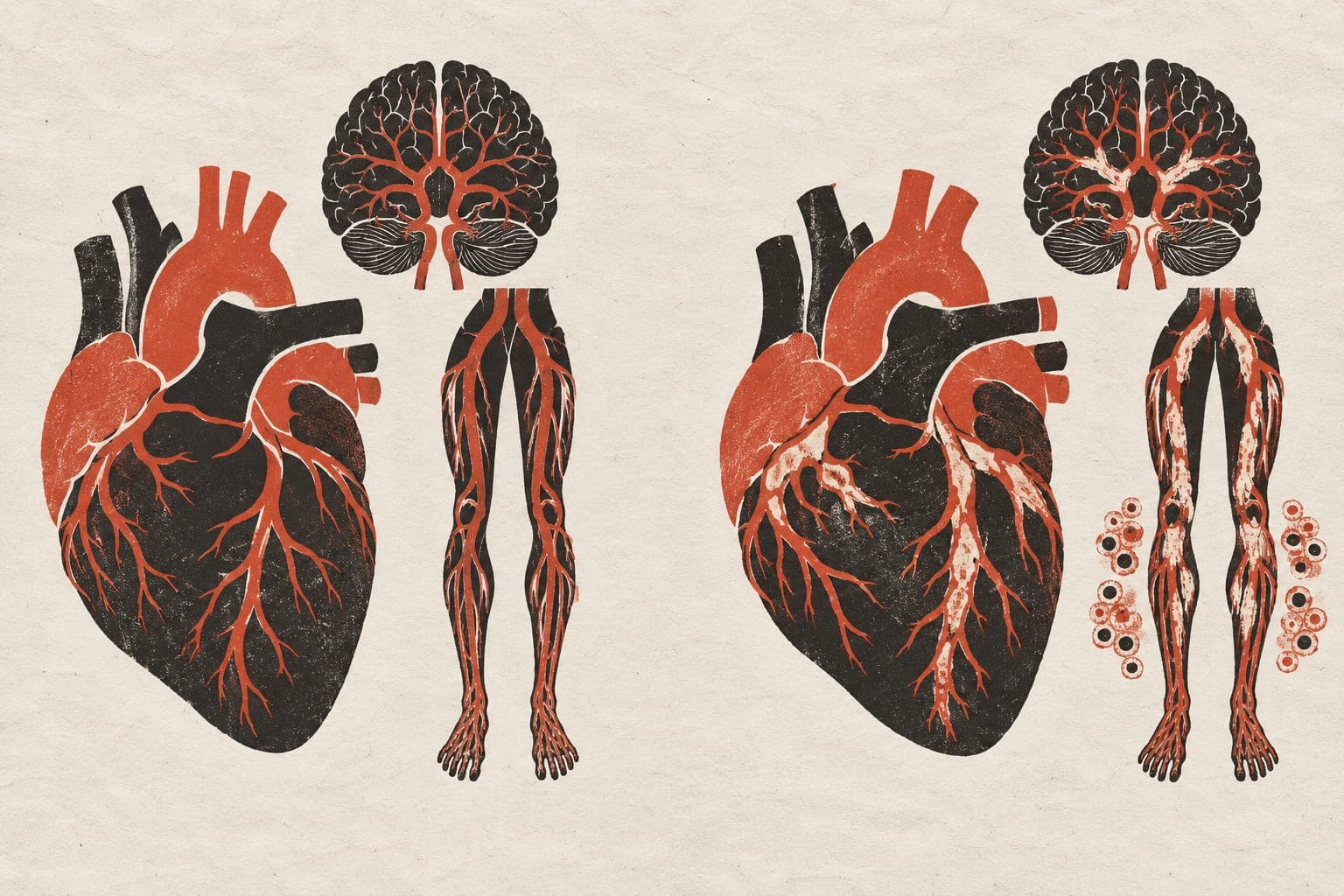
Modifiable Lifestyle Risk Factors for Lower Extremity Arteriosclerosis Obliterans in a High-Risk Population: A Retrospective Case-Control Study
2 years
Abstract
OBJECTIVE: To identify specific modifiable lifestyle risk factors associated with lower extremity arteriosclerosis obliterans (LEASO) in a high-risk screening population to guide targeted primary prevention. METHODS: This retrospective case-control study enrolled 300 individuals at high risk for LEASO from a tertiary hospital in Shanxi Province, China. Baseline lifestyle habits were assessed using the Lifestyle and Lower Extremity Vascular Health Questionnaire, and participants were followed for 2 years. Multivariate logistic regression was used to analyze the relationship between lifestyle habits and LEASO incidence. RESULTS: Multivariate logistic regression identified smoking (OR = 2.289, 95% CI: 1.254-4.178), high-salt diet (OR = 2.040, 95% CI: 1.334-3.120), high-fat diet (OR = 1.988, 95% CI: 1.232-3.239), high-cholesterol diet (OR = 1.571, 95% CI: 1.131-2.183), staying up late (OR = 1.826, 95% CI: 1.119-2.980), and prolonged sitting (OR = 2.259, 95% CI: 1.034-4.937) as significant independent risk factors (all P < 0.05). CONCLUSION: In high-risk populations, specific lifestyle factors-particularly smoking, prolonged sitting, and poor dietary habits-are strongly associated with LEASO. These findings highlight the critical need for behavior-targeted community interventions to mitigate peripheral vascular disease progression.
From the paper
- Participants
Among the 300 enrolled high-risk individuals, 32 were diagnosed with lower extremity arteriosclerosis obliterans (LEASO) (arteriography revealed an ankle-brachial index [ABI] of 0.644±0.11), yielding an incidence rate of 10.67% (32/300).
- Follow-up
Considering the potential loss to follow-up or invalid questionnaires during the 2-year follow-up period, a total of 300 participants were ultimately enrolled in this study, which is statistically justified.
- Limitation
We fully acknowledge that as a single-center retrospective case-control analysis, the overall generalizability and causal credibility of our findings are inherently limited by the specific regional sample.
Quoted word for word from the full text on dovepress.com.
- High-cholesterol diet
- High-fat diet
- High-salt diet
- Lower extremity arteriosclerosis obliterans
- Lifestyle and Lower Extremity Vascular Health Questionnaire
- Humans
The paper
Shanxi Academy of Medical Sciences
Risk Management and Healthcare Policy, 10 Oct 2026, Open access