Deep learning-based quantification of muscle volume and attenuation and their associations with preinjury ambulatory status in patients with hip fractures
Abstract
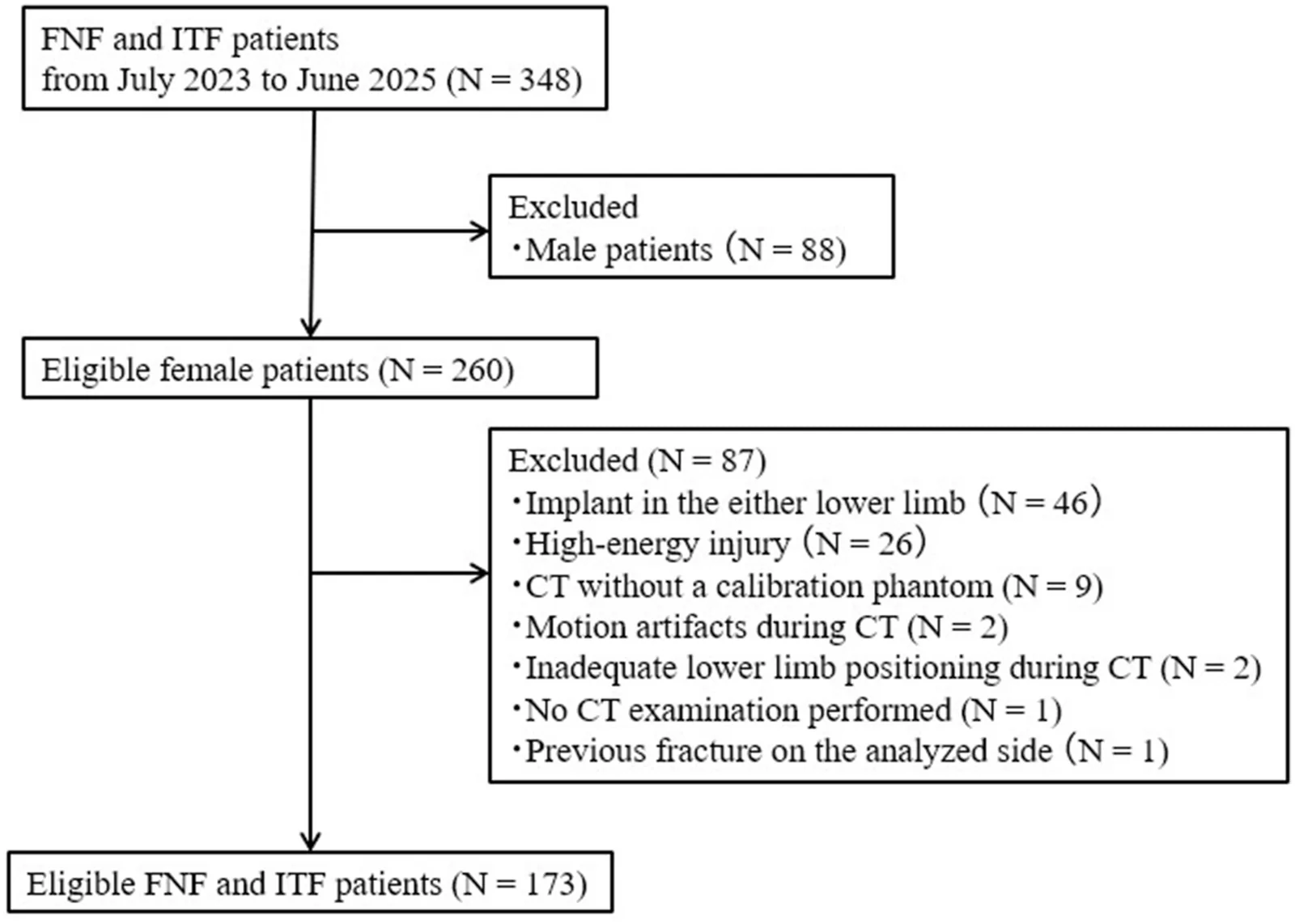
OBJECTIVES: Use a deep learning model on computerized tomography images to explore how muscle volume and attenuation relate to preinjury ambulatory levels in patients with intertrochanteric or femoral neck fractures. METHODS: This retrospective study involved 170 female patients with intertrochanteric or femoral neck fractures who had preoperative hip computed tomography (CT) scans. Using a deep learning-based model, muscles on the unfractured side were automatically segmented, and the muscle volume and attenuation were measured for four groups: gluteal muscles, hip adductors, quadriceps, and hamstrings. Preinjury walking ability was categorized into three groups based on the Koval index: Group 1 (Koval index 1-3; walking outdoors), Group 2 (Koval index 4-6; walking indoors), and Group 3 (Koval index 7; chairbound or bedridden). Finally, associations between preinjury ambulatory status and muscle parameters, patients' age, body mass index (BMI), hip bone mineral density, geriatric nutritional risk index, and Charlson comorbidity index (CCI) were analyzed using ordinal logistic regression models. RESULTS: Ambulatory status was associated with muscle attenuation, CCI, and BMI across all four muscle groups. Other factors did not reach statistical significance. Patients with poorer ambulatory function had lower muscle attenuation, higher CCI, and lower BMI. CONCLUSIONS: Muscle attenuation on CT images correlated with preinjury ambulatory status, whereas muscle volume did not. This indicates that evaluating muscle quality via CT may more accurately reflect functional decline in older adults than assessing muscle quantity alone.
The paper
Osaka University Hospital; The University of Osaka
Osteoporosis and Sarcopenia, 29 May 2026, Open access