Determinants of self-reported sustained breast cancer screening among women in Shenzhen, China: a study based on the health belief model
Abstract
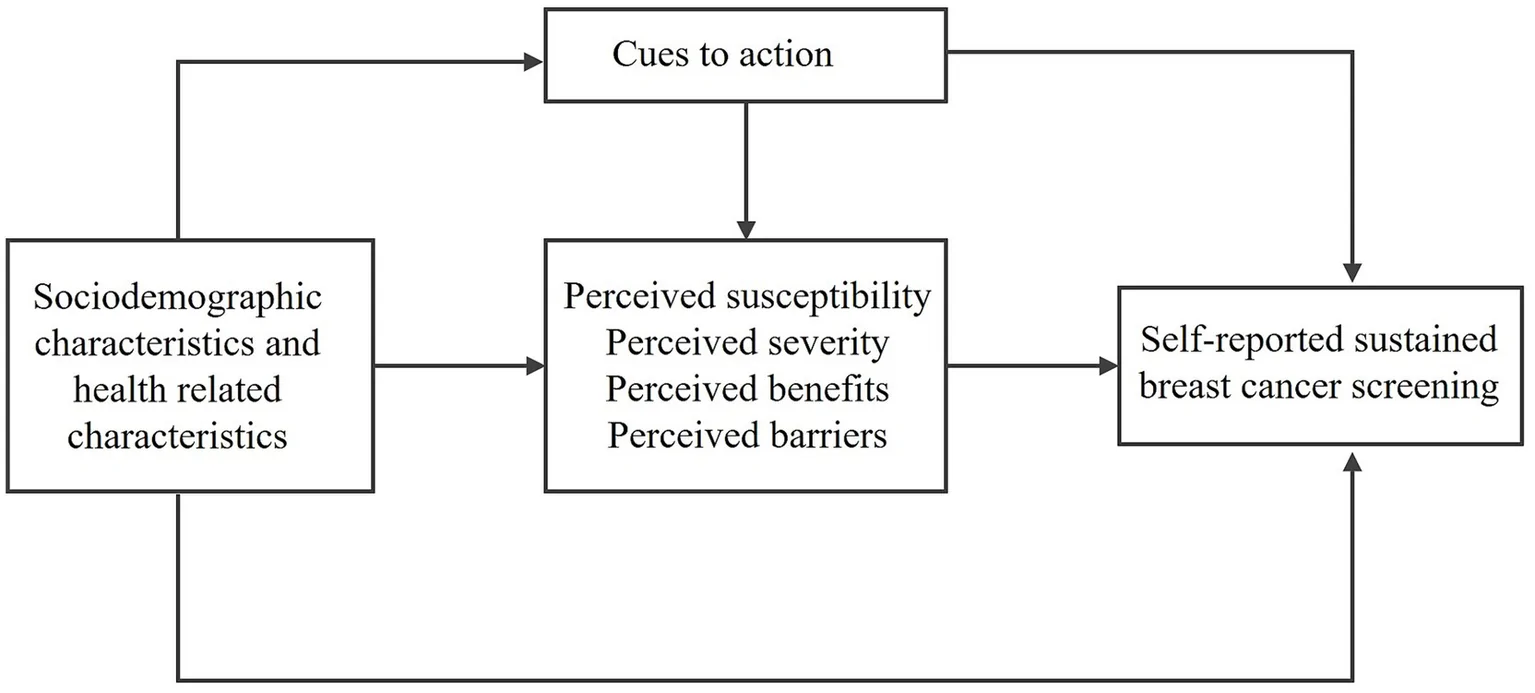
BACKGROUND: Breast cancer is the most commonly diagnosed cancer among women worldwide. In Shenzhen, breast cancer screening is available through both a government-funded free program and a range of out-of-pocket or employer-sponsored options; however, evidence on factors associated with sustained screening remains limited. This study aimed to examine the direct and indirect associations of sociodemographic and health-related characteristics and health belief model (HBM) constructs with self-reported sustained breast cancer screening among women in Shenzhen, China. METHODS: A cross-sectional survey was conducted in Shenzhen, China, from November to December 2024, using multi-stage cluster sampling. Data on sociodemographic characteristics, health-related factors, and HBM constructs (five-point Likert scale) were collected. A structural equation model (SEM) was constructed to examine direct and indirect pathways linking sociodemographic characteristics, health-related factors, and HBM constructs to self-reported sustained breast cancer screening. Model fit was assessed using chi-square statistic divided by degrees of freedom (χ²/df), comparative fit index (CFI), Tucker-Lewis index (TLI), root mean square error of approximation (RMSEA), and standardized root mean square residual (SRMR). RESULTS: A total of 1,665 women were analyzed; 70.2% (1,169/1,665) had self-reported sustained breast cancer screening. The SEM showed good fit ( χ 2 / df =3.635; CFI = 0.960; TLI = 0.924; RMSEA = 0.040, SRMR = 0.022). Among the six HBM constructs, cues to action (β standardized = 0.106, p = 0.013) were positively associated with self-reported sustained breast cancer screening, whereas perceived barriers (β standardized = -0.165, p < 0.001) were negatively associated with this outcome. Additionally, age (β standardized = -0.010, p = 0.029), educational level (β standardized = 0.020, p < 0.001), average monthly income per household (β standardized = 0.016, p = 0.002), and history of breast diseases (β standardized = 0.011, p = 0.011) were indirectly associated with self-reported sustained breast cancer screening through perceived barriers. Moreover, history of breast diseases (β standardized = 0.013, p = 0.028) was additionally indirectly associated with self-reported sustained breast cancer screening through cues to action. Furthermore, age (β standardized = -0.003, p = 0.045), marital status (β standardized = 0.003, p = 0.019) and history of breast diseases (β standardized = 0.005, p < 0.001) were indirectly associated with self-reported sustained breast cancer screening through the sequential pathway involving cues to action and perceived barriers. CONCLUSION: Cues to action and perceived barriers were key factors associated with self-reported sustained breast cancer screening. Targeted interventions that strengthen cues to action and reduce perceived barriers may help promote sustained breast cancer screening.
From the paper
- Participants
A total of 1,665 participants were included in this study, of whom 70.2% (1169) self-reported sustained breast cancer screening.
Results, 3.1 Characteristics of participants and univariate analysis
Quoted word for word from the full text on frontiersin.org.
The paper
Shenzhen Maternity and Child Healthcare Hospital
Frontiers in Public Health, 30 Sep 2026, Open access