Association of eGFR Discrepancy With Subsequent Frailty in Middle-Aged and Older Adults
Abstract
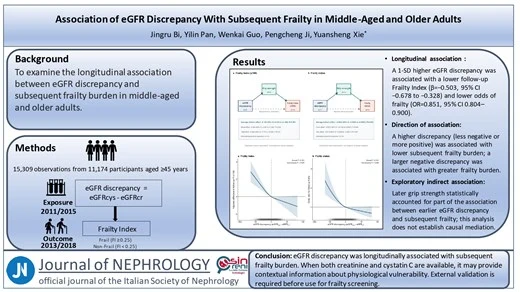
BACKGROUND: Creatinine- and cystatin C-based estimated glomerular filtration rate estimates are influenced by different non-GFR determinants. Their difference (eGFRcys-eGFRcr) may therefore provide information beyond either marker alone. We examined its longitudinal association with frailty and exploratory indirect associations through grip strength. METHODS: We analyzed 15,309 observations from 11,174 China Health and Retirement Longitudinal Study participants aged 45 years or older across 2011-2013 and 2015-2018. Standardized eGFR discrepancy was the exposure; follow-up outcomes were the 32-item Frailty Index and frailty (Frailty Index ≥0.25). Linear mixed models and generalized estimating equations accounted for repeated observations. Model 3 was primary; eGFRcys adjustment was a conditional sensitivity analysis. RESULTS: Median age was 60.0 years, and 53.4% of participants were female. A 1-SD higher discrepancy was associated with a lower follow-up Frailty Index (β, -0.503; 95% CI, -0.678 to -0.328; P < 0.001) and lower odds of frailty (OR, 0.851; 95% CI, 0.804-0.900; P < 0.001). Associations persisted after eGFRcys adjustment. Exploratory three-wave analyses showed indirect associations through grip strength, not causal mediation. CONCLUSIONS: Higher eGFR discrepancy was longitudinally associated with lower subsequent frailty burden. Further studies are needed to clarify its clinical interpretation and underlying determinants.