Abnormal blood proteins were common in Black Soweto adults
Screening detected two forms of the condition in 12% and 3% of participants; prevalence was similar to or higher than in high-risk US groups.
Limit: Convenience sampling may leave community-site participants unrepresentative of Soweto adults
Stake: Authors founded Predicta Biosciences, hold shares in it and sit on its board. An author holds shares in Antares Therapeutics.
In a cross-sectional study, researchers screened 2,004 Black Africans aged 40–75 in Soweto, South Africa, at a single visit. They tested blood using mass spectrometry, a technique for identifying molecules. They looked for monoclonal gammopathy of undetermined significance (MGUS), a condition involving abnormal antibody proteins in the blood.
The heavy-chain form affected 12% of participants, and the light-chain form affected 3%. Heavy and light chains are the larger and smaller protein components of antibodies. MGUS prevalence was similar to or higher than in high-risk US groups screened by the same method. Human immunodeficiency virus infection and smoking were associated with higher odds of MGUS. High physical activity was associated with lower odds.
Why it matters
Screening for MGUS in midlife and later life raises questions about which groups to prioritise for early detection and risk assessment.
Caveats
The single-visit, cross-sectional design could not determine whether the associated factors caused MGUS or preceded it. The South African sample covered Black Africans aged 40–75 in Soweto, not other age groups or populations.
From the paper
- Participants
Non-Black individuals with a positive family history in the US (non-Black US with positive FH) comprised 3807 participants.
- Result
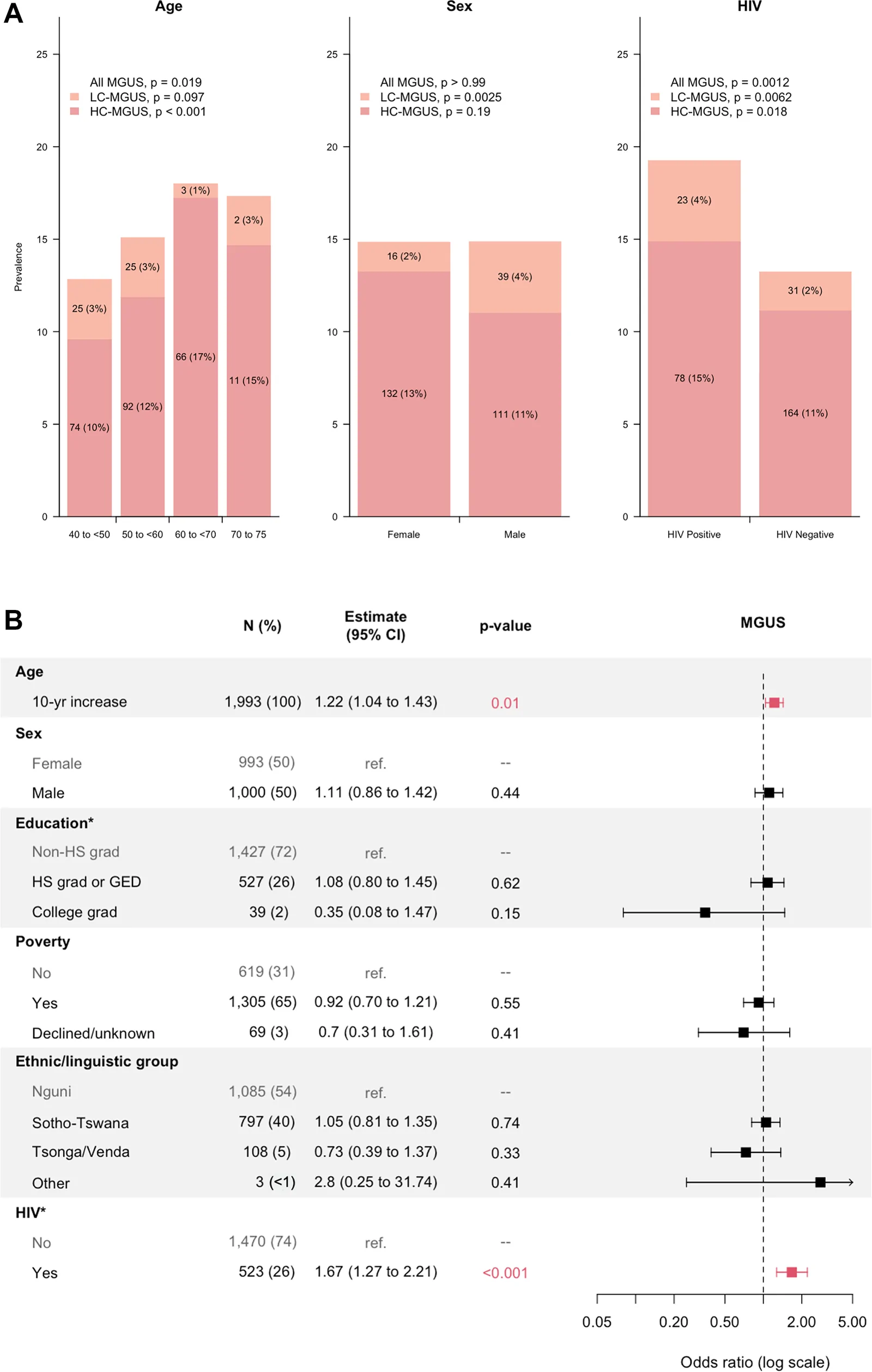
In a multivariable model mutually adjusted for sociodemographic variables (age, sex, education, poverty, ethnic/linguistic group) and HIV status among Black Africans, each 10-year increase in age was associated with 22% higher odds of MGUS (OR, 1.22; 95% CI, 1.04–1.43; p = 0.01) ( B).
- Limitation
The lack of harmonised exposure data (HIV, smoking, alcohol, physical activity) in a subset of the international comparison cohorts, particularly from MGBB, limit cross-population comparability of the observed associations.
Quoted word for word from the full text on PubMed Central.
- Smoking
- Physical activity
- Monoclonal gammopathy of undetermined significance
- Heavy-chain MGUS
- Light-chain MGUS
- Humans
The paper
Broad Institute; Harvard University
EClinicalMedicine, 2 Oct 2026, Open access