Association of preoperative frailty with health-related quality of life and urinary function after robot-assisted radical prostatectomy
Abstract
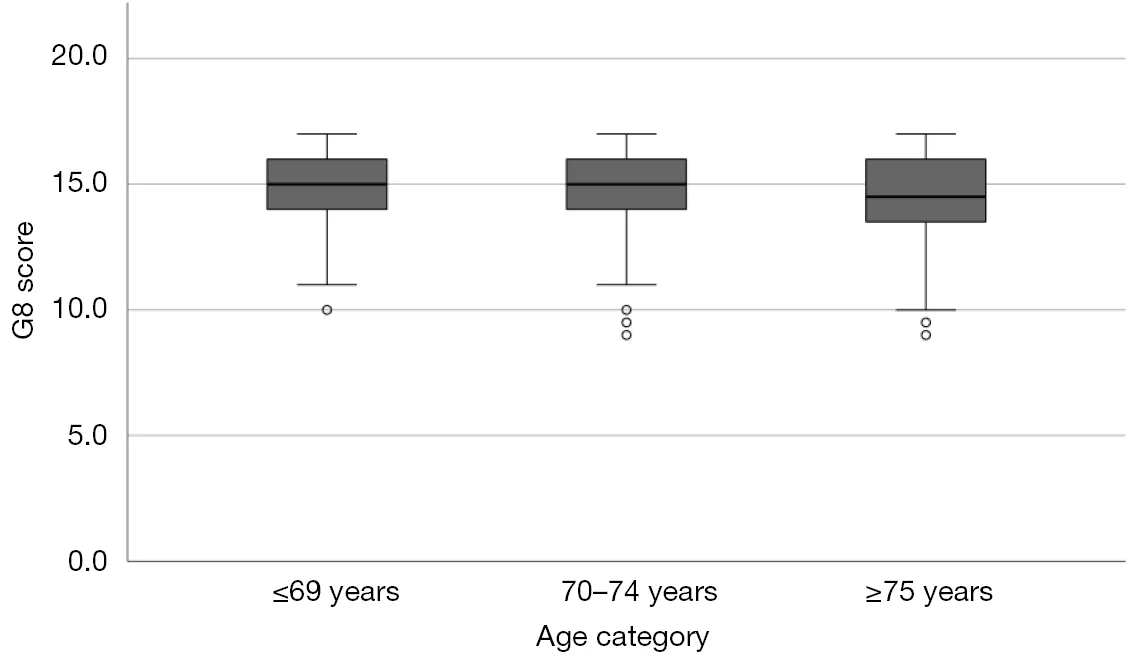
BACKGROUND: Frailty may influence outcomes after robot-assisted radical prostatectomy (RARP), but its association with longitudinal patient-reported outcomes remains unclear. This study aimed to examine the association of preoperative frailty, assessed using the Geriatric (G) 8 screening tool, with longitudinal health-related quality of life (HRQOL) and urinary status in patients who underwent RARP. METHODS: We retrospectively analyzed 328 patients who underwent RARP at a single institution. Patients were preoperatively classified into high, intermediate, and low G8 groups. HRQOL was assessed using the Functional Assessment of Cancer Therapy-General (FACT-G) and Functional Assessment of Cancer Therapy-Prostate (FACT-P) questionnaires. Urinary status was evaluated using the urinary incontinence subscale of the Expanded Prostate Cancer Index Composite (EPIC) and daily pad usage. RESULTS: Preoperative G8 scores demonstrated substantial overlap across age categories, suggesting that chronological age alone did not accurately reflect frailty status. Linear mixed-effects models showed a significant effect of time on FACT-G (P=0.004) and FACT-P (P<0.001), as well as significant main effects of G8 classification on both measures (both P<0.001); however, the time-by-G8 interaction was not significant for either FACT-G (P=0.42) or FACT-P (P=0.14). In models restricted to postoperative assessments and adjusted for baseline HRQOL and age, the time-by-G8 interactions remained nonsignificant, indicating no evidence of differential postoperative HRQOL trajectories among the G8 groups. Urinary status measured by EPIC significantly improved over time (P<0.001), and, after adjustment for baseline urinary status and age, no significant time-by-G8 interaction was observed (P=0.29). Kaplan-Meier analysis revealed no significant difference in time to urinary continence recovery across G8 groups (log-rank P=0.82). CONCLUSIONS: Lower preoperative G8 scores were associated with persistently lower HRQOL before and after RARP, without evidence of a significantly different longitudinal HRQOL trajectory. After accounting for baseline urinary status and age, there was no clear evidence of different postoperative urinary recovery trajectories among the G8 groups, and time to continence recovery did not significantly differ among groups. Frailty screening may provide clinically meaningful information for preoperative counseling and shared decision-making in patients undergoing RARP.
- Robot-assisted radical prostatectomy
- Urinary incontinence
- Daily pad usage
- Expanded Prostate Cancer Index Composite urinary incontinence subscale
- Functional Assessment of Cancer Therapy-General
- Humans
The paper
Kansai Medical University
Translational Andrology and Urology, 24 Sep 2026