Opportunistic computed tomography assessment of bone, muscle, and adipose tissue: evidence, limitations, and clinical translation
Abstract
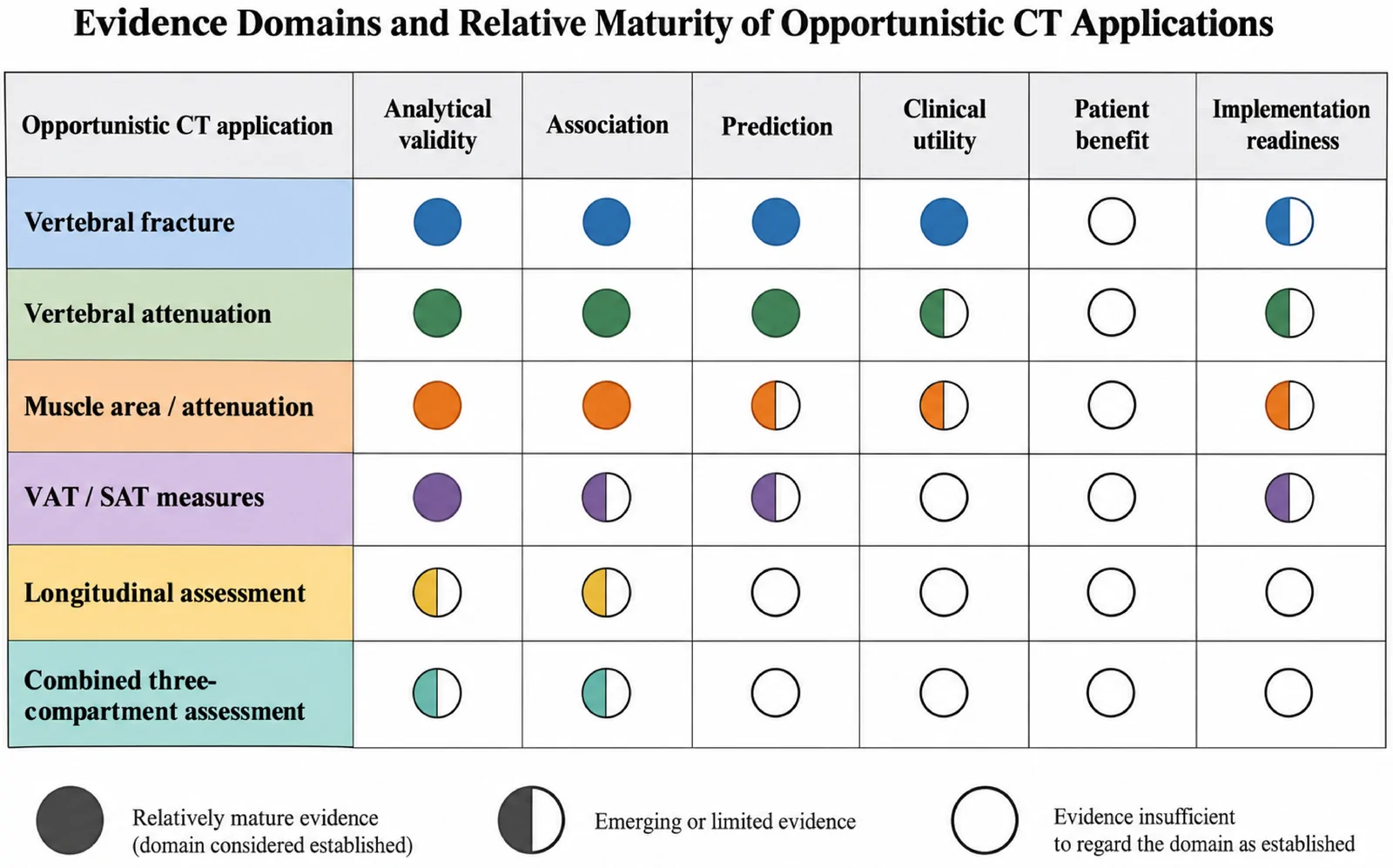
Routine body computed tomography (CT) contains quantitative information beyond the organ or disease for which the examination was requested. When technically suitable images have already been acquired, vertebral trabecular attenuation, vertebral fractures, skeletal muscle cross-sectional area and attenuation, and visceral and subcutaneous adipose tissue can be assessed without an additional scan or additional radiation exposure. This narrative review separates analytical validity, clinical association and prediction, clinical utility, demonstrated patient benefit, and implementation readiness. Vertebral fracture detection and protocol-specific vertebral attenuation currently have the most direct connection to established osteoporosis pathways, whereas muscle measures provide mainly disease-specific risk information and adipose, longitudinal, combined, and automated applications remain more heterogeneous. CT muscle area is a surrogate for muscle quantity rather than a direct measurement of muscle mass, and CT alone does not diagnose sarcopenia. Visceral adipose tissue area, subcutaneous adipose tissue area, the visceral-to-subcutaneous adipose tissue ratio, adipose attenuation, and longitudinal fat loss are distinct constructs and do not provide CT-only diagnoses of metabolic syndrome, malnutrition, cachexia, or sarcopenic obesity. Recent automated systems show strong technical performance, including external and prospective workflow evaluations, but evidence that routine automated reporting improves patient outcomes remains limited. Combined bone-muscle-adipose assessment is biologically plausible but should currently be regarded as hypothesis-generating unless incremental predictive or clinical value is demonstrated. Translation therefore requires protocol-aware measurement, repeatability assessment, visible quality control, explicit responsibility for verification and follow-up, and prospective evaluation of patient benefit, workload, equity, and cost-effectiveness.
- Opportunistic computed tomography
- Osteoporosis
- Sarcopenia
- Vertebral fracture
- Adipose attenuation
- Longitudinal fat loss
The paper
Shanghai Jiao Tong University; The Affiliated Taizhou People's Hospital of Nanjing Medical University
Frontiers in Medicine, 28 Sep 2026, Open access