Dietary melatonin and obesity incidence: a non-linear association in the Brazilian cohort (CUME+ Study)
Dose-response
Abstract
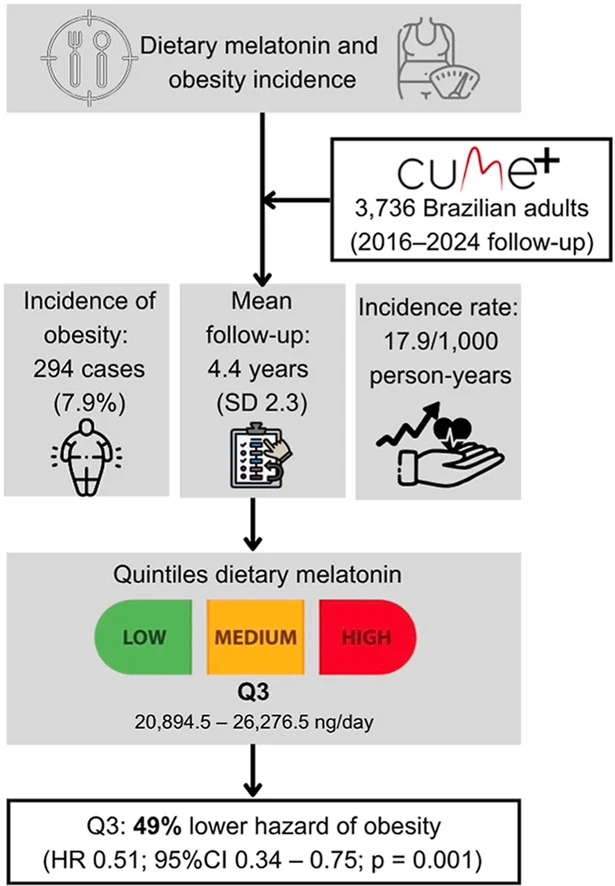
BACKGROUND AND AIMS: Obesity is a major global health challenge, with rising prevalence and complex etiology. Bioactive dietary components with antioxidant and anti-inflammatory properties may help prevent obesity. We examined the prospective association between dietary melatonin and obesity incidence in adults. METHODS AND RESULTS: This cohort study included 3736 participants followed for a mean of 4.4 years (2016-2024); dietary melatonin intake was estimated using a validated food frequency questionnaire. We defined obesity as body mass index (BMI) ≥30 kg/m². Associations were assessed using multivariable Cox models and restricted cubic spline analyses (3 knots). During follow-up, 294 participants (7.9%) developed obesity. Most were women (65.8%), with a mean age of 36.5 years and a mean BMI 24.5 kg/m². Obesity incidence ranged from 6.3% in Q3 to 10.0% in Q5 (p = 0.032). In the fully adjusted multivariable Cox model, compared with Q1, participants in Q3 (20,894.5-26,276.5 ng/day) had a 49% lower risk of incident obesity (HR 0.51; 95% CI 0.34-0.75; p = 0.001). Restricted cubic spline analysis (3 knots) confirmed a statistically significant non-linear association (p-overall = 0.0396; p-nonlinearity = 0.0186), demonstrating an intermediate protective window. CONCLUSION: Intermediate dietary melatonin intake was prospectively associated with a lower incidence of obesity, exhibiting a significant non-linear dose-response relationship. These findings suggest a potential protective window at moderate consumption levels, independent of smoking status and caffeine intake.
The paper
Universidade Federal de Viçosa
Nutrition, Metabolism, and Cardiovascular Diseases, 17 Sep 2026