Long-Term Determinants of Lean Mass in Ageing Adults: A 17-Year Longitudinal Cohort Study With Repeated Measures
Abstract
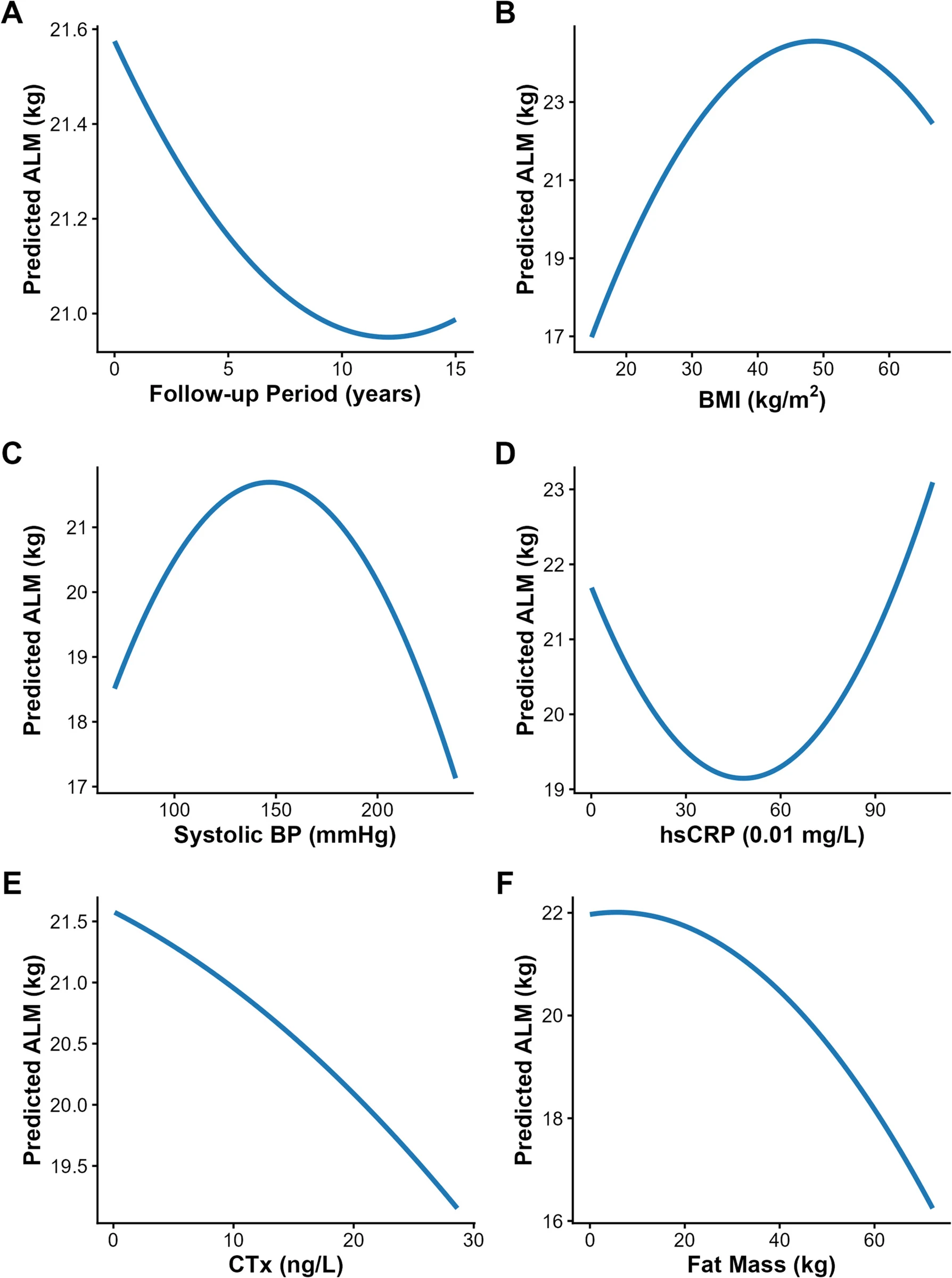
OBJECTIVE: Age-related loss of lean mass is a hallmark of sarcopenia and a contributor to functional decline and morbidity in ageing populations. This study aimed to identify long-term determinants of lean mass during ageing. METHODS: Data from 3033 participants (ages 20-96 years; 49% women) in the Geelong Osteoporosis Study were analysed using linear mixed effect models with random intercepts. Appendicular lean mass (ALM) was derived from arm and leg lean mass measured using dual-energy X-ray absorptiometry. Time-varying covariates were included; missing data were imputed using predictive mean matching. RESULTS: Over 16.7 years (IQR 9.7-23.2), women and older participants had lower ALM (β = -8.36; 95% CI -8.58, -8.15; β = -0.07; 95% CI -0.08, -0.06). Higher ALM was associated with socio-economic status (0.33; 0.14, 0.51), dietary calcium intake (0.46; 0.20, 0.67), femoral neck BMD (0.38; 0.29, 0.47) and thyroid hormone therapy (0.52; 0.04, 0.99). Physical inactivity (-0.48; -0.65, -0.31), smoking (-0.24; -0.46, -0.06) and stroke history (-0.51; -0.96, -0.07) were associated with lower ALM. Non-linear associations were observed for follow-up duration (fu: β = -0.16; fu²: β = 0.01; -p < 0.001), body mass index (BMI: β = 0.55; BMI²: β = -0.00; p < 0.001), systolic blood pressure (SBP: β = 0.06; SBP²: β = -0.00; p < 0.001), serum C-terminal telopeptide of type I collagen (CTx: β = 0.14, p < 0.001; CTx²: β = -0.01, p = 0.03) and high-sensitivity Creactive protein (hsCRP: β = -10.38; hsCRP²: β = 11.70; -p < 0.001). In fat-mass-adjusted models, low-density lipoprotein cholesterol (0.14; 0.04, 0.24) and triglycerides (0.22; 0.11, 0.33) were positively associated with ALM, whereas high-density lipoprotein cholesterol (-0.53; -0.81, -0.25) was inversely associated with ALM. CONCLUSIONS: Sociodemographic, lifestyle, anthropometric, clinical, biochemical and treatment-related factors show independent associations with longitudinal changes in ALM.
From the paper
- Participants
A total of 3033 individuals (n = 1494 women, n = 1539 men; median age 55.3 years) were assessed at baseline.
- Follow-up
The median follow-up duration was 16.7 years (IQR 9.7–23.2).
- Result
Over 16.7 years (IQR 9.7–23.2), women and older participants had lower ALM (β = −8.36; 95% CI –8.58, –8.15; β = −0.07; 95% CI –0.08, –0.06).
- Limitation
Selective attrition and survivorship may have affected late-phase trajectories; although sensitivity analyses showed consistent results, some bias cannot be excluded.
Quoted word for word from the full text on onlinelibrary.wiley.com.
The paper
Deakin University
Australasian Journal on Ageing, 12 Oct 2026