Physical activity, atrial fibrillation and the dose-response relationship: a systematic review and meta-analysis
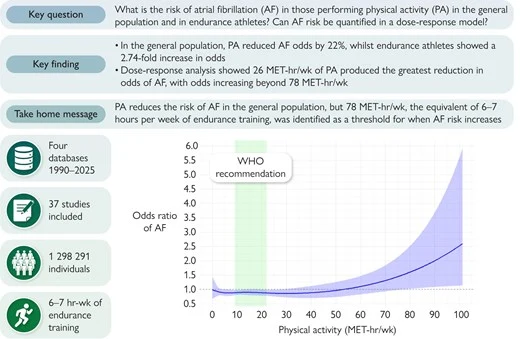
Dose-response
Abstract
BACKGROUND AND AIM: Regular physical activity (PA) may reduce atrial fibrillation (AF) risk in the general population, however, contemporary data suggests individuals engaging in the highest levels of PA may exhibit a paradoxical rise in AF risk. The point at which the dose-response curve reverses remains unclear. This meta-analysis aimed to assess the association between PA and AF across the full continuum of PA exposure. METHODS: Four databases were searched (from January 1990 to June 2025). Eligible studies included those that reported PA exposure compared against a sedentary control group and assessed AF incidence or prevalence. PA exposures were standardised to metabolic equivalent of task hours per week (MET-hr/wk). Pooled odds ratios (ORs) were calculated using a weighted random-effects model. A weighted restricted cubic spline model of logarithmic odds was used to produce a dose-response curve. RESULTS: 37 studies were included (n = 1,298,291 individuals). In the general population, PA was associated with a reduction in odds of AF by 22% (22 studies; OR 0.78; 95% CI 0.68, 0.89). Athlete status was associated with an increase in the odds of AF (15 studies; OR 2.74; 95% CI 1.72, 4.39). Dose-response analysis (26 studies; n = 1,022,790 individuals) showed 26 MET-hr/wk of PA was associated with the greatest reduction in odds of AF, with doses beyond 78 MET-hr/wk associated with increased odds of AF; the equivalent of 6-7 hours per week of endurance training. CONCLUSION: PA and AF demonstrate a U-shaped relationship whereby beyond a quantitative dose threshold of 78 MET-hr/wk, the protective effect of exercise may reverse.
The paper
University of Leicester and the National Institute for Health and Care Research (NIHR) Leicester Biomedical Research Centre
European Journal of Preventive Cardiology, 12 Oct 2026