Development of a Non-Invasive Prediction Model for MASLD Using Routine Clinical and Biochemical Markers: A Retrospective Study
Abstract
PURPOSE: Metabolic dysfunction-associated steatotic liver disease (MASLD), formerly known as non-alcoholic fatty liver disease, is a leading chronic liver condition associated with obesity and metabolic syndrome. Practical non-invasive models based on commonly available clinical and biochemical indicators may support risk stratification in health-check settings. METHODS: This retrospective observational study included 8181 adults who underwent routine health examinations at the Health Examination Center of The First Hospital of Jiaxing from January 2024 to November 2024, including 4814 participants without MASLD and 3367 participants with ultrasound-reported hepatic steatosis after exclusion of secondary causes. Baseline comparisons, univariable logistic regression, multivariable logistic regression, Spearman correlation analysis, receiver operating characteristic (ROC) analysis, multicollinearity assessment, calibration assessment, and five-fold cross-validation were performed. RESULTS: In the final model, older age, overweight, obesity, higher triglycerides, higher alanine aminotransferase, and higher uric acid were associated with higher odds of MASLD, whereas vitamin K was inversely associated with MASLD after adjustment. The final equation was logit(P) = -6.5363 + 0.0387 × age + 1.3838 × overweight + 2.6166 × obesity - 1.6016 × underweight + 1.0122 × triglycerides + 0.0267 × ALT + 0.0048 × uric acid - 0.1784 × vitamin K. The model achieved an AUC of 0.894 (95% CI 0.888-0.901). At the Youden-index cutoff of 0.402, sensitivity was 0.819 and specificity was 0.811. Five-fold cross-validation yielded a mean AUC of 0.894. CONCLUSION: A prediction model based on routine clinical and biochemical markers showed good discrimination for MASLD status in a single-center health examination cohort. Vitamin K was identified as an inversely associated exploratory marker, but this association should be interpreted cautiously and requires prospective and external validation before clinical or interventional conclusions can be drawn.
From the paper
- Participants
A total of 8181 participants were included in this analysis (non-MASLD: n = 4814; MASLD: n = 3367), and the prevalence of MASLD among all participants was 41.16%.
- Result
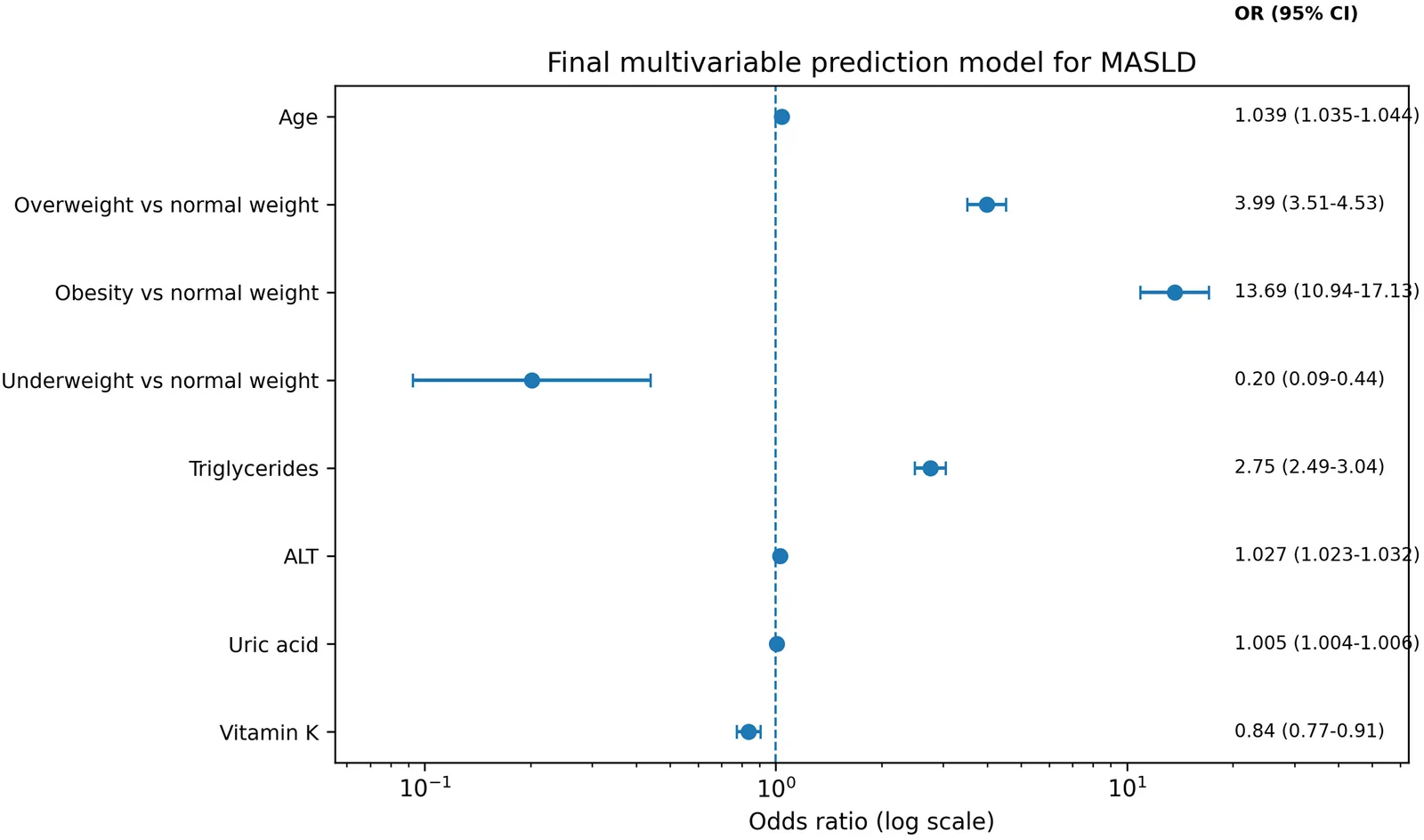
… overweight and obesity were associated with increased odds of MASLD (overweight: OR = 3.990, 95% CI: 3.511–4.535, P < 0.001; obesity: OR = 13.689, 95% CI: 10.940–17.128, P < 0.001), whereas underweight was associated with lower odds of MASLD (OR = 0.202, 95% CI: 0.092–0.439, P < 0.001).
Results, Forest Plot and Final Multivariable Prediction Model
Quoted word for word from the full text on dovepress.com.
- Machine learning
- Lipid and ceramide metabolism
- Hepatic steatosis
- Metabolic dysfunction-associated steatotic liver disease
- Alanine aminotransferase
- Humans
The paper
First Hospital of Jiaxing
Diabetes, Metabolic Syndrome and Obesity, 7 Oct 2026