The DentoNeural Axis: A Piezo channel-mediated mechanosensory pathway linking tooth loss to cognitive decline
Abstract
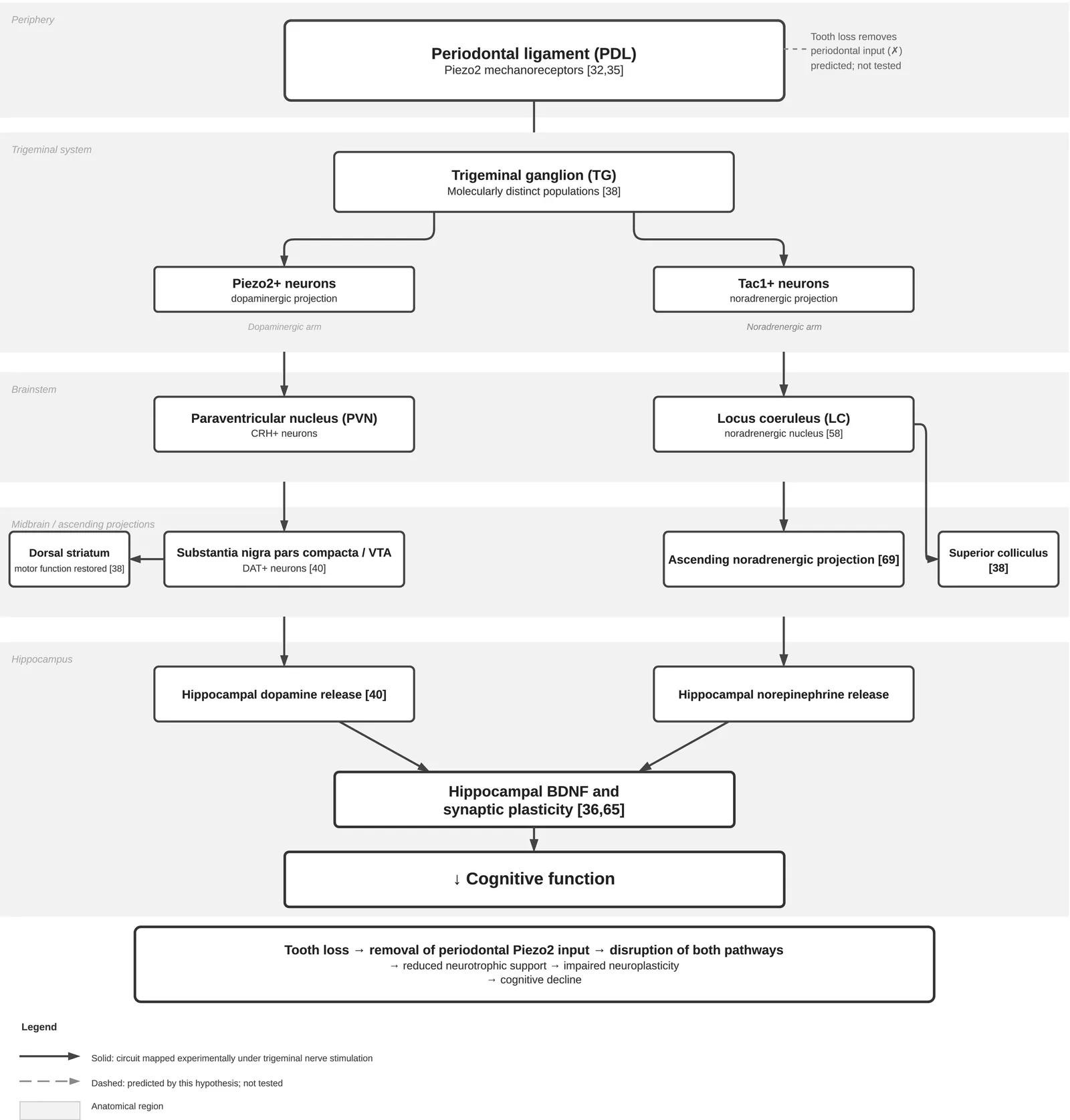
BACKGROUND: Two independent meta-analyses-one of 18 cohort studies (n = 356,297) and one dose-response analysis of 14 longitudinal studies (n = 34,074)-demonstrate dose-dependent associations between tooth loss and dementia. The latter reported hazard ratio (HR) 1.48 (95% CI 1.18-1.87) for cognitive impairment and HR 1.28 (95% CI 1.09-1.49) for dementia; the former reported relative risk (RR) 1.20 and 1.15 for the same outcomes. The 2024 Lancet Commission expanded modifiable dementia risk factors to 14 yet omitted oral health. The mechanism remains unknown. THE HYPOTHESIS: We propose the "DentoNeural Axis"-a Piezo2-mediated mechanosensory pathway connecting periodontal ligament to hippocampal function. Tooth loss removes pulp and periodontal innervation, while periosteal and mucosal afferents persist, potentially disrupting dual neuromodulatory pathways: (1) Piezo2+ trigeminal neurons → paraventricular nucleus (PVN) → dopaminergic signaling, and (2) Tac1 (substance P)-expressing neurons → locus coeruleus → noradrenergic signaling. Both pathways converge on hippocampus to regulate brain-derived neurotrophic factor (BDNF) and synaptic plasticity. EVIDENCE INTEGRATION: This synthesis integrates Piezo channel discovery (2010), Piezo2 immunolocalization in the human periodontal ligament (2024), and trigeminal-locus coeruleus-hippocampal pathways supported by animal models and human MRI evidence linking tooth loss to hippocampal atrophy in mild periodontitis. This hypothesis relies primarily on animal data; human mechanistic validation remains a gap. IMPLICATIONS: If validated, tooth preservation could join hearing aids as sensory-based dementia prevention. This model may explain the "Implant Paradox"-why dental implants, lacking Piezo2-expressing periodontal ligament, may provide incomplete neuroprotection despite restoring mastication.