Trends in Modifiable Risk Factors Contributing to Ischemic Heart Disease Mortality in Afghanistan: Estimates From the Global Burden of Disease Study 2023 (1999-2023)
Abstract
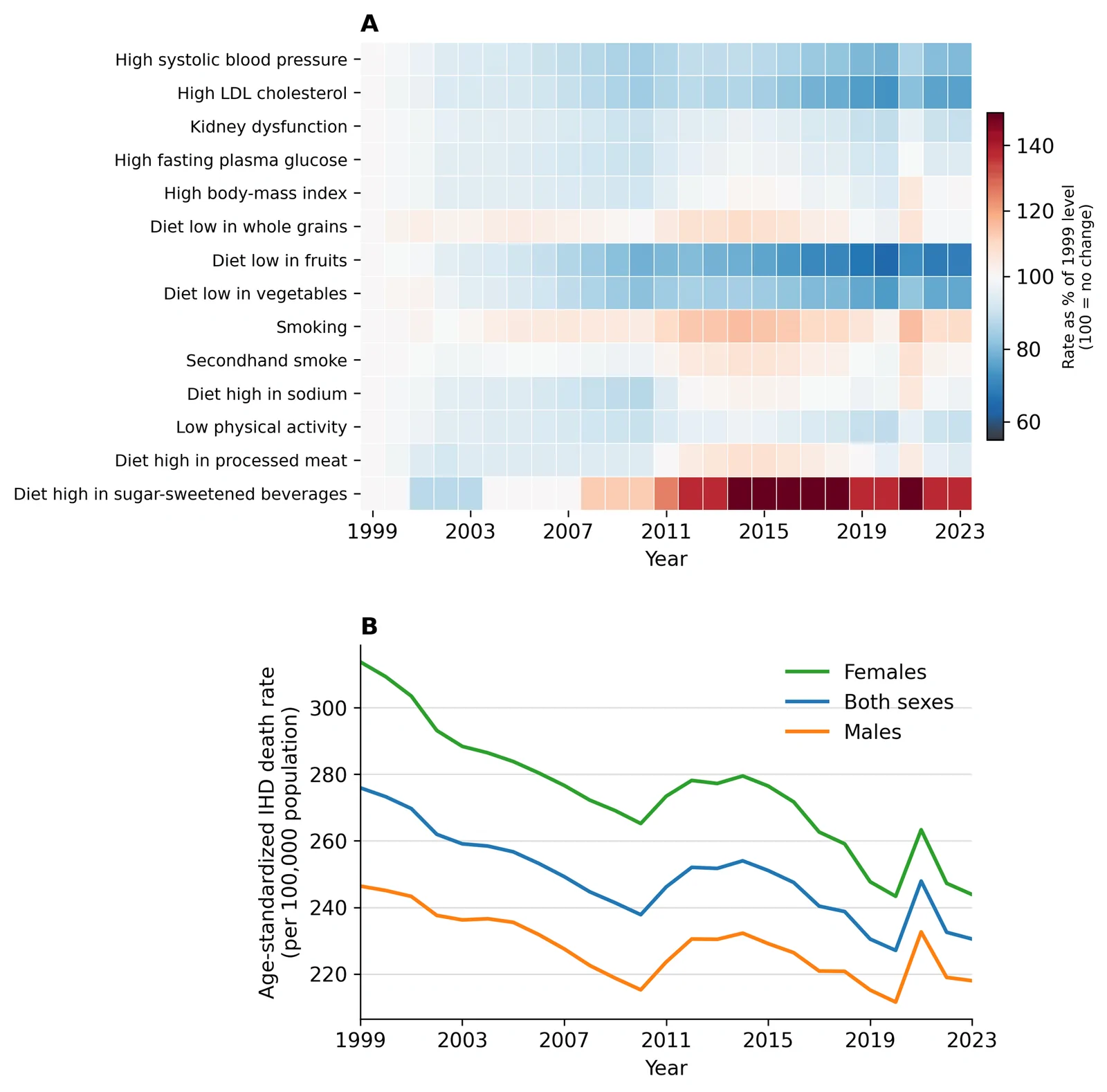
BACKGROUND: Ischemic heart disease (IHD) is the leading cause of death, and the majority of this burden can be attributed to modifiable risk factors. Although surveys show that these risk factors are prevalent in Afghanistan, no study has used Global Burden of Disease (GBD) methodology to describe their contribution to IHD mortality. The study examined trends (1999-2023) in 14 selected behavioral, dietary, and metabolic risk factors for IHD mortality using the GBD 2023 estimates. METHODOLOGY: This retrospective analysis used GBD 2023 estimates of deaths from IHD in Afghanistan attributable to 14 selected behavioral, dietary, and metabolic risk factors and to the GBD "all risk factors" composite, which also includes exposures outside these 14 (e.g., air pollution), covering 1999-2023 (both sexes; all ages and age-standardized). The number (N) and percentage (%) attributable to each risk factor are reported. Trends in age-standardized death rates were examined with a segmented log-linear trend analysis written by the authors as a permutation-based approximation to the NCI Joinpoint approach; the NCI software was not used. The average annual percentage change (AAPC) and its 95% confidence interval (CI) are conditional on the selected model. A multiple linear regression was used only as a descriptive comparison of average rates by risk factor category, sex, and calendar year. A p-value of 0.05 or less was considered significant, with no adjustment for multiple comparisons, so the trend results are exploratory. RESULTS: From 1999 to 2023, the age-standardized IHD death rate for all GBD risk factors combined (the GBD composite) went down from 275.94 to 230.49 per 100,000. This is a drop of 16.5% (AAPC: -0.77%, 95% CI: -0.90 to -0.63; p < 0.001). We found at least one joinpoint in 41 of the 45 series, and most of them were around 2009 and 2013. High systolic blood pressure (11,969.1 deaths, or 55.17% of all IHD deaths in 2023) and high low-density lipoprotein (LDL) cholesterol (5,875.8 deaths, or 27.12%) remained the leading factors among the 14, both of which were decreasing (AAPC: -0.95% and -1.14%; both p < 0.001). The rates associated with a diet high in sugar-sweetened beverages (AAPC: +1.28%, 95% CI: +0.94 to +1.63; p < 0.001) and with smoking (AAPC: +0.37%; p < 0.001) increased, whereas the increases linked to a diet high in processed meat, sodium, and secondhand smoke were not significant in the segmented model (all p > 0.05). The age-standardized rates were higher among females, while the smoking rates were higher among males (25.83 as compared with 5.09 per 100,000). In the descriptive regression model (N = 700; R² = 0.963), average rates differed by risk factor category, calendar year, and sex (all p < 0.05), with high systolic blood pressure having the largest coefficient (B = +140.92; p < 0.001). CONCLUSIONS: In Afghanistan, metabolic risk factors, especially high systolic blood pressure and high LDL cholesterol, were the largest contributors to IHD deaths among the 14 selected risk factors. The composite age-standardized rate declined, with a common inflection around 2009-2013 that may reflect GBD modeling inputs. The rates attributable to sugar-sweetened beverages and to smoking increased, which points to an emerging threat that should be the subject of targeted prevention measures, with ongoing efforts to control hypertension and lipid levels. These exploratory trend estimates need confirmation with the NCI Joinpoint software.
From the paper
- Result
Relative to smoking, high systolic blood pressure had by far the largest coefficient (B = +140.92, 95% CI: +137.93 to +143.91; p < 0.001), followed by high LDL cholesterol (B = +49.74; p < 0.001) and kidney dysfunction (B = +29.47; p < 0.001).
- Limitation
First, the GBD estimates for Afghanistan are based on modeling rather than on data from a complete vital registration and cause-of-death system and are thus subject to greater uncertainty than in countries with more developed health information systems …
Quoted word for word from the full text on cureus.com.
- Diet high in processed meat
- Diet high in sodium
- Lipid and ceramide metabolism
- Ischemic heart disease
- Hypertension
- Humans
The paper
Paktia University; A.T. Still University
Cureus, 10 Oct 2026