Integrative Transcriptomic and Interactome Analyses Prioritize Candidate Genes for Alzheimer's Disease
Abstract
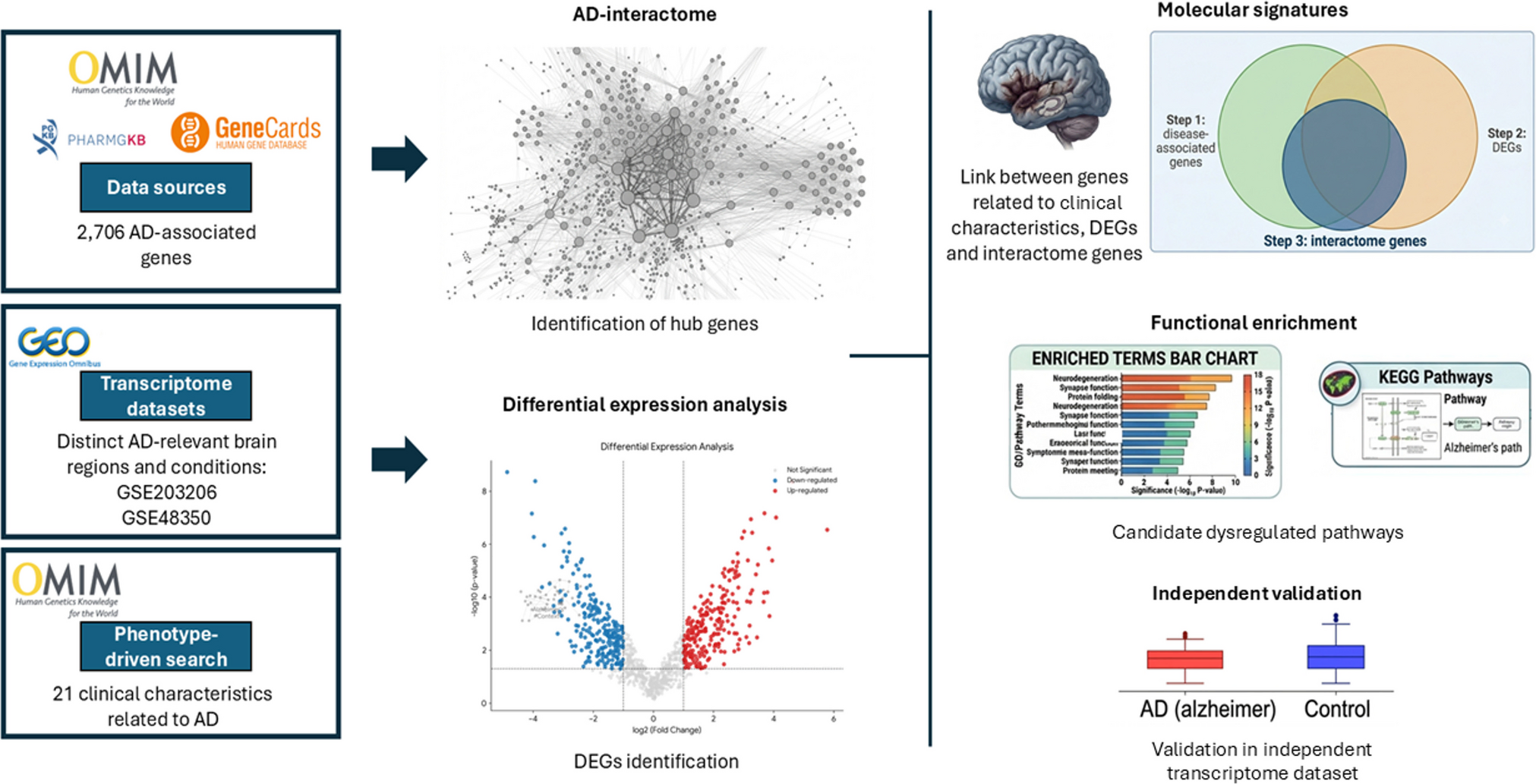
Alzheimer's disease (AD) is a heterogeneous neurodegenerative disorder characterized by complex molecular alterations and diverse cognitive, behavioral, and neuropsychiatric manifestations. Although transcriptomic studies have identified several pathways associated with AD, the integration of molecular signatures with disease-related phenotype annotations and pathological aging remains incompletely understood. Therefore, this study aimed to integrate transcriptomic profiling, protein-protein interaction (PPI) network analysis, pathological aging assessment, and curated clinical phenotype annotations to prioritize candidate molecular signatures associated with AD. Differential expression analyses and network-based approaches were applied to publicly available transcriptomic datasets derived from distinct brain regions. Candidate genes and pathways were prioritized through interactome reconstruction, functional enrichment analyses, cluster-based analyses, and independent validation in an external dataset. In addition, transcriptomic signatures were integrated with curated clinical phenotype annotations using a knowledge-based gene overlap strategy. The analysis identified molecular signatures associated with neuroinflammatory signaling, synaptic dysfunction, endocytosis, and pathological aging. Pathways related to MAPK, PI3K/Akt, NF-κB, and TGF-β1 signaling emerged as candidate dysregulated pathways in AD. Comparative analyses of physiological aging and the AD aging comparison enabled the prioritization of candidate genes potentially more closely associated with the AD condition than with aging alone, including FOS and TAB2. Independent validation reinforced the reproducibility of several prioritized genes, including GFAP, CXCR4, CCL2, HSPA1A, FCGR2A, TLR2, CD44, TLR4, FOS, TAB2, CDC42, and SH3GL2. Integration with curated clinical phenotype annotations suggested partially overlapping molecular signatures across neuropsychiatric and cognitive phenotype annotations in AD. Together, these findings demonstrate the utility of integrative bioinformatics approaches for prioritizing candidate genes, pathways, and molecular signatures associated with AD. This systems-level framework may contribute to future mechanistic studies aimed at understanding the molecular heterogeneity of AD and its associated phenotypic complexity.
- Transcriptomics
- Clathrin-mediated endocytosis
- Inflammation
- MAPK/ERK signalling
- Alzheimer's disease
- Humans
The paper
Molecular Neurobiology, 10 Oct 2026